
Diecast Guides
Common RC Car Problems: Fixes for Batteries, Steering and More
Nov
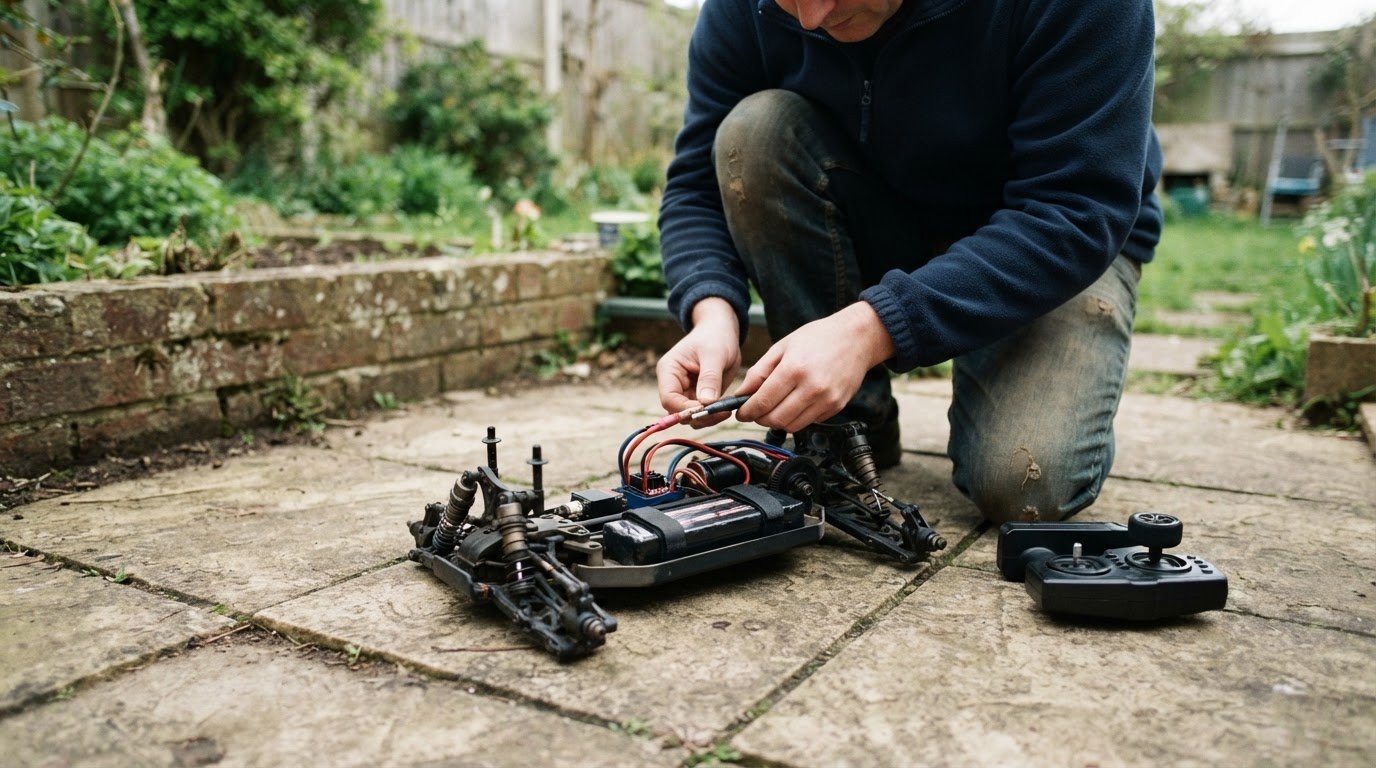
Start with the basics: check that the car and transmitter are switched on, the batteries are fitted correctly and the connections are secure. If a LiPo battery reads below 3.5 V per cell, it needs charging. These simple checks are a good first step when working through common RC car problems and solutions at home.
An RC car that won’t respond can be frustrating, especially when you’re ready to get it back on the track. Often, you can narrow down the cause by checking one system at a time instead of replacing parts straight away.
This guide covers practical ways to troubleshoot battery and charging faults, electrical connections, steering, suspension, the motor and drivetrain. You’ll learn what to inspect, what you can try yourself and when a damaged component may need replacing, so you can get back to driving with greater confidence.
Key Takeaways
- Start with the simple checks: confirm the transmitter and car are on, batteries are correctly fitted, and connections are secure.
- For charging or battery issues, check the battery type and cell voltage before choosing a charging or storage approach.
- If the car powers up but won’t steer or move, inspect for obstructions, loose motor wiring and worn drive components.
- Learn how to spot damage to suspension arms, pinions and steering servos, and decide what to inspect before replacing a part.
1. Electrical failures and battery or connection problems
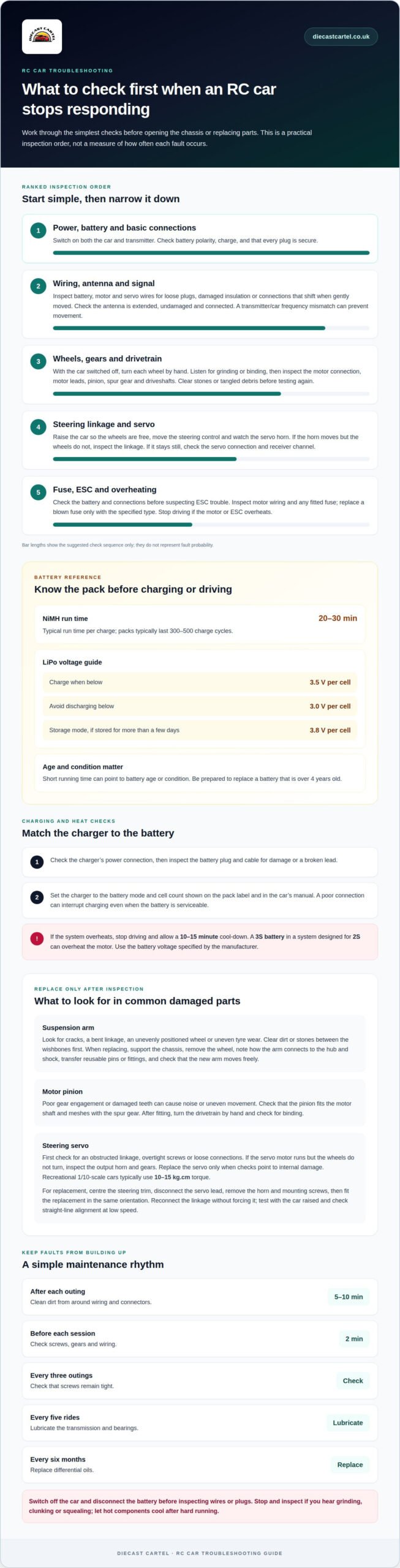
If the car won’t start, check the battery, transmitter and switches before opening the chassis. Make sure the car and transmitter are switched on, batteries are fitted with the correct polarity, and connectors are secure. Check that the antenna is fully extended, undamaged and connected. A flat battery or loose plug can make the car stop, run slowly or lose signal while driving.
Short running time can point to battery age or condition. NiMH packs typically run for 20-30 minutes per charge and last 300-500 charge cycles. LiPo packs need charging below 3.5 V per cell; avoid discharging them below 3.0 V per cell. If storing a LiPo for more than a few days, use storage mode at 3.8 V per cell. Drivers should also be prepared to replace a battery over 4 years old.
For electrical faults, inspect the wires between the battery, motor and servo. Look for loose plugs, damaged insulation or connections that shift when gently moved. A mismatch between the transmitter and car frequency can also prevent movement. If the car loses signal, check the antenna connection before suspecting the receiver.
To troubleshoot ESC issues and motor cut-outs, first check the battery charge and connections, then inspect motor wiring for loose or damaged leads. If the system overheats, stop driving and allow a 10-15 minute cool-down; a 3S battery in a system designed for 2S can overheat the motor.
Routine care helps prevent faults: clean the car for 5-10 minutes after each outing, removing dirt around wiring and connectors. Check that screws remain tight every three outings, and follow the manufacturer’s manual for battery care.
For battery and electronics safety, switch off the car and disconnect the battery before inspecting wires or plugs. Use the battery voltage specified by the manufacturer, and stop driving if the battery or motor overheats.
2. Replacing a suspension arm, motor pinion or steering servo
A bent suspension arm can leave a wheel sitting unevenly, while a damaged pinion can cause poor gear engagement. Before replacing either part, remove the body shell and inspect the area for cracks, stripped teeth or a bent linkage. Compare wheel alignment with the other side, too. Uneven tyre wear can point to alignment trouble, so the arm may not be the only cause.
To replace a suspension arm, support the chassis and remove the wheel. Note how the original arm connects to the hub and shock, then transfer any reusable pins or fittings to the replacement. Check that the arm moves freely before driving. Dirt or a stone between the wishbones can restrict suspension movement, so clear debris before fitting parts.
A motor pinion must fit the motor shaft and mesh correctly with the spur gear. Loosen the pinion’s grub screw and slide it off. Align the replacement with the spur gear before tightening, then turn the drivetrain by hand to check for binding. UK prices should be checked in pounds before budgeting.
Unresponsive or shaking steering doesn’t always mean a failed servo. First inspect the steering linkage for an obstruction, overtight screws or loose connections. If the servo motor runs but the wheels don’t turn, check its output horn and gears. Replace the servo only when those checks point to internal damage; recreational 1/10-scale cars typically use 10-15 kg.cm torque.
To replace the servo, centre the steering trim and disconnect the servo lead, then remove the horn and mounting screws. Fit the replacement in the same orientation and reconnect the linkage without forcing it. Test the steering with the car raised, then check straight-line alignment at low speed. Frequent impacts or extreme steering loads can damage parts. Let components cool after hard running if they feel hot.
3. Drive, transmission and steering faults
A practical way to work through common RC car problems and solutions is to diagnose the drivetrain before blaming the motor or ESC. With the car switched off, turn each wheel by hand and listen for grinding or binding. Check the motor connection, then inspect the motor leads, pinion, spur gear and driveshafts. A loose connection can stop the drive, while damaged gear teeth may cause noise or uneven movement.
On a 4WD model, a broken driveshaft or axle can stop one or more wheels turning. Compare movement across the axles, then check for a disconnected joint or visible damage. Clear stones and tangled debris before testing again. Lubricate the transmission and bearings every five rides, and replace differential oils every six months to help moving parts function smoothly.
Steering faults can come from a jammed linkage, overtightened screws or a servo that isn’t receiving commands from the receiver. Raise the car so the wheels are free, move the steering control and watch the servo horn. If the horn moves but the wheels don’t, inspect the linkage. If it stays still, check the servo connection and receiver channel.
Use this order to narrow down common RC car problems and solutions: inspect non-engine electrical connections, damaged wires and any fitted fuse. Replace a blown fuse only with the type specified for the vehicle. Before each session, spend 2 minutes checking screws, gears and wiring. Grinding, clunking or squealing sounds are clues, so stop the car and inspect the area producing the noise.
Air-conditioning faults apply to full-size cars, not RC models. If you mean overheating or poor cooling, check the motor and ESC for blocked airflow, packed dirt or signs of excessive heat. Stop driving if the temperature rises abnormally. Let the components cool, clear debris and test again. This can help distinguish a cooling issue from a drivetrain fault.
4. Charging problems
A battery that won’t recharge may have a loose connector, broken lead or incorrect charger setting. Check the charger’s power connection, then inspect the battery plug and cable for damage. Match the charger’s battery mode and cell count to the pack, following its label and the car’s manual. A poor connection can interrupt charging even if the battery is still serviceable.
For a LiPo pack, check each cell’s voltage with a compatible tester. Below 3.5 V per cell, the battery needs charging; don’t discharge it below 3.0 V per cell. Use the storage setting when the car will sit unused for more than 48 hours. A LiPo stored for more than a few days should be at 3.8 V per cell.
NiMH batteries have different charging requirements, so select the correct mode rather than treating every pack alike. They typically run for 20-30 minutes per charge and have a lifespan of 300-500 charge cycles. If running time drops, note how long the pack lasts after a full recharge and compare that with its previous condition.
Follow this sequence: check the wall supply, charger cable, battery connector and selected mode. If available, try charging another compatible pack. If it charges, the original battery or its connection may be faulty; if neither pack charges, review the charger setup. After charging, test the car’s response and transmitter signal separately so a radio fault isn’t mistaken for a charging problem.
LiPo capacity can decline after 200-300 charge cycles. Keep a simple record of charging behaviour and running time; repeated cut-outs after a full charge point towards another electrical fault. Battery replacement depends on pack type and capacity, so match the replacement to the manufacturer’s voltage specification. For a separate full-size vehicle fault-code check, explore OBD diagnostic tools.
Diecast Cartel: 1:24 scale Diecast models and trucks
Diecast Cartel offers a natural next step when you’re ready to enjoy another side of the hobby beyond troubleshooting and repairs. Explore 1:24 scale diecast models and trucks, alongside Diecast Trucks and Tractors and 1:18 Scale Model Cars. For hands-on play, the 1:24 remote control forklift brings a working vehicle into your collection.
Whether you’re drawn to detailed display models or remote control machinery, choosing something that suits your interests can keep the hobby fresh between repair sessions. Take a look at the range and find a model that fits your collection or the kind of driving you enjoy.
Visit Diecast Cartel to explore its models and remote control vehicles.
Keep your next RC session on track
Each repair teaches you more about how your model behaves, making the next fault easier to investigate. Note what happened before the problem appeared: did the car cut out under load, pull to one side or make an unfamiliar sound? Those details can help you narrow down the cause instead of replacing parts by guesswork.
If you’re exploring your next RC purchase or battery needs, ask Diecast Cartel about your RC car interests. Keep learning, keep tinkering, and enjoy every run.
Frequently Asked Questions
Can I repair my RC car at home?
Straightforward repairs are often manageable at home with the right tools and model instructions. Start with a clear workspace, a small parts tray and photos of each assembly before dismantling it. These make it easier to return washers, clips and screws to their original positions. If a repair involves soldering or damaged electronics, work carefully and stop if you can’t identify the correct connections.
How do I fix my RC car motor?
First, work out whether the motor is faulty or another part is preventing it from running. With the car switched off and the battery disconnected, check the motor casing and shaft for trapped grit or damage. If the shaft turns freely but the motor won’t run when reconnected, inspect its wiring and plug. A worn motor may need replacing; use the model’s manual to match the part.
How long do RC car batteries last?
Battery life depends on its chemistry, how often you run the car and how it’s stored. A pack used for long, demanding sessions faces different conditions from one used for short runs. Track charging behaviour and the car’s performance rather than judging by age alone. A noticeable reduction in run time after a full charge can signal reduced capacity.
Why is my RC car not working?
An RC car can seem completely dead even when the fault is limited to one part of its system. Test separate controls: does the steering work while the throttle doesn’t, or does neither respond? This distinction helps narrow down the fault to the drive controls or radio system. Note any change after a bump, driving on wet ground or replacing a part.
Why is my RC car steering not responding?
Check the transmitter’s steering trim and rate settings, which affect how much steering input reaches the car. Move the trim towards neutral, then test left and right with the car raised. If steering responds in only one direction, note which way and whether the servo makes a sound. This can help distinguish a settings issue from a mechanical or servo fault.
What are the most common RC car problems and symptoms?
Common clues include reduced speed, sudden stops, uneven turning, rattling and a car that pulls to one side. Note when each symptom happens: only under acceleration, after a collision or throughout a run. For example, a new rattle after an impact may point to a part that has shifted or been damaged. Recording the timing makes diagnosis more focused.
