
RC & Construction
How to Charge RC Car Batteries Safely: The Ultimate UK Hobbyist’s Guide 2026
Jul
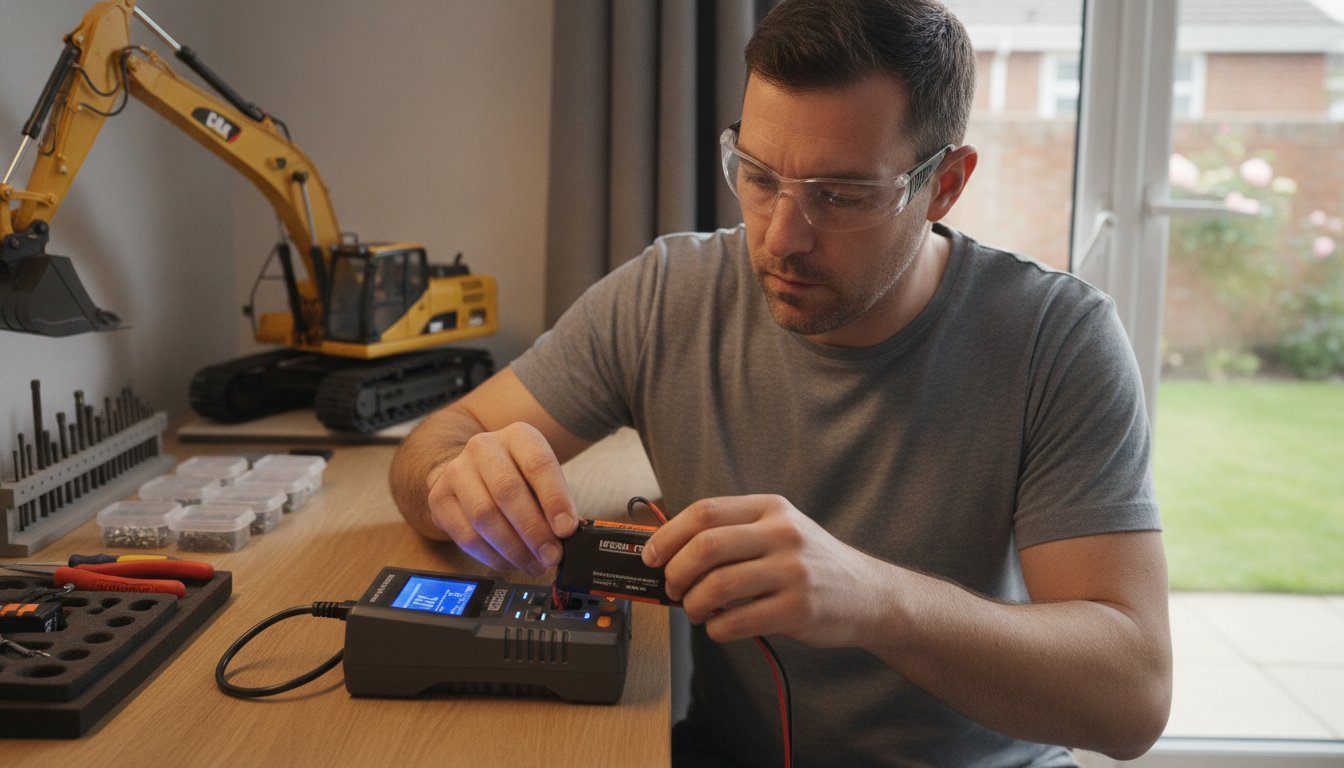
You’ve just spent hours perfecting the look of your new 1:24 scale construction vehicle, but the excitement quickly turns to hesitation when you reach for the charger. Learning how to charge RC car batteries safely is about much more than just plugging things in; it’s the foundation of being a responsible collector. We’ve all felt that flicker of worry about overcharging or the confusion that comes with matching the right connector to the right port. It’s a common hurdle that every enthusiast faces when they want to move beyond basic setups and truly care for their collection.
This guide will show you how to master the essential techniques for charging both LiPo and NiMH batteries to protect your models and ensure long-term performance. You’ll gain the confidence to identify your battery types at a glance and set up a dedicated charging station that keeps your home secure. We’ll explore the simple, practical steps you can take today to extend the lifespan of your favourite batteries, ensuring your trucks and cars stay powered up for many more adventures. It’s time to take the guesswork out of the hobby and focus on the joy of the drive.
Key Takeaways
- Learn why identifying your battery chemistry is the vital first step to avoid damage and ensure your 1:24 scale models run perfectly.
- Master the “1C” rule to understand how to charge RC car batteries safely without risking overheating or long-term cell degradation.
- Discover why a dedicated smart charger is a superior investment over generic adapters for protecting your high-quality diecast and RC collection.
- Set up a fire-safe charging zone and learn the pre-charge inspection checklist to spot physical damage before it becomes a hazard.
- Unlock the secret of “storage charging” to prevent your batteries from losing capacity whilst they sit in the cupboard between races.
Identifying Your RC Battery: LiPo vs NiMH Differences
Before you can master how to charge RC car batteries safely, you must identify exactly what chemistry is powering your model. It’s the non-negotiable first step for every collector; getting this wrong can lead to permanent damage or even a fire hazard. Think of your battery as the heart of your RC car. Just as you wouldn’t put the wrong fuel in a real truck, you shouldn’t use the wrong charging profile for your cells. Most modern hobbyists will encounter two main types: NiMH and LiPo. Each has its own personality, strengths, and specific handling requirements.
The Anatomy of a NiMH Battery
NiMH batteries are the rugged, heavy-duty workhorses of the RC world. If you look closely at the pack, you’ll usually see a series of cylindrical cells bundled together under a layer of heat-shrink plastic. They typically offer voltages between 7.2V and 8.4V. Many enthusiasts find that NiMH is often the favourite for 1:22 scale remote control construction vehicles. These models, like dump trucks and excavators, benefit from the steady, reliable power delivery NiMH provides. There’s a common myth about the “memory effect” where batteries lose capacity if not fully drained, but modern NiMH cells are much more resilient. They are generally safer to store and less prone to volatile reactions if handled roughly.
The Power of LiPo Batteries
When you need high-performance speed or lightweight agility, LiPo is the standard. These batteries are based on Lithium Polymer Battery Technology and are usually rectangular in shape. They can come in “soft-case” packs, which are lighter but more vulnerable, or “hard-case” versions that offer better protection for off-road bashing. Identifying a LiPo is easy if you know what to look for on the label:
- The “S” Rating: This tells you the cell count. A 2S pack has two cells (7.4V), whilst a 3S pack has three (11.1V). Higher cell counts mean more voltage and higher top speeds for your car.
- The Balance Lead: This is the smaller, multi-coloured wire with a white plug. It’s a vital component in learning how to charge RC car batteries safely because it allows your charger to monitor and equalise the voltage of each individual cell.
- Capacity (mAh): This indicates how much “fuel” is in the tank. A higher mAh means a longer run time for your favourite models.
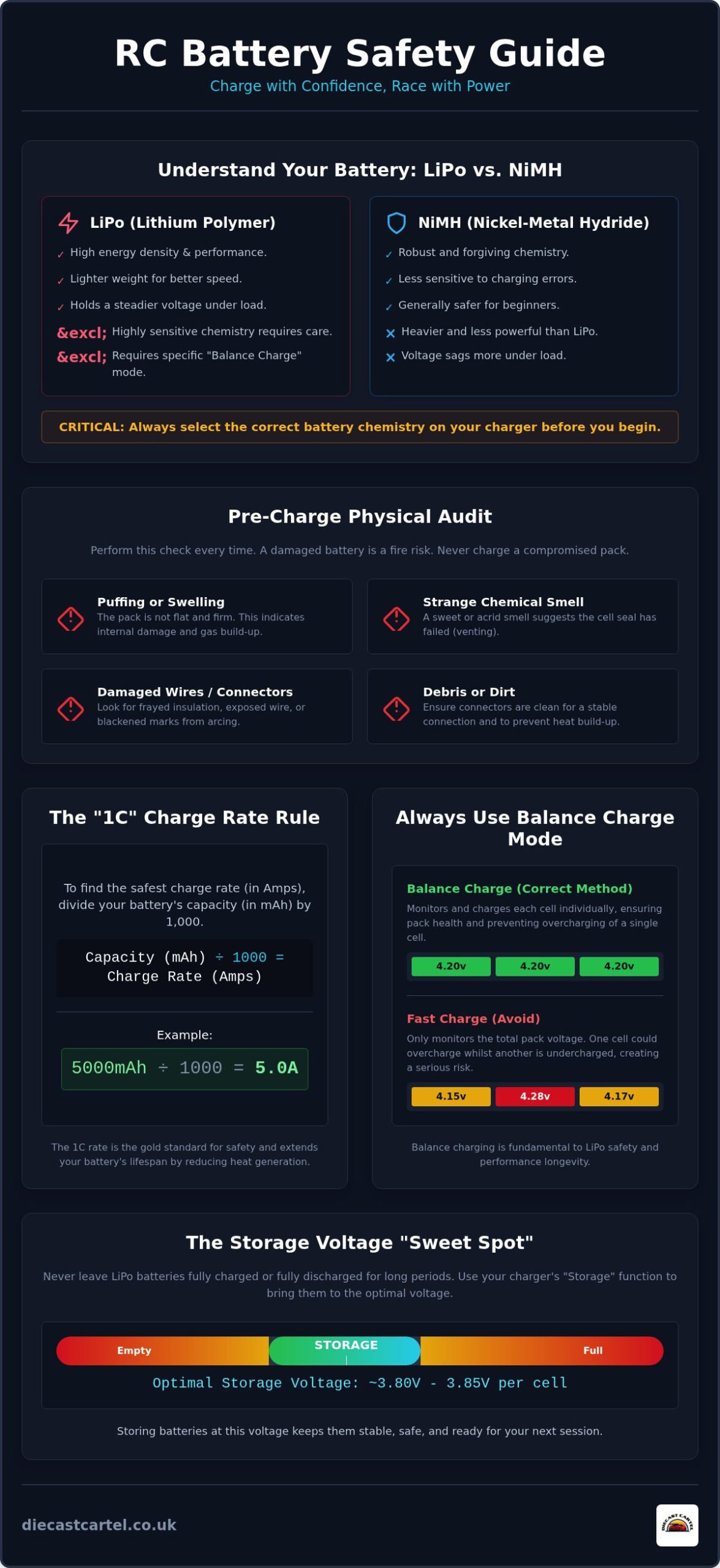
Understanding these visual cues is essential for the longevity of your collection. Always check the label for any signs of damage, such as “puffing” or swelling, before you start the charging process. A healthy battery should be flat and firm. If it looks like it’s starting to bloat, it’s time to retire it safely at a local recycling centre rather than risking a charge in your home.
Understanding Charge Rates and Safe Voltage Limits
Once you’ve identified your battery chemistry, the next step in learning how to charge RC car batteries safely is mastering the numbers on the label. You’ve likely noticed a “C” rating followed by a number. This isn’t just hobbyist jargon; it’s the speed limit for how fast your battery can safely receive or discharge energy. Whilst some modern packs claim they can handle high-speed charging, the golden rule amongst seasoned collectors is the 1C rate. This setting provides the perfect balance between getting back to the track and preserving the internal chemistry of your expensive cells. Think of it as a gentle top-up rather than a forced injection of power.
Calculating the 1C Charge Rate
Setting your charger correctly requires a tiny bit of maths, but it’s easy once you know the trick. To find your 1C rate, you simply take the capacity of your battery in mAh and divide it by 1,000. This gives you the number of Amps you should select on your charging unit. For example, if you are powering a 1:24 scale truck with a 2000mAh battery, your safe charging speed is 2.0 Amps. If you have a larger 5000mAh pack for a construction vehicle, you would set it to 5.0 Amps.
Why does this matter so much? Pushing a battery with “Fast Charging” at 2C or 3C might save you twenty minutes, but it often leads to excessive internal heat. Heat causes the delicate layers inside the battery to degrade prematurely. If you want your favourite models to perform at their peak for years rather than months, sticking to 1C is the most reliable strategy you can adopt. If you find your current cells are getting too hot during a standard charge, it might be time to look for reliable replacement batteries to ensure your fleet stays safe and ready for action.
Voltage Thresholds You Must Know
Voltage limits are the boundaries that keep your hobby enjoyable and safe. For a standard LiPo cell, 4.2V is the absolute maximum “full” state. If a charger continues to push energy beyond this point, the battery is being overcharged. This is a leading cause of “puffing,” where the battery case begins to swell. Following general NFPA Battery Safety principles is essential here; never leave a battery on the charger once it has reached its maximum voltage.
Equally important is the lower limit. Discharging a battery too far is just as damaging as overcharging it. For LiPo batteries, you should never let a cell drop below 3.0V to 3.2V. If the voltage falls too low, the chemical reaction inside can become unstable, often “bricking” the battery so it can no longer be recognised by your charger. Using a simple digital cell checker whilst you are out in the field is a fantastic habit. It allows you to monitor your health between runs and ensures you never accidentally push your equipment into the danger zone.
Selecting the Right Charger for Your RC Fleet
Have you ever been tempted by a cheap USB adapter found in a kitchen drawer? Whilst it might look like a simple way to get back to the action, choosing the right hardware is the next pillar of how to charge RC car batteries safely. A battery is only as safe as the device controlling the flow of electricity into it. For many newcomers, the basic wall chargers included in some ready-to-run kits seem sufficient, but they often lack the sophisticated monitoring required for long-term cell health. Upgrading to a computerised “smart” charger is one of the best decisions you can make to protect your investment in RC hobby vehicles UK.
A quality hobby charger does more than just pump in power; it acts as a vigilant guardian for your collection. These devices feature auto-cutoff technology that stops the process the moment a battery reaches its peak voltage, preventing the overcharging issues we discussed in the previous section. Many also include thermal monitoring, using a probe to track the temperature of the pack. If things get too warm, the charger simply shuts down. This level of control is essential for anyone serious about the hobby, ensuring that every session is as safe as it is fun.
Why USB Charging Hacks Must Be Avoided
The rise of social media tutorials showing “easy” USB charging hacks is a genuine concern for the community. Standard USB ports on laptops or phone plugs are designed for low-voltage consumer electronics, not the high-discharge cells used in RC trucks. They lack the precise voltage regulation needed to balance individual cells in a LiPo pack. Using these non-hobby grade adapters significantly increases the risk of thermal runaway, where a battery enters an uncontrollable, self-heating cycle. Convenience should never trump safety when handling high-capacity cells. Stick to dedicated hobby equipment to ensure your home and your models remain secure.
Features of a Reliable Hobby Charger
When you start shopping for a dedicated unit, look for a clear LCD screen. This display provides real-time data on voltage, current, and the amount of capacity being added. It’s an invaluable tool for spotting a failing battery before it becomes a problem. Multi-chemistry support is another must-have feature; it allows you to use a single device to manage both your NiMH construction vehicles and your high-performance LiPo cars.
For enthusiasts with a growing fleet, a dual-port charger can be a game-changer. These allow you to charge two different batteries simultaneously, even if they have different chemistries or cell counts. Understanding how to charge RC car batteries safely becomes much easier when your equipment does the heavy lifting for you, providing the balance functions and safety checks that basic chargers simply cannot offer. It is a small price to pay for the peace of mind that comes with professional-grade kit.
A Step-by-Step Guide to Safe Charging Practices
You’ve identified your chemistry, crunched the numbers for your 1C rate, and picked out a high-quality smart charger. Now comes the most important part: the physical act of charging. Mastering how to charge RC car batteries safely involves more than just pushing buttons; it’s about the environment you create and the habits you build. Even the best equipment can’t compensate for a cluttered workspace or a lack of supervision. By following a consistent routine, you ensure that every session ends with a powered-up model rather than a call to the emergency services.
Setting Up Your Charging Station
The surface you choose for your charging station is your first line of defence. Never charge your batteries on carpet, wooden tables, or near soft furnishings like the sofa. These materials act as fuel if a battery fails. Instead, find a cool, dry area with a non-flammable surface, such as a tiled floor or a dedicated metal tray. Many seasoned hobbyists use LiPo Guard bags or even repurposed fireproof ammunition cans to contain their batteries whilst they are plugged in. These simple tools are designed to vent heat whilst containing potential flames. Always ensure there is a functional smoke alarm in the room where you work. It’s a small detail that provides massive peace of mind for you and your family.
Maintaining a safe environment is a core principle for any hobby involving complex electrical systems or climate-controlled spaces. For those who also manage indoor cultivation projects, you can learn more about Discount Hydro to see how professional-grade equipment helps maintain a secure and efficient setup.
The Charging Sequence
Plug in. Wait. Watch. It sounds simple, but the order in which you connect your gear matters. Following a strict sequence prevents accidental short circuits and ensures your charger’s software can properly “handshake” with the battery cells. Before you even touch a cable, perform a quick physical inspection. You’re looking for any signs of “puffing,” tears in the plastic wrap, or exposed wires. If everything looks solid, follow these steps:
- Step 1: Power up your charger first. This ensures the internal voltage regulator is stable before a load is applied.
- Step 2: Connect the main power lead to the charger, then attach the battery.
- Step 3: Plug in the balance lead. This is the multi-coloured wire that allows the charger to see individual cell health.
- Step 4: Select the correct programme. Use “Balance Charge” for LiPo packs and “Peak” or “Cycle” for NiMH.
- Step 5: Double-check your Amp settings and press start.
The most vital rule of the hobby is to never leave a charging battery unattended. You don’t need to stare at the screen for an hour, but you must remain in the same room or within earshot of your smoke alarm. Most battery incidents happen when a small problem is left to escalate. If your current packs are showing signs of wear or you need a dedicated fire-safe bag, explore our range of rechargeable batteries and accessories to keep your workshop safe. Staying vigilant ensures your favourite 1:24 scale trucks are always ready for the next adventure.
Battery Longevity and Safe Storage Habits
Your collection is a source of pride, and preserving the heart of those models is what separates a casual user from a dedicated curator. You’ve already mastered how to charge RC car batteries safely for your afternoon sessions, but the real test of a hobbyist’s discipline happens when the cars are back on the shelf. How you treat your batteries during their “rest” periods dictates whether they will last for hundreds of cycles or fail after just a few months. For those of us with growing fleets of 1:22 and 1:24 scale vehicles, managing multiple packs requires a methodical approach to rotation and storage. If you are also looking to expand your collection or find the perfect gift for a fellow enthusiast, browsing diecast truck gift ideas UK collectors will love in 2026 is a great way to discover premium 1:24 scale models that deserve the very best battery care.
Temperature is the silent enemy of battery chemistry. In the UK, it’s tempting to leave gear in a cold garage or near a warm radiator, but both extremes are damaging. High heat accelerates internal chemical breakdown, whilst freezing temperatures can cause permanent capacity loss. The best place for your power packs is a cool, dry spot inside the house, ideally kept within a fire-safe container. To keep track of your inventory, consider labelling each battery with its purchase date and a unique ID. This allows you to rotate your stock effectively, ensuring that no single pack sits forgotten at the bottom of the bin for too long. If you’re investing in RC construction vehicles with metal parts UK hobbyists rely on, proper battery storage is especially important given the higher power demands these robust machines place on their cells.
Storing LiPo Batteries for the Long Term
The most common mistake collectors make is leaving LiPo batteries fully charged or completely empty for weeks at a time. If you don’t plan to use your model within the next 48 hours, you must use your charger’s “Storage” function. This programme brings each cell to approximately 3.8V to 3.85V. At this specific voltage, the internal chemistry is at its most stable. Leaving a battery at 100% charge creates internal pressure that leads to “puffing,” whilst a fully depleted battery may drop below the critical voltage threshold, becoming “bricked” and unusable. Learning how to charge RC car batteries safely means always ending your hobby day with a storage-level check.
UK Battery Disposal and Recycling
Eventually, every battery reaches the end of its life. In the UK, the Waste Batteries and Accumulators Regulations 2009 make it clear that these items must never be thrown into general household waste. Because they contain heavy metals and chemicals, they require specialist handling to prevent environmental damage. When a battery no longer holds a charge or shows signs of physical damage, it’s time to say goodbye.
Most major UK supermarkets and electronics retailers provide designated battery collection points. For larger or damaged hobby-grade packs, your local civic amenity site or household waste recycling centre is the best destination. Before you take them for recycling, it is a good habit to safely discharge the battery as much as possible using a dedicated discharger or a low-draw light bulb setup. Cover the connectors with electrical tape to prevent short circuits during transit. Taking these final steps ensures that your journey with every model remains responsible from the first charge to the final disposal.
Powering Your Next Scale Adventure
You now possess the essential knowledge to ensure your collection stays at its peak performance for years to come. By mastering the 1C charging rule and committing to the “storage charge” habit, you aren’t just avoiding hazards; you’re actively preserving the life of your 1:22 and 1:24 scale models. Knowing exactly how to charge RC car batteries safely is the hallmark of a dedicated curator who values the long-term journey of the hobby as much as the initial thrill of the drive. This same commitment to precision and care is why many collectors trust Atoz Watch And Jewellery Repairs to maintain their fine timepieces and jewellery.
As UK-based hobbyist experts, we share your passion for every detail and provide specialist scale model accessories that are trusted by the UK collector community. When it’s time to refresh your power sources or expand your fleet, browse our range of high-quality rechargeable batteries for RC toys. We’re here to support your journey with reliable gear and expert advice, so you can focus on the joy of discovery and the pride of maintaining a world-class collection. Happy driving!
Frequently Asked Questions
Can I charge my RC car battery with a phone charger?
No, you should never attempt to use a phone charger or a standard USB wall plug for your hobby batteries. These devices lack the sophisticated voltage regulation and balance circuitry required to manage high-capacity cells safely. Using a non-hobby grade adapter increases the risk of overcharging and thermal runaway because the charger cannot communicate with the battery’s internal chemistry.
How long does it take to charge a 3000mAh RC battery?
At a standard and safe 1C charge rate, a 3000mAh battery will typically take approximately one hour to reach a full charge. To achieve this, you would set your computerised charger to 3.0 Amps. Whilst some modern batteries claim to support faster speeds, sticking to this sixty-minute window is the most reliable way to protect your cells and ensure long-term performance for your favourite models.
Why is my LiPo battery getting hot whilst charging?
A healthy battery should remain relatively cool or only slightly warm during the charging process. If your pack feels hot to the touch, you should stop the charger immediately and move the battery to a fire-safe area. Excessive heat is usually a warning sign that the internal resistance is too high, the charge rate is set too aggressively, or the battery has suffered internal damage and is becoming unstable.
What should I do if my RC battery starts to swell or puff up?
If you notice any signs of “puffing” or swelling, you must stop using the battery at once and place it in a fireproof container, such as a LiPo Guard bag or a metal ammunition tin. Swelling indicates that the internal layers have degraded and are releasing gas, which makes the battery a significant fire risk. Never attempt to “squash” the battery or continue using it; instead, take it to a local UK battery recycling centre for safe disposal.
Is it safe to charge RC batteries overnight?
No, it is never safe to charge your batteries overnight or whilst you are away from home. One of the most important rules for how to charge RC car batteries safely is to never leave the process unattended. Most incidents happen when a small error is left to escalate. You should always be in the same room or within earshot of your smoke alarm so you can react instantly if the charger signals a fault.
Do I need a special bag for charging LiPo batteries?
Whilst not strictly required by the charger to function, using a LiPo Guard bag is a highly recommended safety practice amongst the collector community. These bags are designed to contain flames and vent heat in the rare event of a battery failure. They provide an essential layer of protection for your workshop and home, giving you peace of mind whilst your high-performance packs are connected to the power.
How often should I balance charge my LiPo battery?
You should use the balance charge function every single time you charge your LiPo batteries. This process ensures that each individual cell within the pack is matched to the same voltage, which is vital for both safety and the longevity of the battery. If you skip balancing, one cell can easily become overcharged while another remains low, leading to an unstable pack that could fail during your next drive.
What is the best way to store RC batteries during the winter?
The best way to store your batteries during the colder months is to put them into “Storage Mode” using your charger, which brings them to roughly 3.8V per cell. Store them in a cool, dry place inside your home rather than a damp garage or shed. Keeping your batteries at room temperature in a fire-safe box prevents the chemistry from becoming sluggish or losing capacity due to extreme temperature fluctuations.

Pingback: RC Construction Vehicle Gifts UK: The 2026 Hobbyist Buying Guide
Pingback: Best RC Cars for Beginners UK: The 2026 Hobbyist’s Guide
Pingback: 1:22 Scale Remote Control Bulldozer UK: The Ultimate 2026 Hobbyist Guide
Pingback: 1:16 Scale RC Trucks UK: The Ultimate Collector’s Guide to Small-Scale Realism
Pingback: 1:22 Scale Remote Control Dump Truck UK: The Ultimate 2026 Hobbyist Guide
Pingback: 1:24 RC Trucks UK: Ultimate Collector’s Guide 2026