
Diecast Guides
Brushed vs Brushless RC Cars UK: The Ultimate 2026 Comparison Guide

Sep
Is the most expensive motor system always the best choice for your next afternoon of garden bashing? It’s a question we’ve all asked whilst staring at a workbench full of parts, and in 2026, the answer is more nuanced than ever. Whether you are a dedicated collector of 1:22 construction vehicles or a speed enthusiast, the debate over brushed vs brushless RC cars UK isn’t just about raw power; it’s about finding the perfect soul for your machine. We understand the frustration of deciphering proprietary Spektrum IC3 or IC5 connectors and the genuine fear of smelling that dreaded magic smoke from an overheating ESC when you’re just trying to enjoy the hobby.
You want a setup that offers genuine value for money without the constant worry of frying your electronics. This guide will help you decide between the plug-and-play simplicity of a classic brushed motor and the high-performance, granular tuning of a modern brushless system. We’ll explore how these powerhouses perform in the real world, from the torque-heavy demands of RC forklifts to the high-speed thrills of 1:16 trucks. By the end, you’ll have the confidence to choose a system that fits your driving style and integrates perfectly with your existing collection.
Key Takeaways
- Master the mechanical differences between friction-based brushed motors and high-efficiency brushless systems to ensure your next acquisition matches your driving style.
- Identify why torque-heavy brushed setups remain the gold standard for 1:22 scale construction vehicles and precise low-speed manoeuvring.
- Navigate the brushed vs brushless RC cars UK landscape with confidence by weighing the cost of Spektrum’s “Smart” ecosystem against the deep customisation of Hobbywing.
- Learn how to protect your investment by matching the right rechargeable batteries to your ESC, preventing overheating during those intense garden bashing sessions.
- Determine your driver profile to decide if the simplicity of plug-and-play or the thrill of granular tuning offers you the best value for money in 2026.
The Great RC Debate: Why Brushed and Brushless Motors Matter in 2026
The heart of every remote control vehicle is its motor. Whether you’re unboxing a 1:16 truck or a detailed 1:22 construction replica, the power system defines every moment of your driving experience. In the current hobbyist landscape, the choice of brushed vs brushless RC cars UK remains a defining crossroads for every collector. It’s often the first major decision you’ll make when looking to improve performance or reliability. Why does it matter so much? Because in the damp, unpredictable British climate, your motor needs to handle more than just flat tarmac. It has to survive muddy garden paths and the occasional puddle without giving up the ghost.
Upgrading your stock motor is a favourite first step for serious UK enthusiasts. It’s about more than just speed; it’s about matching the machine to your personal journey as a collector. Navigating the options for brushed vs brushless RC cars UK becomes much easier once you understand that these systems offer vastly different levels of engagement. Some drivers prefer the nostalgic, mechanical feel of a traditional setup, whilst others crave the digital precision of modern electronics. Both have a rightful place on your workbench, depending on what you plan to do once the batteries are charged.
Brushed Motors: The Accessible Entry Point
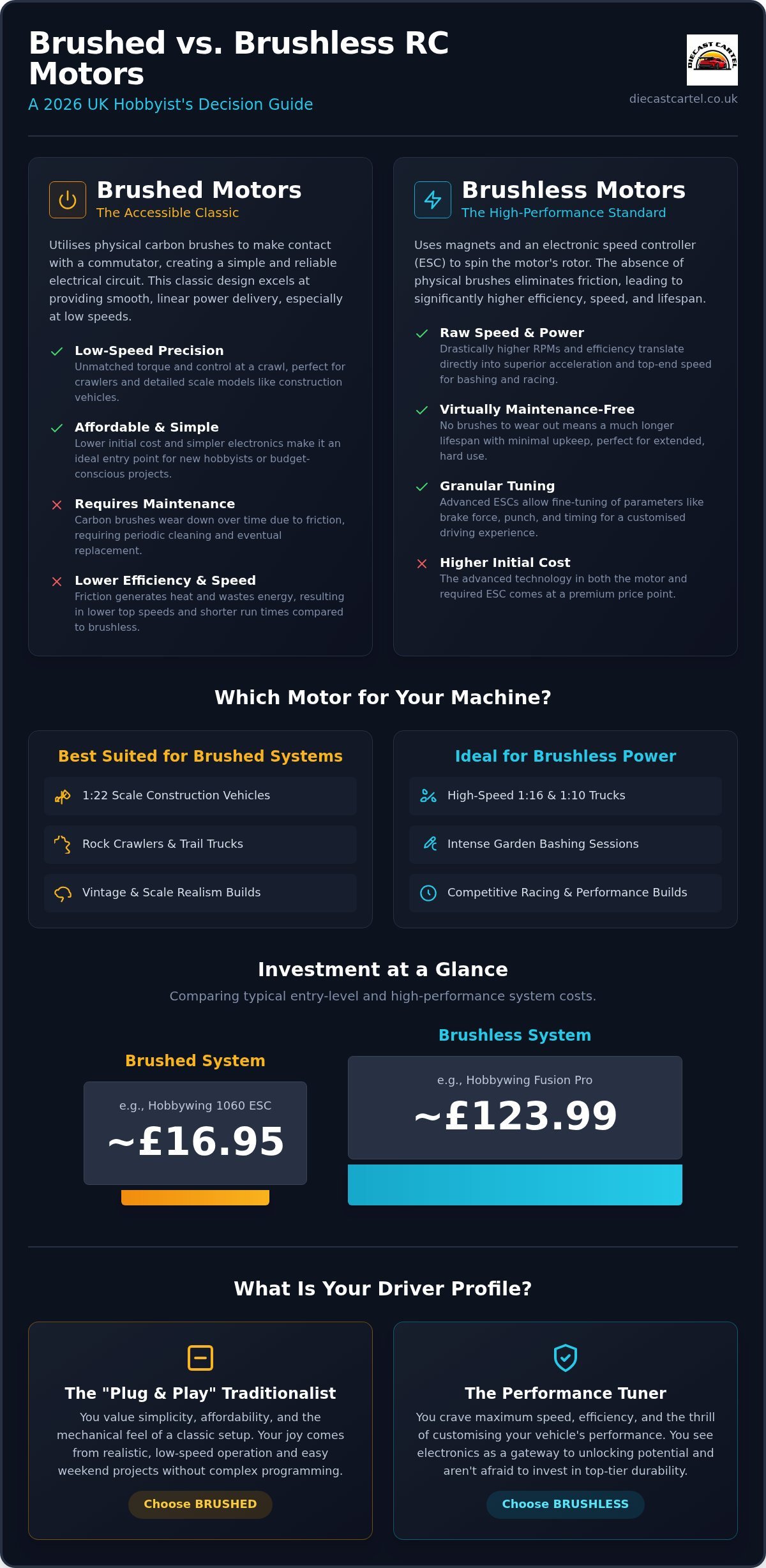
For many, the journey starts here. Brushed motors use physical carbon brushes that press against a spinning commutator to deliver power. This mechanical contact creates a beautifully smooth, linear throttle response that’s hard to beat for low-speed realism. If you’re operating RC construction vehicles with metal parts UK, you’ll appreciate the torque these systems provide at a crawl. They are simple and affordable. For instance, a dependable Hobbywing 1060 brushed ESC often costs around £16.95, making it a very accessible choice for a weekend project. However, that friction comes at a cost. Over time, those brushes wear down and generate significant heat. It’s a classic technology that requires a bit more “old-school” maintenance to keep things running sweetly.
Brushless Motors: The High-Efficiency Future
If you crave raw speed and long-term durability, the brushless route is the modern standard. By removing the physical brushes, these motors rely on magnets and clever electronics to spin the rotor. This Brushless DC electric motor technology significantly reduces friction, meaning more of your energy goes into wheel speed rather than wasted heat. Serious 2026 collectors prefer these systems because they are virtually maintenance-free. When paired with high-quality rechargeable batteries for RC toys, a brushless setup can transform a standard truck into a track-tearing beast. High-end systems like the Hobbywing Fusion Pro can cost around £123.99, reflecting the premium you pay for advanced magnetics. You also gain the ability to customise your drive through ESC programming, allowing you to fine-tune everything from brake force to “punch” settings. It’s a more technical approach, but for many enthusiasts, that granular control is half the fun.
Technical Breakdown: Analysing ESC and Motor Performance
The Electronic Speed Controller (ESC) is the brain that bridges your transmitter’s commands and the motor’s physical movement. When evaluating brushed vs brushless RC cars UK, the efficiency of this component is where the real magic happens. For the casual garden basher, reliability is king. A motor that can survive a tumble or a splash in a British puddle is worth its weight in gold. Brushless systems generally win on pure endurance; they lack the physical components that wear down during high-impact sessions. However, keeping these systems stable requires a solid foundation of power. High-quality rechargeable batteries for RC toys are essential for maintaining consistent voltage, ensuring your ESC doesn’t cut out just as you’re hitting top speed.
ESC Efficiency and Heat Dissipation
Heat is the enemy of performance. In the 2026 market, we see two distinct approaches to cooling. Hobbywing often relies on massive, high-surface-area heatsinks that dissipate thermal energy passively. In contrast, many Spektrum units feature integrated cooling fans to force air across the circuitry. Both methods work well, but fans can sometimes ingest grit if you’re driving in dusty UK conditions. Another technical detail to watch is the Battery Eliminator Circuit (BEC) voltage. A higher BEC voltage ensures your steering servos react with snap and authority, which is vital when you’re navigating tight corners. In 2026, ESC efficiency has reached a point where even lightweight systems provide an incredible power-to-weight ratio for smaller 1:24 models.
Motor Torque and Linear Delivery
Understanding how brushless motors work reveals why they offer such explosive torque. They use electronic timing rather than physical brushes, allowing for near-instantaneous power delivery. This is perfect for heavy-duty bashing where you want to clear a jump with a quick blip of the throttle. However, for those who collect 1:24 scale diecast trucks, the raw speed of brushless isn’t always the goal.
Brushed motors often provide a superior low-end feel. They offer a linear throttle curve that makes slow-speed manoeuvring feel authentic. When you’re backing a trailer or positioning a forklift, that precise control is essential. KV ratings also play a role here; a lower KV brushless motor can mimic some of that brushed smoothness, but it rarely matches the organic “creep” of a traditional motor. If you’re looking to upgrade your current rig, checking out the latest RC accessories and parts can help you strike the right balance between power and poise.
The Ecosystem Advantage: Spektrum Smart vs Hobbywing Customisation
Choosing between brushed vs brushless RC cars UK often comes down to how much time you want to spend with a screwdriver in your hand versus a transmitter. In 2026, the electronics are smarter than ever. It’s no longer just about the raw power we discussed in our Technical Breakdown: Analysing ESC and Motor Performance; it’s about the ecosystem that supports your driving. Do you want a system that does the thinking for you, or one that lets you tweak every millisecond of throttle response?
Spektrum Smart: The Seamless All-in-One Solution
Spektrum has built a “walled garden” that’s incredibly inviting for those who value their time. Their Smart G2 ecosystem uses a single-wire telemetry system that sends real-time data from the ESC directly to your transmitter. You can see your battery voltage and motor temperature whilst you drive, without any extra sensors. For a UK collector who might be juggling multiple models, the convenience is massive.
The real magic happens at the charger. Smart batteries tell the charger exactly what they are, setting the charge rate and cell count automatically. This prevents the common mistakes that lead to puffed LiPos or, worse, workshop fires. Is it worth the premium? If you want a stress-free experience where the tech manages itself, the answer is often yes. Just be prepared for the proprietary IC3 and IC5 connectors which might limit your choice of third-party batteries.
Hobbywing Tuning: The Tinkerer’s Dream
Hobbywing takes a different path, offering a level of customisation that feels like a shared secret amongst seasoned enthusiasts. Instead of a closed loop, they provide tools like the OTA (Over-The-Air) programmer. This allows you to connect your ESC to a mobile app via Bluetooth, letting you adjust punch settings, drag brake, and timing from the palm of your hand. It’s the ultimate setup for those who enjoy the “bench work” as much as the driving.
This brand remains the favourite for those who want flexibility. You aren’t tied to a specific battery brand or radio system. You can mix and match components to build a bespoke rig that’s perfectly tuned for your specific terrain. Whilst Spektrum offers a polished, unified experience, Hobbywing provides the granular control that many UK bashers crave when comparing brushed vs brushless RC cars UK for their custom builds. It’s about deciding whether you want the car to be a finished masterpiece or a project that’s constantly evolving. If you are ready to expand your fleet, exploring the latest RC electronics and accessories is the best way to see these ecosystems in action.
Application Guide: Powering Your Specific RC Collection
Choosing the right heart for your vehicle depends entirely on what you intend to do once you’re out in the field. When we look at brushed vs brushless RC cars UK, the application often dictates the technology. A high-speed racer has very different needs compared to a heavy-duty digger working in a scale quarry. The weight of your motor and the way it delivers torque can either enhance or hinder the realism of your collection. It’s about finding that sweet spot where the electronics complement the physical presence of your model.
Precision Power for Construction Machinery
For owners of RC construction vehicles with metal parts UK, the priority is always precision. If you are operating a 1:22 scale excavator, you need the bucket to move with millimetre accuracy. Torque-heavy brushed setups are often preferred here because they offer that organic, low-end “creep” without the jerky “cogging” sometimes found in cheaper brushless systems. If you do go brushless for a construction rig, a sensored system is a must to maintain that smooth behaviour. The specialised “crawler” modes found in Hobbywing ESCs are a secret weapon for construction hobbyists, providing the drag-brake and throttle finesse needed to hold a heavy load on a ramp.
Speed and Agility for RC Trucks
Moving to 1:24 scale trucks, the requirements shift towards speed and agility. A brushless conversion can turn a standard lorry into a nimble performer, but you must consider the balance. These smaller models are sensitive to weight; a motor that’s too heavy can ruin the handling. Spektrum’s AVC (Active Vehicle Control) is a fantastic tool for high-speed truck stability, using sensors to help you keep the vehicle straight during rapid acceleration. You’ll also need to manage battery draw carefully. High-performance motors can drain a small cell quickly, so balancing your run time with your “fun time” is key. Organise your electronics layout to allow airflow around the ESC, especially if you’ve tucked it away inside a scale cab. Ready to find your next project? Explore our range of RC trucks and construction vehicles to see these systems in action.
Final Verdict: Making the Right Choice for Your RC Journey
We’ve explored the inner workings of magnets and brushes, and peeked into the high-tech ecosystems of 2026. Now, the decision comes down to you and your workbench. Choosing between brushed vs brushless RC cars UK isn’t about finding a “winner” in a vacuum; it’s about matching the technology to your personal passion as a collector. Are you someone who finds joy in the slow, methodical movement of a 1:22 scale digger, or do you live for the moment a 1:16 truck clears a massive jump? Your driver profile is the most accurate compass for this investment.
If you’re just beginning your journey, learning how to start a diecast collection is a brilliant way to appreciate the aesthetic quality of these models before you worry about motor swaps. Once you’re ready to power up, remember that the damp British weather is always a factor. Keep your electronics in peak condition by clearing away grit from cooling fans and ensuring your Spektrum or Hobbywing connectors are free from moisture after an outdoor session. A little preservation goes a long way in this hobby.
Choose Brushed If…
- You value scale realism: If your favourite activity is navigating a 1:24 forklift through a tight indoor warehouse, the smooth, linear creep of a brushed motor is unbeatable.
- Simplicity is key: You want a plug-and-play experience without the need for mobile apps or programming boxes.
- Budget matters: You’d rather spend your pounds on expanding your collection with more vehicles than on a single high-end power system.
Choose Brushless If…
- You crave performance: You want the absolute best speed and efficiency per pound spent, especially for heavy-duty outdoor bashing.
- You’re a tinkerer: The idea of using an OTA programmer to adjust brake force and timing sounds like a perfect evening at the bench.
- Long-term reliability is a priority: You want a motor that can handle high-voltage draws from modern batteries without needing brush replacements or frequent mechanical maintenance.
Ultimately, the brushed vs brushless RC cars UK debate is a testament to how diverse our community has become. Some days call for the quiet, nostalgic hum of a brushed motor as you position a 1:24 truck. Other days, only the explosive torque of a brushless system will satisfy the itch for speed. Whichever path you choose, the most important part is the joy of the drive and the pride you feel for the collection you’ve built. Happy bashing!
Ready to Power Up Your Next RC Adventure?
Deciding on the right motor system is about more than just top speed; it’s about the physical presence and behaviour of your collection. We’ve seen that whilst brushed motors offer the precise, low-speed torque essential for 1:22 scale construction vehicles, brushless systems provide the raw efficiency and customisation that serious bashers crave. Whether you prefer the plug-and-play simplicity of a classic setup or the granular tuning of a modern ESC, your choice in the brushed vs brushless RC cars UK debate will define your experience on the bench and in the field.
As UK-based hobbyist specialists, we’re here to support every step of your journey with expert advice on customisation and maintenance. Our extensive range of 1:22 and 1:24 scale replicas provides the perfect platform to test these systems for yourself. Explore our range of RC vehicles and batteries at Diecast Cartel to find the high-performance power your collection deserves. There’s nothing quite like the thrill of a new acquisition, and we can’t wait to see which system you choose to drive your passion forward.
Frequently Asked Questions
Is a brushless motor compatible with my existing brushed ESC?
No, a brushless motor will not work with a brushed Electronic Speed Controller. Brushless motors require a specific type of ESC that can manage electronic timing through three separate power wires, whereas brushed systems only use two. Attempting to mix these components can result in permanent damage to your electronics. When comparing brushed vs brushless RC cars UK, it is vital to ensure your speed controller matches your motor type for a successful upgrade.
Do Spektrum Smart batteries work with Hobbywing brushless systems?
Yes, Spektrum Smart batteries can power Hobbywing systems, but you will lose the proprietary telemetry features. You will likely need a connector adapter if your Hobbywing ESC uses XT60 or XT90 plugs, as Spektrum batteries typically use IC3 or IC5 connectors. Whilst the battery provides reliable power, the “Smart” communication only happens when paired with a Spektrum ESC and transmitter. It’s a functional setup, though it lacks the integrated data feedback enthusiasts often enjoy.
Which motor type is more waterproof for UK winter bashing?
Brushless motors are generally more resilient for wet UK conditions because they lack the exposed physical brushes and commutators found in brushed versions. Many modern brushless systems are specifically rated as “waterproof” by manufacturers like Hobbywing. However, you should always check the IP rating of your specific ESC before driving. Even with a waterproof motor, you must dry your vehicle thoroughly after a muddy session to prevent rust on the bearings and internal shafts.
Is a sensored brushless motor worth the extra cost for 1:24 trucks?
Sensored motors are definitely worth the investment if you value precise, low-speed control and want to eliminate “cogging” or jerky movements. For 1:24 scale trucks and 1:22 construction vehicles, a sensored setup provides a much smoother throttle response that mimics real-world driving behaviour. If you are purely interested in high-speed runs across a car park, a sensorless system is a more budget-friendly choice that still delivers plenty of raw power for your collection.
Can I use my existing NiMH batteries with a new brushless system?
You can use NiMH batteries, but you won’t experience the full performance potential of a brushless motor. Brushless systems are designed to thrive on the high discharge rates provided by LiPo batteries. If you do use NiMH, ensure your ESC is programmed for the correct low-voltage cutoff to avoid damaging the cells. For the best experience with brushed vs brushless RC cars UK, upgrading to modern rechargeable batteries is highly recommended for stability.
How much faster is a brushless RC car compared to a brushed one?
A brushless RC car can easily be 50% to 100% faster than a brushed equivalent depending on the KV rating and battery voltage. Because brushless motors are more efficient and can handle higher RPMs without overheating, they transform the top-end speed of any vehicle. In a 1:16 scale truck, this could mean the difference between a modest 15mph and a blistering 35mph. It is a significant leap in performance for any dedicated hobbyist.
Do I need a computer to program a modern Hobbywing ESC?
No, a computer isn’t strictly necessary as you can use a portable LED program box or an OTA Bluetooth programmer. These handheld tools allow you to adjust settings like brake force and punch directly at the track or in your garden. The OTA programmer even connects to a mobile app on your smartphone for a very intuitive experience. It makes fine-tuning your vehicle’s behaviour much easier than counting light flashes on a traditional setup button.
What happens if I use a non-Smart battery with a Spektrum Smart ESC?
The system will function perfectly as a standard power setup, but the Smart telemetry features will remain inactive. You won’t receive automatic battery voltage updates or temperature data on your transmitter display. You must also ensure the connectors are compatible or use a high-quality adapter. It’s a common way to use existing battery stock whilst enjoying the high-current delivery and reliability of a modern Spektrum brushless speed controller during your driving sessions.
