
RC & Construction
Rechargeable Batteries for RC Toys UK: The Hobbyist’s Guide to More Run Time
Jul
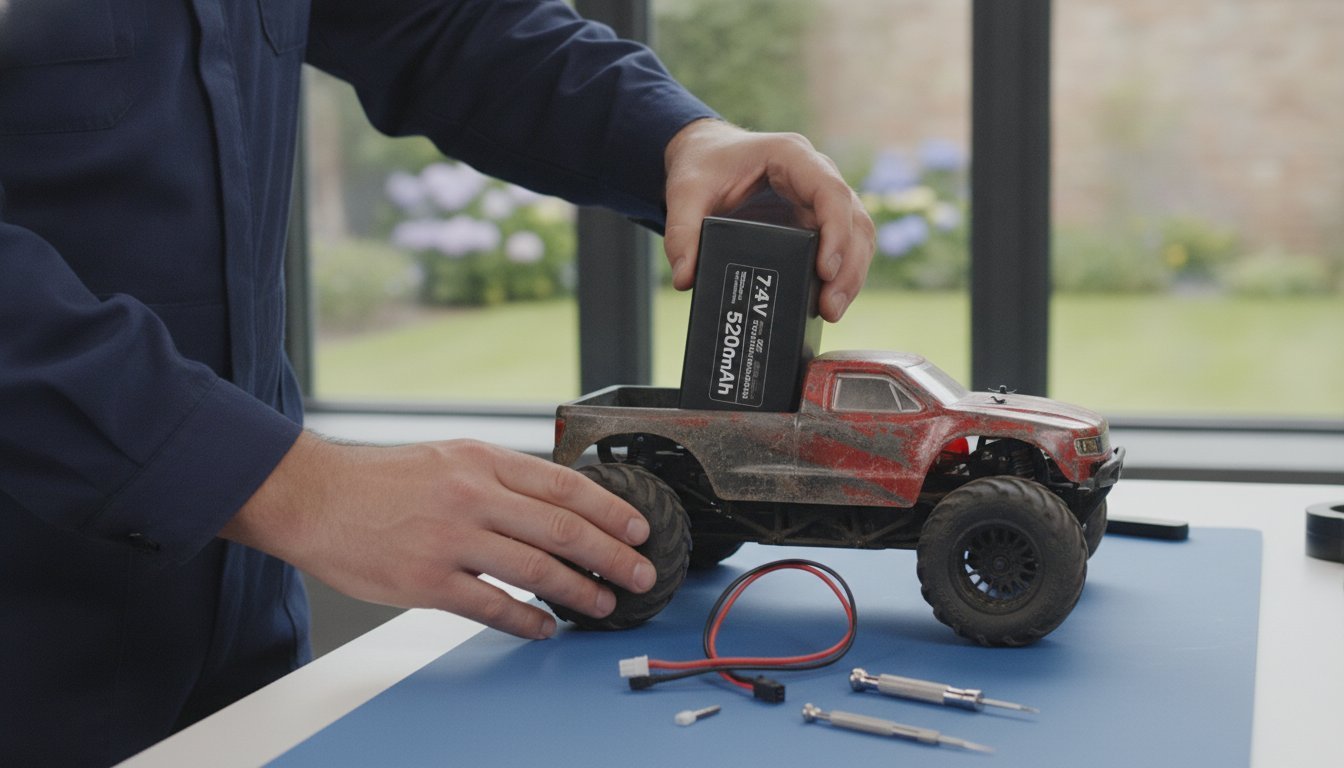
Have you ever reached the most exciting part of a backyard race only for your truck to limp to a halt because the factory battery gave up after ten minutes? It’s a common frustration amongst our community of enthusiasts. We’ve all been there, staring at a static model whilst the sun is still out and the track is calling. Finding the right rechargeable batteries for RC toys UK shouldn’t feel like a high-stakes guessing game where one wrong plug choice might fry your motor. You want more power and longer sessions, but the technical maze of Tamiya, SM-2P, and XT60 connectors can feel overwhelming.
We’re going to help you master the “handshake” between your battery and vehicle so you can upgrade with total confidence. You’ll learn how to identify the exact replacement you need and how to safely increase your mAh capacity for significantly more run time. We’ll also cover essential maintenance and storage tips to ensure your fleet stays running stronger for longer. Whether you’re a seasoned collector or just starting your journey, let’s get your RC vehicles back where they belong: on the dirt.
Key Takeaways
- Learn why NiMH is often the favourite choice for casual hobbyists whilst Li-ion offers that high-performance edge for your construction fleet.
- Discover how to safely upgrade your vehicle’s mAh capacity for longer play sessions without risking damage to the internal motor.
- Demystify common UK connector types like Tamiya and SM-2P to ensure a perfect technical “handshake” for your 1:24 or 1:22 scale models.
- Master the essential maintenance steps for rechargeable batteries for RC toys UK to extend their lifespan and keep your trucks running at peak performance.
- Understand the golden safety rules for charging and storing your power packs to protect your collection and ensure long-term reliability.
Powering the Hobby: Why Rechargeable Batteries are Essential for RC Toys
The UK’s “Ready-to-Run” (RTR) market has exploded in popularity, offering everything from 1:24 scale trucks to massive construction vehicles right out of the box. It’s a fantastic way for newcomers to dive into the hobby. However, these models often come with basic factory batteries that barely scratch the surface of what the vehicle can actually do. If you’re relying on disposable AA batteries, you’ve likely noticed the drain on your wallet and the environment. Using high-quality rechargeable batteries for RC toys UK is the first real upgrade any enthusiast should make. It transforms the experience from a series of short bursts into a proper afternoon of exploration.
The Financial Benefit: Cost-per-Run Analysis
Let’s look at the numbers. A single pack of 50 disposable alkaline batteries might seem cheap at the supermarket, but they’re “one and done.” In contrast, a dedicated rechargeable pack can often handle hundreds of charge cycles before performance starts to dip. Whilst the initial investment in a quality charger and a couple of packs feels higher, it usually pays for itself within the first few months of regular play. You aren’t just buying power; you’re buying hundreds of sessions. It’s about shifting your mindset from a consumer to a curator of your collection.
Performance and Consistency whilst Playing
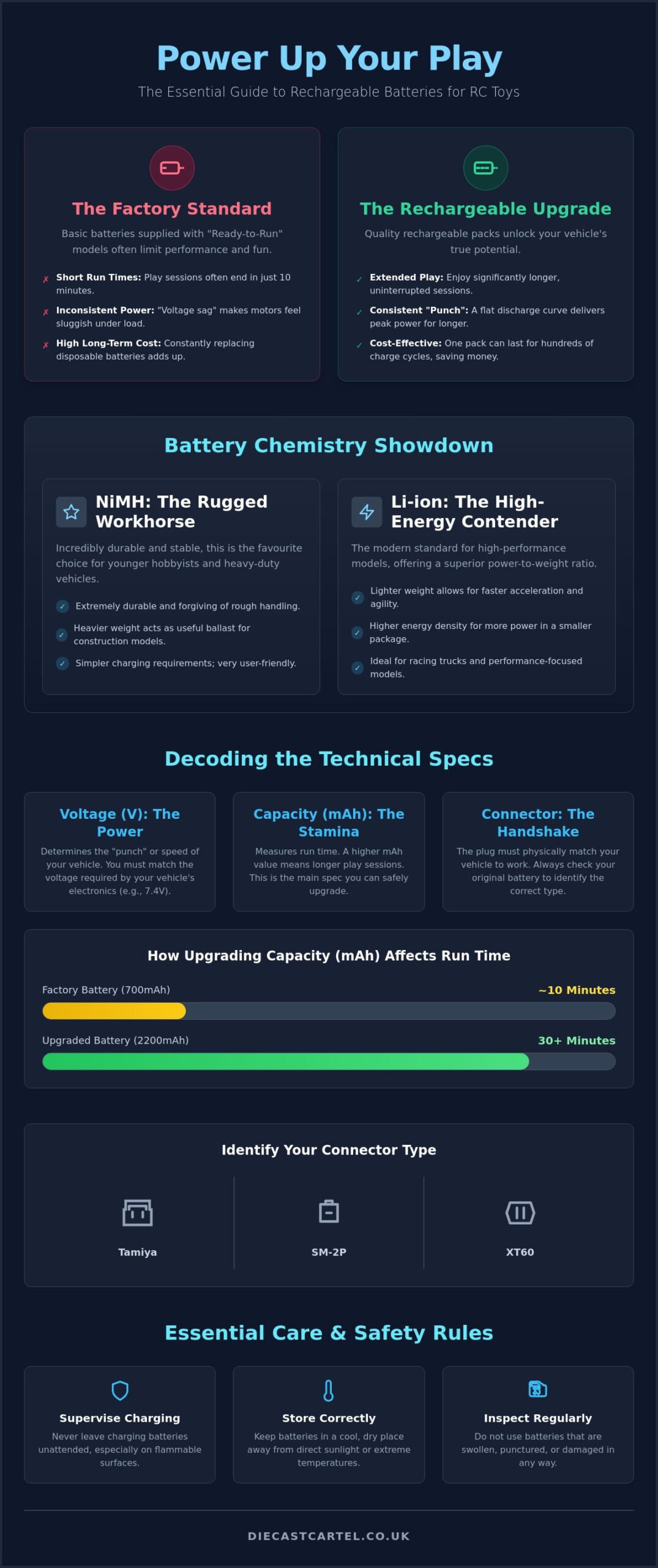
There is a technical reason why professionals avoid alkalines. Standard disposable batteries suffer from significant “voltage sag” under load. When you try to perform a high-torque manoeuvre with a 1:22 scale excavator, an alkaline battery’s voltage drops, making the motor feel sluggish and weak. Modern rechargeable battery technologies, such as NiMH and Li-ion, are designed to provide a much flatter discharge curve. This means you get the same “punch” and speed in the twentieth minute as you did in the first.
The psychology of the hobby plays a huge role here too. When you know your session will last thirty minutes instead of eight, you engage more deeply with the mechanics of your vehicle. You take the time to set up more complex obstacles or refine your driving lines. High-performance rechargeable batteries for RC toys UK don’t just keep the wheels turning; they keep the passion alive by removing the constant “low battery” anxiety that ruins the flow of a good race. It’s about giving your fleet the heartbeat it deserves.
NiMH vs Li-ion: Choosing the Right Chemistry for Your RC Vehicles
Selecting the best rechargeable batteries for RC toys UK depends entirely on what you’re driving and how you like to play. The chemistry inside that plastic casing dictates how your model behaves on the track or the construction site. Whilst many newcomers assume all batteries are created equal, the difference between Nickel-Metal Hydride (NiMH) and Lithium-based cells (Li-ion and LiPo) is quite significant. It’s the difference between a steady, reliable crawl and a high-speed sprint. Understanding these traits helps you match the “heartbeat” of the battery to the personality of your vehicle.
NiMH: The Rugged Workhorse
Nickel-Metal Hydride batteries are the traditional choice for a reason. They are incredibly durable and stable, making them the favourite for younger hobbyists or those who enjoy “bashing” their trucks without worrying too much about delicate electronics. Because NiMH cells are heavier, they actually provide a benefit for our 1:22 scale construction vehicles. That extra weight acts as low-down ballast, helping your excavator or dump truck stay planted whilst lifting heavy loads. You might have heard of the “memory effect,” where batteries lose capacity if not fully discharged. With modern NiMH cells, this is largely a myth. A simple, full charge cycle is usually enough to keep them in top shape. If you’re running a 1:22 scale RC dump truck UK collectors are adding to their fleets, understanding the NiMH advantage for heavy-duty construction work is especially valuable.
Li-ion and LiPo: The High-Energy Contenders
Lithium-ion (Li-ion) and Lithium-polymer (LiPo) are the modern standards for high-performance models. These cells offer a much better power-to-weight ratio. If you’re racing 1:24 scale trucks, a lighter Li-ion pack allows for faster acceleration and more agile handling. You’ll often see these rated by their “S” number, such as 1S (3.7V) or 2S (7.4V). This simply tells you how many cells are hooked up in a series to create the total voltage. If you’re looking to refresh your collection, our range of RC trucks and tractors often utilizes these efficient lithium setups to provide that extra “kick” during operation.
However, lithium batteries require a bit more respect than their NiMH cousins. They need specific chargers that monitor each cell individually to prevent overcharging. For peace of mind, it is always wise to follow the UK government battery safety guidance regarding storage and charging. Finding the right rechargeable batteries for RC toys UK often means balancing this desire for high performance with the safety requirements of lithium chemistry. When handled correctly, these batteries offer an unparalleled level of excitement and power for your remote control fleet.
Beyond the world of RC, choosing the right battery technology is vital for all electric transport; if you’re also looking for advice on larger applications, ukmobilitybatteries.co.uk explains the critical differences between lead-acid and AGM batteries for mobility scooters.
Voltage, Capacity, and Connectors: Finding the Perfect Match
Choosing the right rechargeable batteries for RC toys UK involves more than just picking a brand. It’s about matching the “Handshake” and the “Heartbeat” of your vehicle. The handshake is your connector; the heartbeat is your voltage. If these don’t align, your model either won’t start or, worse, it might suffer permanent damage. Before you buy, you need to check the labels on your current battery pack and measure the physical space available in your vehicle’s chassis. A battery with the wrong specs is like trying to put diesel in a petrol car; it simply won’t end well.
Identifying Your Connector Type
The “Connector Maze” is arguably the most frustrating part of the hobby. It’s the primary reason many enthusiasts end up with a battery they can’t actually use because the plug doesn’t fit the socket. Here are the most common plugs you’ll encounter in the UK market:
- Tamiya and Mini-Tamiya: These translucent white plastic plugs are the old-school standard for NiMH packs. They are reliable but can be bulky.
- SM-2P and JST: Often found in smaller 1:24 scale trucks, these are compact and usually red or black. They are perfect for tight spaces.
- XT60 and Deans (T-Plug): The gold standard for high-current models. They offer a secure, low-resistance connection for high-torque sessions.
The mAh Myth: Can You Have Too Much Capacity?
Many newcomers believe that a higher Milliampere-hour (mAh) rating makes a car faster. This is a common misconception. Think of mAh as the size of your fuel tank. A 2000mAh battery will give you a certain amount of play time, whilst a 4000mAh battery will roughly double it. It won’t increase your top speed, but it will keep you on the track for longer. A Beginner’s Guide To Lithium Rechargeable Batteries provides a brilliant breakdown of how these capacities affect performance over a full discharge cycle.
There is a trade-off to consider. Larger capacity batteries are physically bigger and heavier. If you’re upgrading a 1:22 scale construction vehicle, ensure the new pack actually fits inside the battery compartment. A battery that’s even a few millimetres too long will prevent the hatch from closing securely. Also, remember that longer run times mean more heat build-up in the motor. We always recommend a five-minute “cool down” break between packs to protect your model’s internal electronics. Finding the best rechargeable batteries for RC toys UK is a balance of power, size, and safety.
Maximising Lifespan: Charging and Maintenance Tips for UK Hobbyists
Caring for your gear is an essential part of the hobby. It’s about more than just keeping the wheels turning; it’s about the pride we take in preserving our collection for years to come. When you invest in high-quality rechargeable batteries for RC toys UK, your maintenance routine determines whether that pack lasts for fifty sessions or five hundred. A well-maintained battery provides a consistent, reliable heartbeat for your vehicle. Neglect it, and you’ll find yourself back at the shop sooner than you’d like.
The Golden Rule of the hobby is simple: never leave a charging battery unattended. Whether you are using a basic USB charger or a professional balance station, stay in the same room. It is also vital to handle old cells responsibly. In the UK, you should never throw these in the general waste. Most local supermarkets and recycling centres have dedicated bins for the safe disposal of power cells. Look for the “crossed-out wheeled bin” symbol on your battery. It’s our collective responsibility to ensure these materials are recycled correctly according to UK environmental regulations.
Safe Charging Practices at Home
Always use a fire-safe LiPo bag when charging lithium-based batteries. These inexpensive pouches are designed to contain heat and prevent accidents. Whilst it is tempting to use a “fast charge” setting to get back to the action, a slower, gentler charge is always better for long-term health. Keep an eye out for any physical changes in your packs. If a battery starts to feel excessively hot, leaks any fluid, or begins to “puff” and swell like a small cushion, stop using it immediately. These are clear signs that the internal chemistry is failing. You can’t fix a puffed battery; you can only replace it.
Seasonal Maintenance for Your RC Fleet
UK winters often mean our outdoor trucks and tractors spend a few months on the shelf. Don’t let your batteries sit forgotten in a cold garage. Lithium batteries should be stored at a “storage voltage,” which is roughly 50% capacity. Storing them completely full or totally empty for months can cause permanent damage. For NiMH users, it is a good idea to “cycle” your packs every few months by giving them a full charge and discharge to keep the chemistry active. Before you head out for your first spring session, check the connectors and wires for any signs of corrosion or fraying. If you need a fresh start for your fleet, you can find high-quality rechargeable batteries for RC toys that are ready for your next adventure.
Upgrade Your Fleet with Diecast Cartel’s High-Performance RC Batteries
You’ve mastered the technical maze of connectors, voltages, and chemistries. Now it’s time to put that knowledge into practice and give your models the power they deserve. Finding the right rechargeable batteries for RC toys UK is the final piece of the puzzle for any dedicated collector. At Diecast Cartel, we don’t just sell products. We curate a selection of power solutions that we use in our own fleets. We understand that a high-quality battery is the difference between a model that sits on a shelf and one that dominates the backyard track or the living room floor.
Batteries for 1:22 and 1:24 Scale Models
Our 1:22 scale remote control construction vehicles and 1:24 remote control forklifts have unique power requirements. For heavy lifting and digging, torque is king. We prioritise 4.8V NiMH packs for their steady reliability and 7.4V Li-ion packs for that extra punch needed during intense sessions. A fresh, high-capacity battery can completely revitalise an older model in your collection. It’s often the simplest way to bring a tired truck back to life. Whether you’re clearing a site with an excavator or stacking pallets with a forklift, matching the right “fuel tank” to your machine ensures you aren’t left stranded mid-job. For a deeper dive into which chemistry suits your specific rig, our guide on NiMH vs LiPo batteries for 1:22 scale RC dump trucks covers everything you need to make the right call.
This level of precision in component selection is something any custom builder would appreciate; much like how Fat Boy Design USA supports enthusiasts in the world of custom motorcycles and racing, choosing the right battery ensures your RC fleet performs at its absolute peak.
The Diecast Cartel Community Advantage
Choosing a UK specialist means you get more than just a box in the post. You gain access to a community of enthusiasts who know these models inside out. We’ve tested these batteries in real-world conditions to ensure they meet the standards our fellow collectors expect. Because we’re based right here in the UK, our shipping is fast and reliable. There’s no need to wait weeks for an overseas delivery whilst your fleet sits idle. We’re here to help you navigate the technical specs so you can focus on the joy of the hobby.
Ready to extend your run time and boost your vehicle’s performance? Our team is always happy to offer advice on the best rechargeable batteries for RC toys UK for your specific model. We believe in building long-term relationships with our customers, treating every enquiry with the same passion we have for our own collections. It’s about more than just a transaction; it’s about growing the hobby together. Browse our range of RC batteries and vehicles at Diecast Cartel and get your fleet back into top gear today.
Power Up and Get Back to the Action
Mastering the technical details of your power source is the most rewarding upgrade you can give your collection. You now know that matching the “handshake” of your connector and the “heartbeat” of your voltage is essential for safety and performance. You’ve also discovered that increasing mAh is the secret to longer afternoons on the track without risking damage to your motor. By following simple UK storage and maintenance rules, you’ll ensure your fleet remains ready for duty at a moment’s notice. It’s these small technical steps that separate a casual toy from a high-performing hobbyist fleet.
As a specialist UK-based hobbyist retailer, we take pride in our expertly curated selection specifically chosen for 1:22 and 1:24 scale models. We aren’t just a shop; we’re a trusted community of scale model enthusiasts who share your passion for every turn of the wheel. If you’re looking for the best rechargeable batteries for RC toys UK, we have the tested solutions you need to keep the race going.
Ready to revitalise your trucks? Explore our full range of high-quality RC batteries and accessories to find the perfect technical match for your vehicle. We can’t wait to see your fleet back in full force and hear about your next adventure. Happy driving!
Frequently Asked Questions
Can I use a higher voltage battery to make my RC car faster?
No, you shouldn’t use a higher voltage battery than your vehicle is rated for because it can permanently damage the motor and speed controller. Whilst a higher voltage might provide a temporary speed boost, the extra heat will likely fry the internal electronics. It’s always best to stick to the manufacturer’s voltage requirements and focus on high-quality rechargeable batteries for RC toys UK with a higher mAh rating if you want more performance without the risk.
How long does a 2000mAh RC battery take to charge?
The charge time depends entirely on the output rate of your charger, which is measured in milliamps (mA). You can estimate this by dividing the battery capacity by the charger’s output; for example, a 500mA charger will take roughly four hours to fill a 2000mAh pack. Remember that basic USB chargers included with many 1:24 scale trucks are often slower than dedicated hobby-grade charging stations. Always check the light indicator on your specific device to confirm when the cycle is complete.
Why is my RC battery getting very hot whilst charging?
A battery getting excessively hot is a warning sign that the charging process has gone wrong or the internal cells are failing. Whilst NiMH batteries can feel slightly warm toward the end of a charge, they should never be too hot to touch. If you notice intense heat, a “puffed” appearance, or a strange smell, disconnect the charger immediately. This behaviour often indicates overcharging or high internal resistance, meaning it’s time to retire that pack and find a fresh replacement for your fleet.
What is the difference between a Tamiya and a Mini-Tamiya plug?
The primary difference between these two plugs is their physical size and the scale of the models they serve. Standard Tamiya connectors are roughly 14mm wide and were the old-school favourite for larger 1:10 scale vehicles. In contrast, the Mini-Tamiya is about 10mm wide and is now the most common handshake for rechargeable batteries for RC toys UK in the 1:24 scale range. They aren’t cross-compatible, so you must ensure the plug matches your vehicle’s socket exactly before you buy.
Can I leave my RC battery charging overnight?
No, you should never leave any battery charging overnight or whilst you are out of the house. Even with modern safety features, there is always a small risk of a technical fault leading to overheating or fire. This is especially true for lithium-based batteries which require constant supervision. Make it a habit to only charge your packs when you are in the same room and can react quickly if something doesn’t look or feel right. Safety always comes first in our hobby.
How do I know when my NiMH battery pack is worn out?
You’ll know your NiMH pack is reaching the end of its life when you notice a significant drop in run time and overall “punch.” If a battery that used to last twenty minutes now gives up after five, the internal chemistry is likely degraded. You might also find that the battery gets very hot almost as soon as you start using it. When these signs appear, the battery can no longer hold a steady voltage under load and should be replaced to avoid disappointing sessions on the track.
Is it safe to use a LiPo battery in a toy that came with a NiMH pack?
It is generally not safe to swap a NiMH pack for a LiPo battery unless your vehicle’s speed controller is specifically designed for lithium. LiPo batteries have a different discharge curve and require a “Low Voltage Cut-off” to prevent them from draining too low and becoming dangerous. A standard NiMH-only model won’t have this safety feature. If you want the lithium advantage, ensure your model’s electronics are “LiPo ready” before making the switch to avoid permanent damage.
Where can I dispose of old RC batteries in the UK?
In the UK, you can safely dispose of old cells at dedicated battery collection points found in most major supermarkets like Tesco, Sainsbury’s, or Waitrose. Local council recycling centres also provide specialist bins for hobbyist power packs and electronics. Following these UK regulations ensures that hazardous materials are handled correctly and kept out of the general waste stream. It’s a vital part of being a responsible member of our enthusiast community and protecting the environment for future hobbyists.
