
Diecast Guides
Diecast Car Value Guide UK: How to Estimate What Your Model Is Worth
Oct
What if the asking price on a listing tells you less about a diecast car’s value than the price someone actually paid? Online listings can show a wide spread of figures, so it’s worth checking what completed sales suggest before deciding which ones are relevant. This diecast car value guide UK collectors can use starts with a simple idea: value is an evidence-based range, not a fixed price attached to a model’s name.
You’re right to look beyond age alone. The maker and edition, rarity, scale, condition and original packaging can all affect what a model is worth. A missing accessory can make two similar examples poor comparisons, and an asking price is not proof of a sale. Comparing like-for-like evidence from the UK market gives you a more grounded starting point.
In this guide, you’ll learn how to identify the details that matter, assess condition and completeness consistently, and use recent UK sales to build a more reliable estimate. Whether you collect 1:18 or 1:24 scale cars, trucks or tractors, the aim is to help you make a considered choice about buying, keeping or selling a model, while enjoying the hunt for pieces that genuinely appeal to you.
Key Takeaways
- Use the diecast car value guide UK to build a considered estimate from comparable completed sales, rather than relying on sellers’ asking prices.
- Identify the exact model and scale before comparing it with other listings; small differences can make a comparison less useful.
- Assess the model, original packaging, paperwork and accessories separately, and record any marks or missing parts.
- Use clear photographs and concise notes to keep your research organised and support a realistic comparison.
- Let market evidence inform buying or selling decisions, while keeping personal enjoyment at the heart of your collection.
What determines a diecast car’s value in the UK?
A useful estimate starts with evidence, not the highest figure beside a similar-looking model. In the UK market, value is best understood as a current estimate based on comparable completed sales. It isn’t a guaranteed future return: collector interest can change, and a model’s appeal to you may differ from its appeal to another buyer.
A diecast car valuation is a context-dependent estimate of what a particular model might sell for, based on comparable completed sales and its identity, rarity, condition, completeness and current demand. Those factors work together. A scarce variant may attract interest, but its condition and whether key parts or packaging are present still matter. The background on what die-cast toys are can help if you’re new to the hobby and want context on their materials, history and scales.
Why asking prices do not prove a model’s value
An unsold listing tells you what a seller hopes to receive, not what a buyer has agreed to pay. Treat asking prices as clues at most; completed UK sales offer closer evidence of what collectors have actually paid. Don’t let one result set your estimate, either. A sale may be an outlier because of its condition, timing or the interest it attracted. Look for several relevant results where possible, and note when they took place.
Which diecast models are being compared?
Before comparing prices, check that you’re looking at the same maker, model name, variant, scale and release details. A familiar car can appear in different versions, with differences in colour, markings or specification that may matter to collectors. Similar appearance isn’t proof of an exact match.
Scale helps narrow the comparison, but it doesn’t decide value on its own. A 1:18 model and a 1:24 model represent different sizes, so compare each with examples of the same scale and identity rather than treating one scale as automatically more valuable. The same careful approach applies to model cars, trucks and tractors. Ask yourself: would a collector searching for your exact model recognise these sales as genuine comparisons?
That’s the starting point of a reliable diecast car value guide UK collectors can use: identify the model precisely, then weigh several like-for-like completed sales against its condition, completeness and current demand.
How condition, rarity and completeness change diecast car value
Once you’ve identified the exact model, look closely at what’s actually there. Two examples of the same release can attract different interest if one has clean paint and intact glazing while the other has chips, loose parts or signs of repair. Condition isn’t just about whether a model looks good on display; it helps explain why apparently similar examples can achieve different results.
How to assess a model’s condition consistently
Inspect the paint and bodywork for chips, scratches, dents and corrosion, then check the glazing for cracks or cloudiness. Look at the wheels and tyres, and note whether doors, bonnets or other moving parts are present and operate as expected. Record repairs, loose components and signs of handling. Specific descriptions are more useful than a broad label such as “mint”, which people may interpret differently.
Try to distinguish the original factory finish from later wear or alterations. Repainted areas, replacement parts or touch-ups can affect how collectors view an example, even if the work makes it look tidier. Note what you can see without attempting to restore or alter the model just to improve its appearance.
Rarity, provenance and original packaging
Age alone doesn’t prove a model is rare. Look for reliable details that support a particular release or variation, such as manufacturer information or distinctive features, rather than assuming an old model had a small production run. Rarity matters only when collectors want that particular model or variation. Provenance, the record of a model’s ownership or history, can add useful context, but it isn’t automatic proof of rarity or a higher selling value.
Assess the model separately from its box and extras. Record whether the original packaging, inserts, paperwork and accessories are present, and describe their condition too. A box may be complete but scuffed or torn; an accessory may be present but detached. Clear notes make those differences easier to communicate and compare. The purpose of a valuation matters as well: Chubb’s collector’s guide to appraisals explains the distinction between fair market and replacement value, which serve different needs.
For your diecast car value guide UK research, treat condition, scarcity and completeness as separate observations, then consider how they combine with buyer interest. If you’re comparing models as you shape your collection, browse diecast model cars, trucks and tractors and focus on the pieces that appeal to you.
How to compare UK diecast car sales and estimate a realistic value
With the model identified and its condition recorded, gather completed-sale examples that genuinely match. A useful comparison is more than a similar photograph and a figure: note the details that could explain why one sale differs from another. This gives your diecast car value guide UK research a clear, repeatable basis.
How to find useful completed-sale comparisons
Search using the maker, model name, variant and scale together. Broad searches can return lookalikes that differ in release, specification or completeness. Filter for completed transactions where possible, then check the listing details and photographs rather than relying on the title alone. Record the sale date, since older evidence may not reflect current collector interest.
Use a simple comparison table to organise what you find:
| Detail | What to record |
|---|---|
| Identity | Maker, model name, variant and release details |
| Scale | For example, 1:18 or 1:24 |
| Condition | Paint, bodywork, glazing, wheels and any damage or repairs |
| Completeness | Accessories, paperwork, original box and inserts |
| Sale evidence | Completed sale, date and sale format |
Compare photographs closely. A box visible in one listing may be absent from another, and damage can be easy to miss in a small image. Clear photographs reveal details that a sparse description may leave uncertain, so avoid treating a listing as a close match if you can’t judge its condition or completeness.
What to do when comparable sales disagree
Different results don’t necessarily mean your research has failed. Check whether the examples vary in condition, completeness, edition or sale date before drawing a conclusion. Sale format and shipping can complicate comparisons too: a buyer’s total outlay may include delivery, while an auction, fixed-price sale or collection listing may attract different audiences. Keep those details in your notes rather than treating every result as directly equivalent.
Give more weight to several close matches than to one surprising result. A single sale might reflect unusual timing or strong interest from a particular buyer, so don’t use it alone as your benchmark. If only a small number of relevant sales exist, note that your evidence is limited. Build a cautious range from the best comparisons, and present it as an estimate, never a guaranteed outcome.
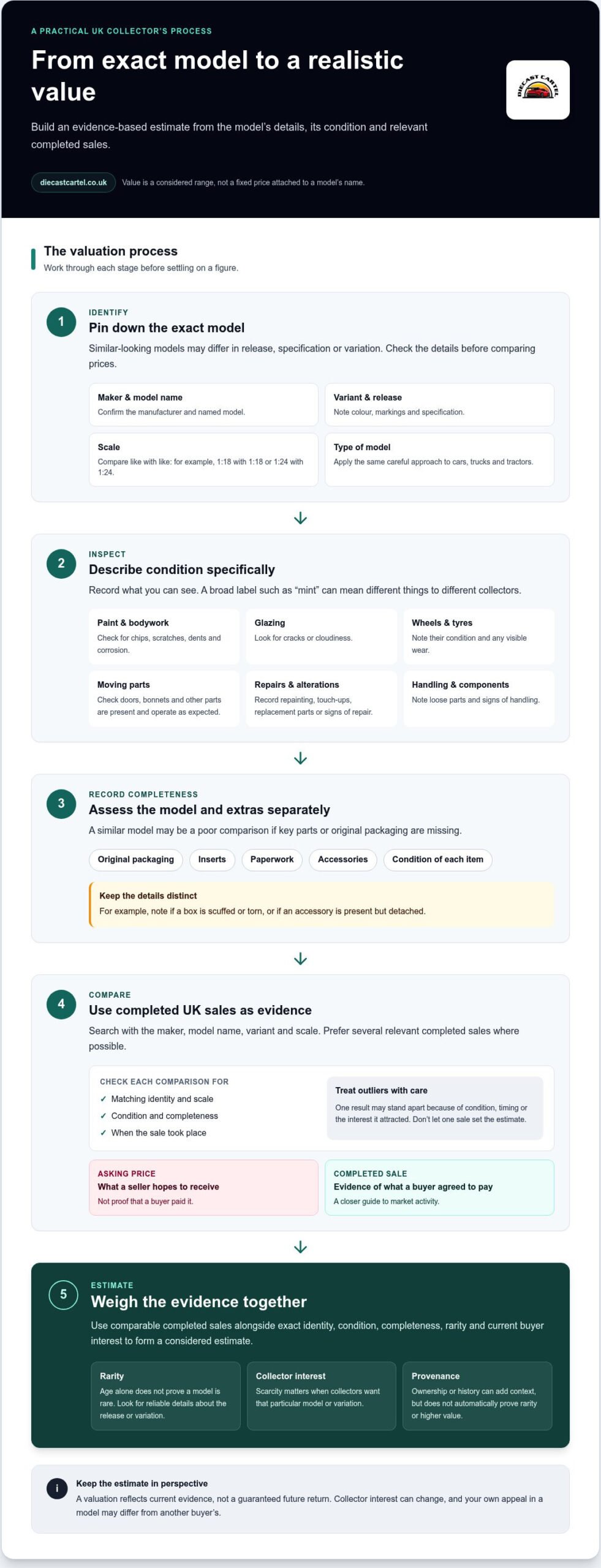
A practical checklist for valuing a diecast car you own
A consistent process makes your estimate easier to review and update. Work through these steps in order, keeping notes as you go. You’ll be able to see how you reached your figure instead of relying on a quick impression.
- Identify the model. Record visible maker marks, the model name, variant, scale and any edition or release details. Check the base as well as the body, since useful identifying information may appear underneath.
- Photograph it clearly. Take sharp, evenly lit photographs of the base, body, wheels, glazing and any moving parts. Photograph the box, inserts, paperwork and accessories separately so their condition and presence are clear.
- Describe condition and completeness. Note paint chips, scratches, loose or missing parts, repairs and signs of handling. Record packaging and accessories separately from the model. Be precise: “small chip on the left front wing” gives a clearer picture than “good condition”.
- Keep supporting records. Save purchase records and provenance notes if you have them. They can help establish a model’s history, although they don’t prove rarity or a particular market value on their own.
- Find and log comparisons. Compare the model with multiple completed sales that match its identity and scale as closely as possible. For each one, record the source, sale date, condition, completeness and any differences that might affect the result.
- Form a cautious estimate. Consider how your model’s condition and completeness compare with the examples. Explain each adjustment in your notes, and keep the market estimate separate from what the model means to you personally.
Be transparent about uncertainty. If you find few close comparisons, or the available examples differ substantially, describe your result as a broad estimate based on limited evidence. Don’t make a sparse set of sales sound conclusive. A clear record also makes it easier to revisit your estimate when more relevant completed-sale evidence becomes available.
This practical approach makes the diecast car value guide UK a repeatable way to assess a model, whether it’s a car, truck or tractor. If you’re also choosing a model for your collection, view diecast model cars, trucks and tractors and follow the subjects that genuinely interest you.
Using a value guide to buy, sell or build your collection
Valuation research is most useful when it helps you make a decision, not when it’s treated as a promise. A diecast car value guide UK collectors can use gives you a way to weigh market evidence before buying or selling, while leaving room for what makes a model personally meaningful.
Using comparable sales before buying or selling
If you’re considering a purchase, compare the exact model, scale, condition and completeness with completed sales. A listing may look like a match at first glance, but differences such as missing accessories or damaged packaging can change the comparison. Use the evidence to decide whether the asking price makes sense for you, rather than assuming the model will later sell for the same amount.
For sellers, completed sales can help set realistic expectations. Describe the model accurately, note marks or missing parts, and photograph the body, base, packaging and accessories clearly. Transparent details help potential buyers understand exactly what’s included. Past results are useful context, not a guarantee of what your example will achieve or how its value might change.
If you’re deciding whether to keep a model, market evidence is only one part of the picture. You might value its place in a collection, the memories attached to it or simply the pleasure of seeing it on display. A collection doesn’t have to be an investment to be worthwhile.
Let collecting interests guide your next model
Think about what you enjoy collecting and displaying. Do you prefer the presence of a larger model, or a particular subject such as classic cars, trucks or tractors? Scale, available display space and personal interest may matter more to you than resale potential. Those preferences can help shape a collection that feels distinctly yours.
If you’re new to the hobby, start by choosing subjects and scales that interest you, then consider how much display space you have and what fits comfortably into your collection. Diecast Cartel offers 1:18 and 1:24 scale diecast model cars, trucks and tractors for collectors exploring those categories.
Use your research to make informed choices, then follow the models that genuinely catch your eye. Diecast Cartel’s diecast car, truck and tractor categories offer a place to browse as you consider what might earn a place in your collection next.
Make your next collecting decision with confidence
A reliable diecast car value guide UK collectors can use starts with careful identification and realistic evidence. Compare completed sales for the same model, variant and scale, then consider condition and completeness before forming an estimate. A seller’s asking price isn’t proof of what a buyer will pay, and a handful of sales can only offer a guide, not certainty.
Use your research to make a more informed choice about buying, selling or keeping a model, but don’t let market value overshadow the fun of collecting. The models you enjoy displaying or discovering can be worthwhile additions regardless of their investment potential. That personal connection is part of what makes every collection its own.
Ready to find a model that speaks to your interests? Diecast Cartel is a UK-based online retailer specialising in 1:18 and 1:24 scale diecast cars, trucks and tractors. Explore Diecast Cartel’s diecast models and keep building a collection that feels unmistakably yours.
Frequently Asked Questions
Is my diecast car valuable?
It may be, but value depends on the exact model, its condition and completeness, and current collector demand. First identify the maker, model and variant, then compare several closely matched completed sales. Age, a high asking price or personal importance alone doesn’t establish market value. Treat your conclusion as an estimate, especially if there’s little recent evidence for comparable examples.
How do I find out what my diecast car is worth in the UK?
Start by identifying the maker, model, variant and scale, then assess the car’s condition and packaging. Search UK completed sales for close matches, recording sale dates and differences such as damage or missing accessories. In this diecast car value guide UK, the key is to distinguish completed sales from asking prices, which don’t confirm what buyers paid. If results vary, use a cautious range rather than an unsupported precise figure.
Does the box affect a diecast car’s value?
Original packaging can affect desirability and completeness, but its importance varies by model and buyer. Record whether the box is present and describe its condition: an intact box and a worn or torn one aren’t equivalent. Note any inserts and accessories separately, too. For a fair comparison, look at boxed examples alongside boxed examples, and unboxed ones alongside unboxed ones. Don’t assume a box adds the same amount in every case.
Are older diecast cars always worth more?
No. Age alone doesn’t determine value. The maker, exact model and production details, condition, completeness and current demand all influence collector interest. An older car might be common or damaged, while a newer release may attract keen buyers. Identify the precise version and compare relevant completed sales instead of using age or nostalgia as a shortcut. The evidence, not the year alone, helps you form a grounded estimate.
How can I tell whether a diecast car is rare?
Look for reliable evidence of a limited release or a clearly identifiable variation; a lack of search results alone doesn’t prove rarity. Scarcity and buyer demand are related but different: a model may be hard to find without attracting strong interest. Record its maker, model and distinguishing details, then check multiple credible references and relevant completed sales before calling it rare. Be clear about what you’ve verified and what remains uncertain.
Should I use asking prices or sold prices to value a diecast car?
Prioritise completed sales because they show that a transaction took place. Asking prices can indicate what sellers hope to receive, but an unsold listing doesn’t show that a buyer will pay that amount. Compare several close matches, noting condition, packaging and sale date. If you can find only asking prices, describe your estimate as uncertain rather than presenting those listings as confirmed market values.
Can a damaged diecast car still have value?
Yes. Damage doesn’t automatically make a model worthless, but its effect depends on the car, the type of damage and collector demand. Record chips, repairs, missing parts and packaging accurately, then compare the model with completed sales for similarly affected examples. A damaged car shouldn’t be directly compared with a pristine one without accounting for the difference. Keep your estimate cautious if close condition matches are scarce.
Do 1:18 and 1:24 scale diecast cars have different values?
Scale affects a model’s size, detail and potential collector audience, but it doesn’t set value by itself. The exact model, maker, condition, completeness and demand matter too. Compare like-for-like examples within the same scale wherever possible, rather than assuming 1:18 or 1:24 is inherently more valuable. For more on scale choices, see “The Collector’s Guide to Diecast Scales: Choosing Between 1:18 and 1:43 for Your Display”.
