Diecast Guides
Different Types of RC Cars: A Beginner’s Guide to Choosing Your Style

Oct
The best RC car for you isn’t necessarily the fastest one. It’s the one that suits the surfaces you can drive on and the kind of experience you enjoy. The different types of RC cars can be confusing at first, especially when it’s hard to tell a road car from a buggy or a rugged truck. A few practical comparisons can help you find a good starting point without learning every technical term first.
Begin with where you want to drive and what you want to do. Do you picture practising turns on smooth ground, sliding through corners, or finding a route over uneven terrain? This guide introduces the main categories, from touring cars and buggies to monster trucks and crawlers. It also explains what to check in a model’s power and control specifications once you’ve found a style that appeals. By the end, you’ll have a clearer idea of which RC car fits your space and preferred way to drive.
Key Takeaways
- Separate vehicle category from scale and power source when comparing the different types of RC cars.
- Compare how buggies, drift cars, crawlers and other styles suit different surfaces and driving experiences.
- Learn which motor, control and battery details are useful to check without getting lost in technical jargon.
- Choose a starting point by considering your practice surface, available space, preferred handling and appetite for setup.
- Explore RC cars, trucks and specialist construction vehicles at Diecast Cartel once you know what kind of driving appeals to you.
Different types of RC cars: what are the main categories?
Buggy, drift car, crawler: the names can sound like specialist jargon when you’re new to the hobby. An RC car is a vehicle controlled remotely, but its category usually describes its design and intended driving style. To compare the different types of RC cars, keep three things separate: category describes the vehicle style, scale indicates its size relative to a full-size vehicle, and power source tells you how it runs.
Here’s a quick guide to the main categories. These labels are useful starting points, not guarantees of identical performance. Models in the same category can differ in design, components and handling.
- On-road cars: designed mainly for smoother surfaces and controlled cornering.
- Drift cars: set up for controlled sliding through corners, with steering technique at the heart of the experience.
- Buggies: an off-road style with a nimble, purposeful design.
- Truggies: combine design cues associated with buggies and trucks.
- Monster trucks: recognisable by their large tyres and high-riding look.
- Crawlers: made for deliberate driving over obstacles, where careful control matters more than fast laps.
For a broader reference, this overview of types of radio-controlled cars also introduces vehicle categories and power sources. Use category names as clues to a model’s intended use, then check the individual specifications rather than assuming every car in a group behaves alike.
What makes an RC car on-road, off-road or a drift car?
On-road cars are intended mainly for smoother surfaces, where their design suits flowing runs and turns. Drift cars also focus on cornering, but the goal is different: instead of following the neatest line, the driver works to hold a controlled slide. Off-road designs are intended for less even surfaces. Their suitability still depends on the specific model and ground conditions, so “off-road” doesn’t mean that every surface is suitable.
Are buggies, truggies and monster trucks different types?
Yes, although their names describe broad styles rather than one fixed specification. Buggies have a distinct off-road profile, while truggies combine cues associated with buggies and trucks. Monster trucks stand out with their larger-looking tyres and taller stance, especially beside lower-profile on-road cars. Crawlers offer a different challenge: making deliberate progress over obstacles. Consider which activity sounds most satisfying, threading through a corner, holding a slide, or choosing a careful route across uneven ground.
How RC car types handle different terrain and driving styles
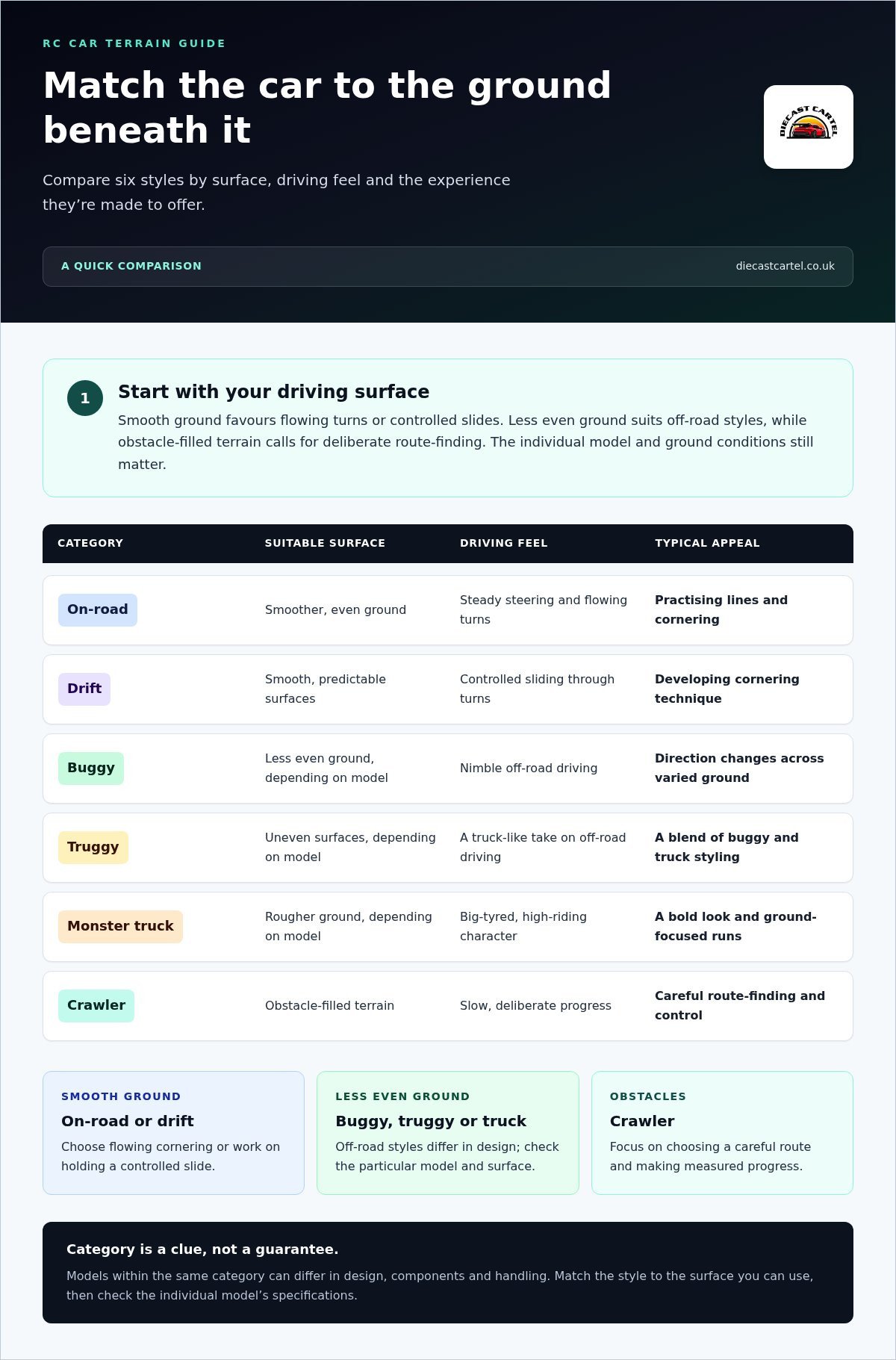
The surface beneath the tyres can change the experience as much as the vehicle category. Smooth, open ground lets you focus on steering and cornering. Uneven terrain introduces obstacles and calls for a different approach. Use this comparison to narrow your options, then check the individual model’s specifications because category alone can’t guarantee how it will handle on a particular surface.
| Category | Suitable surface | Driving feel | Typical appeal |
|---|---|---|---|
| On-road | Smoother, even ground | Steady steering and flowing turns | Practising lines and cornering |
| Drift | Smooth, predictable surfaces | Controlled sliding through turns | Developing cornering technique |
| Buggy | Less even ground, depending on model | Nimble off-road driving | Combining direction changes with varied ground |
| Truggy | Uneven surfaces, depending on model | A truck-like take on off-road driving | A blend of buggy and truck styling |
| Monster truck | Rougher ground, depending on model | Big-tyred, high-riding character | A bold look and ground-focused runs |
| Crawler | Obstacle-filled terrain | Slow, deliberate progress | Careful route-finding and control |
Which RC cars suit roads, tracks and smooth surfaces?
On-road and drift cars both suit smoother ground, but they reward different driving inputs. With an on-road style, you steer through a turn along a controlled line. With a drift style, you work to manage a slide through the corner. A clear, even practice area makes it easier to notice how steering affects the car’s direction and balance. For organised racing context, ROAR (Remotely Operated Auto Racers) offers information about RC racing and competition.
Which RC cars are suited to rough ground and obstacles?
Buggies, truggies and monster trucks are all associated with off-road use, but their designs differ, and suitability depends on the model and surface. A buggy has a distinct off-road profile, a truggy blends buggy and truck cues, and a monster truck is known for its larger tyres. Crawling is different again: the aim is to choose a route over obstacles at a measured pace, not to chase a speed run. Interested in working-machine models? Explore this guide to heavy-duty RC construction vehicles.
Choose a category based on the surface you can use and the driving experience you want. Browse the RC cars and trucks to compare styles that suit your interests.
RC car motors, controls and batteries: what beginners need to know
A car’s category describes its design and intended driving style. Its motor, radio control and battery are separate parts of the setup, so two vehicles with similar bodies can use different components. Treat specifications as useful details to compare, not as a substitute for deciding where and how you want to drive.
What is the difference between brushed and brushless RC cars?
Brushed and brushless refer to two types of electric motor. A brushed motor uses physical brushes to transfer electrical current to the rotating part of the motor. A brushless motor uses electronic control to switch current between motor windings without those brushes. Motor design can affect how a particular motor is built and maintained, but the label alone doesn’t tell you everything about a vehicle’s performance or upkeep.
Read the full model specification rather than judging a car by its motor label. The vehicle’s overall design and other components matter too, and a brushless setup isn’t automatically the right choice for every newcomer. For broader context on engineering and MIT’s technology and research work, explore the institution’s website. For a specific RC car, its own documentation is the practical guide to its components.
How do the transmitter and battery affect an RC car?
The transmitter is the handheld controller. It sends your driving commands to a receiver in the vehicle, which forms part of its control system. You use the transmitter to steer and operate the car; the receiver passes those instructions to the vehicle’s electronics.
Check battery details just as carefully. Note the battery’s chemistry and capacity, and make sure its type and connections are compatible with the vehicle and charger. Don’t assume batteries are interchangeable because they look similar. Charging instructions can vary by battery, so follow the guidance for the specific one you’re using.
For practical guidance on charging and handling, read how to charge RC car batteries safely. Understanding these component terms makes it easier to compare model specifications without losing sight of the driving experience you want.
How to match an RC car type to your space and experience
A good first choice starts with your actual driving conditions, not just a vehicle’s name or appearance. Consider four things: the surface you can use, the kind of driving you enjoy, the room available, and how much setup you’re comfortable with. Working through them in this order helps narrow the different types of RC cars to options that fit your routine.
- Choose a surface. Think about where you can practise regularly, such as smooth ground, a track or a space with natural obstacles.
- Pick a driving style. Decide whether you want to focus on cornering, controlled drifting, obstacle navigation or general off-road driving.
- Consider your space. The car needs room to turn and stop. Tight areas can limit the manoeuvres you can practise, while a larger open space gives you more room to explore.
- Decide how much complexity suits you. Check the controls and the model’s stated setup requirements. A straightforward control layout may feel more approachable while you learn; a more involved setup may appeal if you enjoy adjusting and understanding your vehicle.
What should a beginner consider before choosing an RC car?
Start with places you can actually use, rather than an ideal driving spot you may rarely visit. The surface affects how the car behaves, while the room available shapes the turns and routes you can attempt. Consider noise too, as the sound of a vehicle can affect where and when it’s practical to practise. Take the model’s information and your surroundings into account.
Then compare the complete vehicle specification. Category names are helpful clues, but they don’t describe every detail of the controls, components or setup. Think about what you’ll enjoy learning, not only what looks impressive at first glance.
How do scale and vehicle size fit into the decision?
Scale describes a model’s proportional size relative to the full-size vehicle it represents. It doesn’t directly promise a particular speed, handling or capability. Size still has practical consequences: consider whether you have enough room to drive, somewhere to store the vehicle and a convenient way to transport it to your practice area. A model that fits your available space is easier to make part of your regular hobby.
Match the vehicle type to the surface you can use and the driving experience you want. Explore RC cars and trucks to compare options with your preferred style in mind.
Explore RC cars and specialist RC vehicles at Diecast Cartel
Once you’ve narrowed down the different types of RC cars, focus on the kind of driving you’d genuinely enjoy. Smooth-surface cornering calls for a different style from careful obstacle navigation or general off-road runs. With your preferred surface and experience in mind, you can compare individual vehicles more meaningfully than by appearance or category label alone.
Diecast Cartel offers remote-control cars and trucks in 1:16 and 1:24 scales, alongside specialist construction vehicles. These give you different ways to enjoy the hobby, from driving a car or truck to operating a miniature working-machine-style vehicle.
Where do RC construction vehicles fit among RC cars?
Construction vehicles belong to the wider remote-control hobby, but they aren’t a car category. Their appeal centres on machinery and the movements of working vehicles, rather than road handling, drifting or car-based off-road driving. Diecast Cartel’s range includes 1:22 scale remote-control construction vehicles and a 1:24 remote-control forklift. If machinery catches your eye, explore this RC construction vehicles guide for a closer look at that specialist branch.
What is a sensible next step after learning the RC car types?
Make a shortlist before comparing individual models. Start with the surface you expect to use, then decide whether you’re drawn to cornering, controlled drifting, obstacle navigation or a general off-road experience. This gives you a practical way to sort through the options and keeps the focus on the driving you’ll look forward to.
Next, read each vehicle’s specifications. Look at its stated features and control setup, and pay attention to battery information, including compatibility. Compare the complete vehicle rather than assuming two models with similar labels offer the same setup or experience. If you’re considering a construction vehicle, review its details as a separate option for a different style of play.
Choosing can be part of the fun: there’s no single style that suits every enthusiast. Let your preferred surface and pace guide you, then explore RC cars and trucks at Diecast Cartel.
Choose your RC style and start exploring
The different types of RC cars make more sense when you begin with two things: the surface you can drive on and the experience you want, whether that’s practising turns, drifting or tackling obstacles. Category names are useful clues, but the details of an individual vehicle matter too. Check its specifications, controls and compatible battery before deciding.
At Diecast Cartel, you’ll find 1:16 and 1:24 scale RC cars and trucks, as well as remote-control construction vehicles and rechargeable batteries for RC toys. If working machinery appeals more than car-based driving, it offers another way into the hobby.
Ready to choose a style? Explore RC cars and trucks at Diecast Cartel and compare the options with your preferred driving experience in mind.
Frequently Asked Questions
What are the main types of RC cars?
The main types include on-road cars, drift cars, buggies, truggies, monster trucks and crawlers. On-road and drift styles are intended mainly for smoother surfaces, but offer different driving experiences. Buggies, truggies and monster trucks are associated with off-road use, while crawlers focus on navigating obstacles at a measured pace. These labels describe broad designs and intended uses, so individual models can still vary in their features and handling.
Is a drift car different from an ordinary RC car?
A drift car is a type of RC car designed around controlled sliding through corners. Rather than simply steering along a neat line, the driver practises managing a slide and maintaining control through the turn. Other RC cars may focus on different experiences, such as smooth on-road cornering or off-road driving. A smooth, predictable practice surface can make it easier to see how steering affects a drift car’s movement.
Can you drive an off-road RC car on the road?
It depends on the vehicle and surface. An off-road design may travel over smooth ground, but its handling and intended use can differ from an on-road car. Don’t assume that an off-road label means the model suits every road or surface. Check the vehicle’s specifications, then practise in a suitable open space where you have room to steer and stop safely.
Which type of RC car is best for beginners?
There isn’t one best type for every beginner. Start with the surface you can use and the experience you’d enjoy: on-road driving for practising turns, drifting for controlled slides, or a crawler for slow obstacle navigation. Then compare the model’s controls, setup and specifications. A manageable learning experience depends on the individual vehicle as well as its category, so don’t make the decision by label alone.
What is the difference between a buggy and a monster truck RC car?
A buggy has a distinct off-road style, while a monster truck is recognisable by its large tyres and high-riding appearance. Both are associated with off-road driving, but their designs and handling can differ from model to model. Neither label guarantees suitability for every rough surface. If you’re comparing them, consider where you plan to drive and read the individual vehicle’s specifications rather than relying only on its shape or category.
Are brushless RC cars always faster than brushed RC cars?
No. Motor type alone doesn’t establish how fast a particular RC car will be. Brushed and brushless describe different electric motor designs, but overall performance depends on the vehicle’s complete setup and specifications. Compare the information for the individual models you’re considering rather than assuming every brushless car is faster than every brushed one. Motor type also doesn’t determine whether a vehicle’s category, controls or driving style will suit you as a beginner.
How do I choose between an RC crawler and a buggy?
Choose a crawler if careful obstacle navigation sounds more enjoyable than covering ground quickly. Crawling centres on measured progress and choosing a route over uneven terrain. A buggy offers a different kind of off-road run, with handling that depends on the model. Think about the space and surface you can use, then compare the vehicles’ specifications. The right choice is the one that fits your preferred pace and practice area.
