
Diecast Guides
RC Cars for Fathers and Sons with Various Run Times
Nov
The fastest RC car isn’t automatically the best choice for a father-and-son outing. The best RC cars for father and son are the ones that suit both drivers, the place you’ll use them and how you want to spend your time behind the controls.
It’s easy to focus on speed or appearance, but a good shared run depends on more. Age and experience affect how easy a car is to control, while sound, lights and movement can shape each driver’s enjoyment. And if the battery runs down sooner than expected, the fun may be cut short.
This guide explains how to weigh age guidance, sensory effects, venue and running time when choosing an RC car for time together. You’ll also learn why rechargeable batteries and the type of vehicle matter, helping you choose a set-up for your plans, whether you’re heading outdoors or playing at home.
Key Takeaways
- Match the car’s controls and pace to both drivers’ ages and experience for a more enjoyable shared run.
- Consider how sound, lights and movement affect each person’s experience before choosing a model.
- Choose a car with the driving venue and preferred session length in mind, and factor battery needs into your plans.
- Compare what matters for your outing, then explore RC vehicles and rechargeable batteries alongside Diecast Cartel’s model range.
Age recommendation and sensory effects
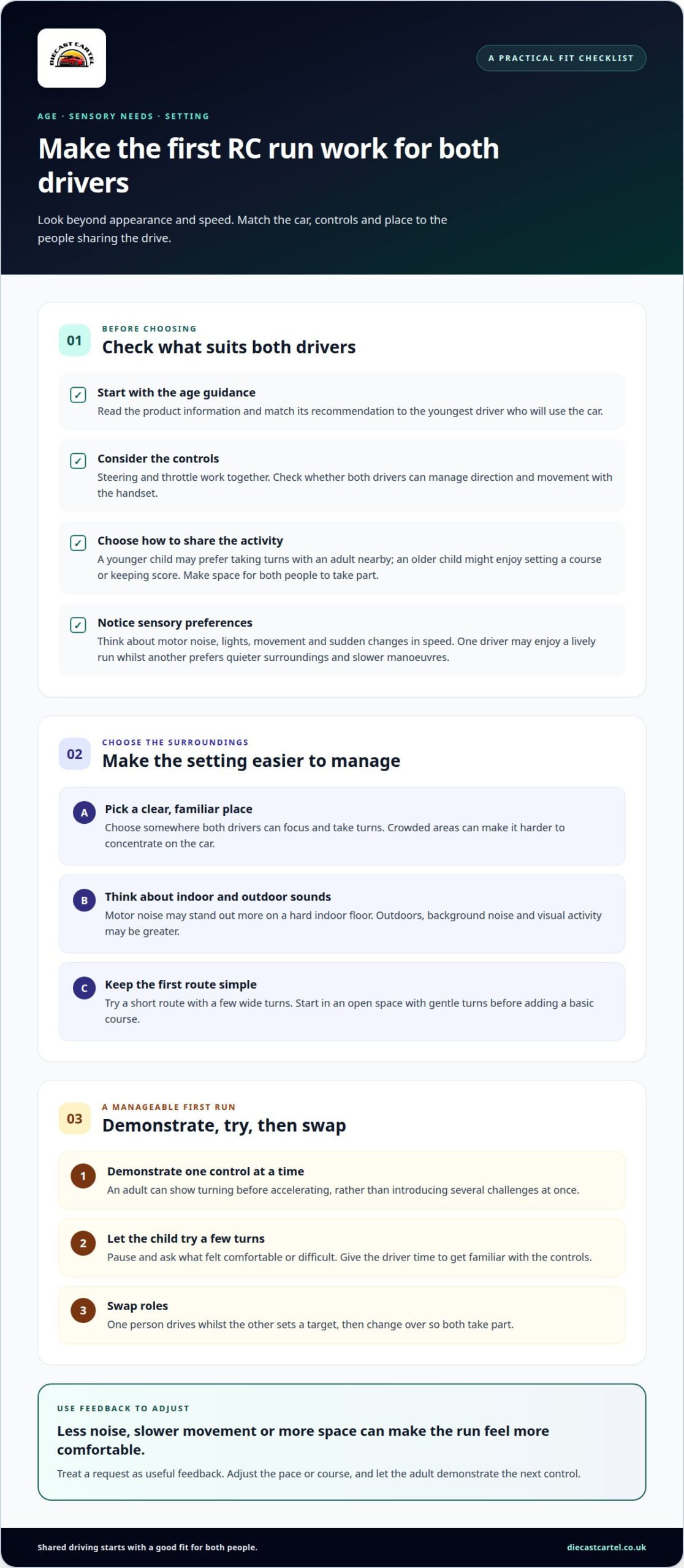
Start with the age recommendation for the particular RC car. It’s a more useful starting point than choosing by appearance, speed or a child’s height. Two similar-looking cars can have different controls, operating steps and handling. Read the product information before deciding, then consider whether the younger driver can follow the instructions and use the handset comfortably. An adult’s experience can help, but it doesn’t replace the model’s stated guidance.
Next, consider what each driver can manage independently. Steering and throttle work together: one hand controls direction while the other adjusts movement. A child still learning these actions may enjoy a simple session more than a demanding race. Start in an open space with gentle turns, then add a basic course once the controls feel familiar. The adult can demonstrate one action at a time, such as turning before accelerating.
Age also affects how you share the activity. A younger child may prefer taking turns with an adult nearby, while an older child might enjoy setting a course or keeping score. Neither approach is automatically better. The key is making sure both people take part, rather than leaving one driver to do all the controlling. Agree on a simple routine: one person drives while the other sets a target, then swap roles.
Sensory effects deserve equal attention. An RC car’s motor sound, movement, lights and sudden changes in speed can affect how a driver experiences it. A child who enjoys fast movement may want a lively run; someone sensitive to noise might prefer a quieter setting and slower manoeuvres. Consider the model’s features and how it sounds in the intended setting before a longer session. If sound or flashing lights are distracting, try a calmer activity, such as a slow obstacle course.
The venue can change these sensory demands. Motor noise may be more noticeable on a hard indoor floor, while outdoors there may be more background noise and visual activity. Crowded areas can also make it harder to concentrate on the car. Choose a clear, familiar place that suits both drivers. For a first outing, try a short route with a few wide turns instead of combining obstacles, speed challenges and spectators.
Use these checks before choosing:
- Read the age guidance. Match it to the youngest driver who will use the car.
- Consider the controls. Decide whether steering and throttle feel manageable for both people.
- Notice sensory preferences. Think about motor noise, lights and how quickly the car moves.
- Plan the setting. Choose a space where both drivers can focus and take turns.
Keep the first run simple. Let the child try a few turns, pause, then ask what felt comfortable or difficult. A request for less noise, slower movement or more space is useful feedback, not a reason to give up. Adjust the course or pace, and let the adult demonstrate the next control. The best RC cars for father and son outings suit both people’s abilities and preferences, not just the fastest option.
Best prices
The best price is the one that fits your budget and the way you’ll use the car. A low purchase price may not represent the full cost of a father-and-son hobby. Before choosing, compare what each listing includes, how the car will be used and whether you’ll need accessories. In the UK, set a spending limit in pounds first. Then compare models that meet your needs, rather than starting with the cheapest option.
Compare like with like. A small car for indoor use and a larger vehicle for outdoor runs may differ in scale, construction and purpose. Their prices aren’t directly comparable if only one suits your planned venue. Note the essentials: who will drive, where you’ll use it and which features matter. If both drivers want relaxed sessions at home, paying extra for features you won’t use may offer little value.
Check what’s included before judging a listing’s price. Look for the car, handset, battery and charger, and note whether each is included or sold separately. A model that needs a separate rechargeable battery may cost more to get running than its headline price suggests. The same goes for a charger or another necessary component. Compare the complete set-up, not just the vehicle.
Running time can affect value, too. If a session ends when the battery runs down, an additional compatible rechargeable battery may reduce waiting between runs. First, check which battery the model uses and whether one is included. Don’t assume batteries are interchangeable between cars. An unsuitable battery adds expense without helping your outing.
Look at care and replacement needs, too. A car used on rough ground may experience different wear from one driven gently across a clear indoor floor. That doesn’t make a higher-priced model automatically better; it makes your venue and driving style important parts of the comparison. Consider whether replacement parts are available for the model and how you’ll store it between outings. A sturdy case or tidy storage space can help protect the car and handset.
Use this comparison checklist for each option:
- Full set-up: Note which components are included and which require separate purchases.
- Battery plan: Check the required battery type and whether a spare suits your expected session length.
- Venue fit: Match the vehicle to indoor floors, outdoor paths or the space you’ll actually use.
- Long-term use: Consider care, storage and replacement parts alongside the initial price.
Delivery and returns can affect the overall value of an online purchase. Read the product listing and delivery information together, then compare the total shown before ordering. Keep the product name and included components beside the final cost. This makes it easier to spot when similar-looking offers cover different set-ups. A price comparison is only useful if each option includes what you need to use the car.
Finally, decide which features are worth your budget. A faster model may sound exciting, but speed alone doesn’t make it a better buy for a shared outing. Prioritise control, venue, battery needs and expected use over extras that won’t improve your sessions. With those priorities clear, you can judge which RC car offers the best value for your family instead of chasing the lowest displayed price.
Diecast Cartel
Diecast Cartel offers a range of remote-control vehicles and rechargeable batteries to help you build an outing around the kind of driving you enjoy. If you’re choosing a car for shared runs, its 1:16 and 1:24 scale remote-control cars and trucks give you options to consider alongside your preferred venue and driving style. A compatible rechargeable battery can also be relevant when you’re planning longer sessions.
The range extends beyond RC vehicles, with 1:24 scale diecast models and trucks, Diecast Trucks and Tractors, 1:18 Scale Model Cars and a 1:24 remote-control forklift. These suit families who enjoy both hands-on driving and collecting detailed models. For help exploring the range, contact Diecast Cartel.
Make your next run your own
The best RC cars for father and son aren’t simply a shared purchase; they can be the start of a hobby you shape together. Use your first outing to learn each other’s driving styles, invent a course and decide what to try next. You might keep it relaxed, set friendly challenges or add another vehicle as your interests grow. There’s no need to plan an elaborate race. A clear space, a little time and taking turns can make the experience your own.
As your plans take shape, use your priorities to guide your next step, whether that means exploring RC options or considering a model to enjoy off the track. If you’d like to discuss suitable RC cars, contact Diecast Cartel. Choose a car that makes you both keen to take the controls, then enjoy discovering where the hobby leads.
Frequently Asked Questions
What are the best RC cars for a father and son to use together?
The best RC cars for a father and son depend on whether you want to take turns or race side by side. One shared car makes turn-taking simple, while two similar cars let you set up friendly head-to-head runs. For a fair race, choose vehicles with comparable handling rather than pairing a steady car with a much quicker one. Agree on the format before you start.
Which RC cars are suitable for beginners and different age groups?
Choose a model whose age guidance and controls suit the youngest driver, then consider how much challenge the older driver wants. A beginner may enjoy practising simple manoeuvres before trying a timed course, while an experienced adult can set a harder challenge with tighter turns. For mixed abilities, create separate course options so both drivers can progress at their own pace.
What safety rules and age recommendations apply to RC cars in the UK?
Follow the age recommendation and operating instructions for the specific RC car; don’t assume one age limit applies to every model. Before a run, an adult can check the car and handset for visible damage and make sure everyone knows how to stop. Keep the activity away from traffic and passers-by, and pause if the vehicle behaves unpredictably.
How much do good RC cars cost in the UK, including batteries and chargers?
Set a spending limit in pounds, then compare the total cost of the complete set-up. Check whether the handset, battery and charger are included or sold separately.
Which RC cars offer the best speed, durability and battery life for the price?
Don’t choose on speed alone. Consider how the car suits your venue and driving style, its care and replacement needs, and whether a compatible rechargeable battery or spare supports your planned session length.
