
Diecast Guides
Finding rare diecast models: Which features shape their value
Nov
A model’s scale can shape its appeal, but it does not make it rare by itself. Finding rare diecast models means weighing production numbers and collector demand alongside condition, special-edition details and scale. Age alone does not establish value, so assess the whole model.
It’s easy to be drawn to a beautifully detailed car or a scarce-looking release, and those qualities can make collecting such a rewarding hunt. The key is knowing what each one tells you: whether a model is genuinely hard to find, well preserved and sought after, or simply a favourite for its size and detail. This guide explains how rarity, condition, demand and special editions influence value, then explores how scales such as 1:18 and 1:24 affect a model’s presence and appeal. You’ll have a clearer way to assess the models that catch your eye.
Key Takeaways
- Judge a model by production rarity, collector demand and its condition together, rather than relying on age alone.
- Look beyond a limited-edition label: the release details and collector interest help determine whether it stands out.
- Use scale to compare a model’s size, detail and display appeal with the space and style you prefer.
- Research brands and model characteristics to focus your search on pieces that suit your collecting interests.
1. How rarity, condition and demand affect value
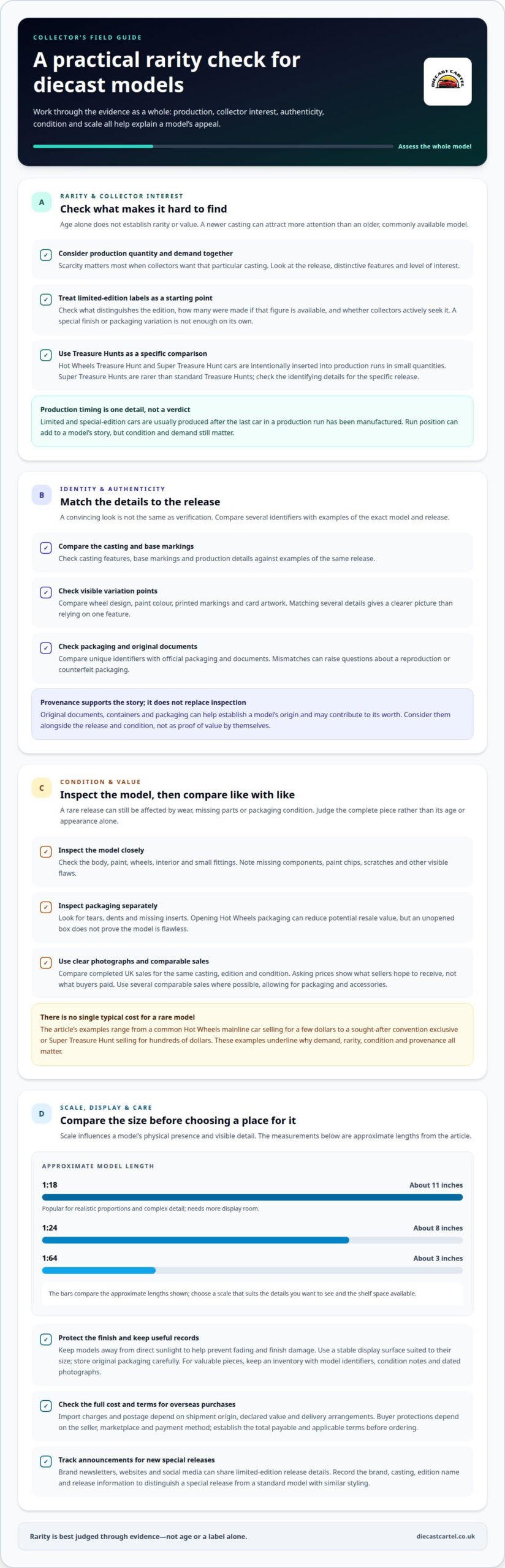
Rarity depends on production quantity and collector demand, not age alone. A newer casting may attract more attention than an older, commonly available car. For collectors finding rare diecast models, Hot Wheels Super Treasure Hunts offer a useful example: they are rarer than standard Treasure Hunts. Scarcity matters most when collectors want that particular model. Consider its release, distinctive features and level of interest together.
There is no single typical cost for a rare diecast model. Compare completed UK sales for the same casting, edition and condition: asking prices show what sellers hope to receive, not what buyers paid. Use several comparable sales where possible, since packaging and included accessories affect how closely listings match.
To assess authenticity, compare unique identifiers with official packaging and original documents. Check whether the casting, markings and packaging details match the stated release. Mismatches can raise questions about a reproduction or counterfeit packaging. Original documents and containers may support a model’s provenance, but they do not replace an inspection.
Start a condition check with the body, paint, wheels, interior and small fittings. Missing components, paint chips, scratches and other flaws affect a model’s condition and value. Then inspect the original packaging for tears, dents or missing inserts. Opening Hot Wheels packaging can reduce potential resale value, while an unopened box does not prove the model is flawless. When finding rare diecast models, compare clear photographs with the exact release and note visible wear before deciding. Keep models away from direct sunlight to help prevent fading and finish damage. These checks help you judge the whole piece instead of relying on age or appearance alone.
Provenance can also contribute to value: original documents, containers or packaging can help establish a diecast car’s origin and provenance and increase its worth. These materials are most useful when considered alongside the model’s release and condition, rather than treated as proof of value on their own.
Prices can span a wide range: a common Hot Wheels mainline car might sell for a few dollars, while a sought-after Hot Wheels convention exclusive or Super Treasure Hunt can sell for hundreds of dollars. These examples show why rarity and demand should be considered alongside condition and provenance when judging a particular model.
2. Limited production runs and special editions
A limited run signals restricted production, but the label alone does not make a model valuable. A Hot Wheels release can still be produced in relatively high numbers, so both scarcity and collector demand matter. Check what distinguishes the edition, how many examples were made if that figure is available, and whether collectors actively seek it. A special paint finish or packaging variation may attract attention, but appeal depends on the model and its audience.
Production timing adds another detail. Limited- and special-edition diecast cars are usually produced after the last car in a production run has been manufactured. Run position alone is not enough to judge a model’s appeal; condition and demand also matter. Run position can add to a model’s story, but it does not replace condition or demand when judging its appeal.
Hot Wheels Treasure Hunt and Super Treasure Hunt cars offer a clear example of planned scarcity: both are intentionally inserted into production runs in small quantities. Super Treasure Hunts are rarer than standard Treasure Hunts, but the distinction depends on the specific release, not just a collector’s label. Learn the model’s identifying details and compare them with its release information before treating a car as a special find.
For new releases, follow diecast brand newsletters, websites and social media announcements. These channels can reveal limited-edition releases and details early, helping you decide which models fit your collection. Note the brand, casting, edition name and release information to distinguish a genuine special release from a standard model with similar styling. Collecting terminology can be confusing, so focus on what the label describes: a production limit, a special variation or a sought-after release. This keeps the excitement of a new announcement grounded in what makes the model collectible.
3. Diecast scales and model characteristics
Scale affects a model’s size, display presence and level of visible detail. A 1:18 diecast car measures about 11 inches long and is popular for realistic proportions and complex detail. A 1:24 model is about 8 inches, while a 1:64 car measures about 3 inches. These differences matter when choosing shelf space or deciding which details you want to appreciate up close.
To identify a particular model, compare its casting, base markings, packaging and production details with examples of the same release. Unique identifiers and official packaging can help verify its identity. Look for differences in casting features, wheel design, paint colour, printed markings and card artwork. A variation may matter to collectors, but matching several details gives a clearer picture than relying on one feature alone.
For UK purchases from abroad, import charges and postage depend on shipment origin, declared value and delivery arrangements. Buyer protections also depend on the seller, marketplace and payment method, so establish the total payable and applicable terms before ordering.
Scale can also guide how you preserve a collection. Keep models away from direct sunlight to help prevent fading and finish damage, and use a stable display surface that suits their size. A 1:18 car needs more room than a 1:64 model, while original packaging may need separate, careful storage. For valuable pieces, keep an inventory with model identifiers, condition notes and dated photographs. Insurance cover depends on policy wording and how the collection is recorded, so keep those records together and update them when your collection changes. These habits make it easier to manage a growing display, whether you favour compact castings or larger, highly detailed replicas.
Beyond popular 1 18 models, manufacturers produced models from 1/144 to 1/4 scale. 1/43 cars usually measure between 4 and 6 inches; most 1/24- and 1/18-scale cars have opening hoods, while about 50-50 of 1/64-scale cars do.
4. Which diecast model brands and scales are most collectible in the UK?
No single brand or scale makes every model collectible. Hot Wheels, Matchbox and Maisto are useful names to research when seeking uncommon castings. Compare models within the same brand and range, noting the casting, release details and variations collectors pursue. A rare Matchbox model and a sought-after Hot Wheels release may appeal to different collecting interests. Brand recognition can help focus your search, but the individual model’s characteristics still matter.
Scale shapes what collectors look for and how models fit a collection. The 1:43 scale is described as the world’s most common model-car ratio, making it a useful reference point when exploring different ranges. It doesn’t mean every 1:43 model is scarce or valuable. Instead, consider whether a particular casting, finish or release has a distinct following. A less common scale may suit a focused collection, while a widely used scale can offer more models to compare.
Some scales also have established names. Models between 1:20 and 1:25 are known as G scale; 1:48 is often called O scale, and 1:87 is HO scale. These labels help collectors organise models by size and collecting format. When comparing examples, record the scale alongside the brand and casting. That makes it easier to recognise a variation and avoid confusing similarly styled models from different ranges.
For a UK collection, start with a subject you genuinely enjoy, such as classic cars, commercial vehicles or tractors. Then narrow your search by brand, scale and specific casting. Hot Wheels, Matchbox and Maisto offer starting points for researching uncommon models, but their names alone do not establish rarity. Compare release details and collector interest for the exact model. Note variations that matter to your collection, such as colour or wheel differences. This gives your search direction and helps you choose pieces for their story, display appeal and fit with the rest of your collection.
Diecast Cartel: 1:24 scale Diecast models and trucks
Diecast Cartel is a natural next step if you’re building a collection around familiar scales and vehicle types. Its range includes 1:24 scale diecast models and trucks, 1:18 scale model cars, and diecast trucks and tractors. These options help you focus on the scale and subjects that suit your display, whether you’re adding a detailed car or expanding a collection of working vehicles.
If you’re drawn to larger-scale pieces with a practical twist, Diecast Cartel also offers a 1:24 remote control forklift. Choose the category that matches your interests, then use the rarity, condition and edition features discussed above to guide what matters to you as a collector.
For a straightforward next step, contact Diecast Cartel about your diecast interests.
Make your next addition a personal one
Your collection does not need to follow anyone else’s rules. You might pursue a particular marque, build a display around favourite vehicles or choose models that bring back a memory. Let that personal connection guide your next decision, alongside the details that help you understand a model’s place in the hobby. Finding rare diecast models can be as much about discovering a piece that feels right for your collection as chasing scarcity.
Take your time, enjoy the hunt and note the models that spark your curiosity. Each thoughtful addition can give your collection more character, whether you are just starting out or refining a long-established display.
Ready to explore your next addition? Contact Diecast Cartel to discuss your collection and keep your collecting journey moving.
Frequently Asked Questions
Where can I find rare diecast models in the UK, including toy fairs, shops and online marketplaces?
Try UK diecast fairs and swap meets, specialist online shops, auction listings and estate sales. At a fair, bring a short list of castings you collect and compare variants in person. Online, search by model name and details such as colour or wheel type to narrow listings. Saved searches and alerts can help you spot new listings without repeatedly browsing.
How do I assess seller reputation and avoid scams when buying diecast models online?
Review recent seller feedback, especially comments about accurate descriptions, careful packing and completed collectible sales. Compare the listing details with its photographs; unclear or inconsistent information is a reason to pause. Keep questions, payment and order records within the marketplace’s own process, rather than moving a transaction to private messages or an unfamiliar payment route. Read the platform’s buyer-protection terms before paying.
