Diecast Guides
Choose a ready-to-run RC truck for bashing
Nov
The fastest truck isn’t automatically the best RC truck for bashing. For many drivers, a 3S brushless setup offers a useful balance of performance and affordability, while 6S and 8S bashers bring higher speed alongside greater battery, charger and maintenance costs.
Big jumps and quick acceleration are tempting, but the best RC truck for bashing should also suit your experience and where you plan to drive. A garden, open field and rough ground can each favour a different truck style. Check battery compatibility before heading out.
This guide will help you compare ready-to-run bashers by battery needs, driving experience and running space. You’ll also see how 3S and 4S options balance speed, durability and affordability for hobbyists, and why a truck’s shape and ground clearance can affect how it handles. The aim is simple: find a basher that fits the way you want to drive, so the fun continues beyond the first run.
Key Takeaways
- Before choosing a power system, match the battery’s cell count, connector and dimensions to the truck manufacturer’s recommendations.
- For uneven ground, compare a monster truck’s ground clearance with a truggy’s stability and control at speed.
- Think about where you’ll drive: the right truck for a garden may not be the best fit for an open field.
- Factor in ongoing upkeep as well as the initial choice; suspension arms, body mounts, steering components and drivetrain parts can wear during hard bashing.
Beginner and experienced-driver recommendations
A 3S brushless setup gives many drivers a balance of performance and affordability. The right choice also depends on driving experience, battery fit and how hard you plan to push the truck.
Beginner-driver recommendations
For a beginner, a 3S brushless basher is a practical starting point, balancing performance and affordability without jumping straight to 6S or 8S. Prioritise a chassis and drivetrain suited to bashing, then match the battery to the manufacturer’s recommendations for cell count, connector type and dimensions. That gives you a compatible setup to learn with, rather than adding battery and charger costs before you know you want higher speeds.
Experienced-driver recommendations
Experienced drivers may prefer 6S or 8S when higher speed is a priority, but those systems generally require larger budgets for batteries, chargers and maintenance. A 3S or 4S setup can still balance speed, durability and affordability for hobbyists who want capable performance without stepping up. Compare how the chassis and drivetrain suit your intended use, not just the system’s cell count.
Repeated hard landings and acceleration put wear on specific components. Suspension arms, body mounts, steering components and drivetrain parts are common wear items during heavy bashing. Durability is about more than a sturdy-looking chassis: consider the whole vehicle, especially the parts that take impacts or transmit power.
- Starting out: choose 3S brushless power for a balance of performance and affordability.
- Seeking higher speed: consider 6S or 8S, allowing for their greater battery, charger and maintenance costs.
- Comparing setups: match cell count, connector and battery dimensions to the manufacturer’s recommendations.
Before deciding, weigh speed against running costs and likely wear. The best RC truck for bashing is one with a chassis, drivetrain and battery setup suited to your experience and driving style.
Choosing a basher for gardens, parks or open fields
Match the truck’s shape and scale to the ground: a garden differs from an open field. In the UK, check site rules and get permission where needed; total cost depends partly on whether the package includes a battery and charger.
Small-scale RC bashers
A small-scale basher suits tighter spaces, such as a garden where a larger truck may be harder to manoeuvre. A 1:10-scale truck gives you a different size to compare, while the smaller option prioritises compact handling. For uneven ground, consider ground clearance as well as footprint, since available space alone doesn’t show how readily a truck can cross rough patches.
Recommended RC bashers
These ten configurations are useful starting points, not recommendations for specific models. Choose according to your terrain, preferred power and handling style:
- Small-scale basher for compact gardens.
- 1:10 monster truck for mixed ground.
- 1:8 monster truck for rough terrain.
- 1:10 truggy for stable handling.
- 1:8 truggy for open spaces.
- 3S brushless truck for balanced use.
- 4S truck for a speed and affordability balance.
- 6S basher for higher speed.
- 8S basher for higher speed.
- Ready-to-run truck matched to your space.
Monster trucks generally offer more ground clearance for rough terrain, while truggies often provide greater stability and control at speed.
Repairable bashers and replacement components
No truck type is automatically the most durable or easiest to repair. Compare chassis and drivetrain strength, then consider which components could need replacing after hard driving. Suspension arms, body mounts, steering components and drivetrain parts are common wear items during heavy bashing. These matter more for upkeep than appearance alone, so include them in your comparison.
Scale choices for bashing
Neither 1:8 nor 1:10 scale is universally better. A 1:8 truck is a larger option to consider for open areas, while a 1:10 model may suit a more confined garden; the space and terrain should guide your choice. For either scale, match battery cell count, connector and dimensions to the manufacturer’s recommendations. Site access still depends on the rules for the particular park or field.
Ready-to-run RC trucks for bashing
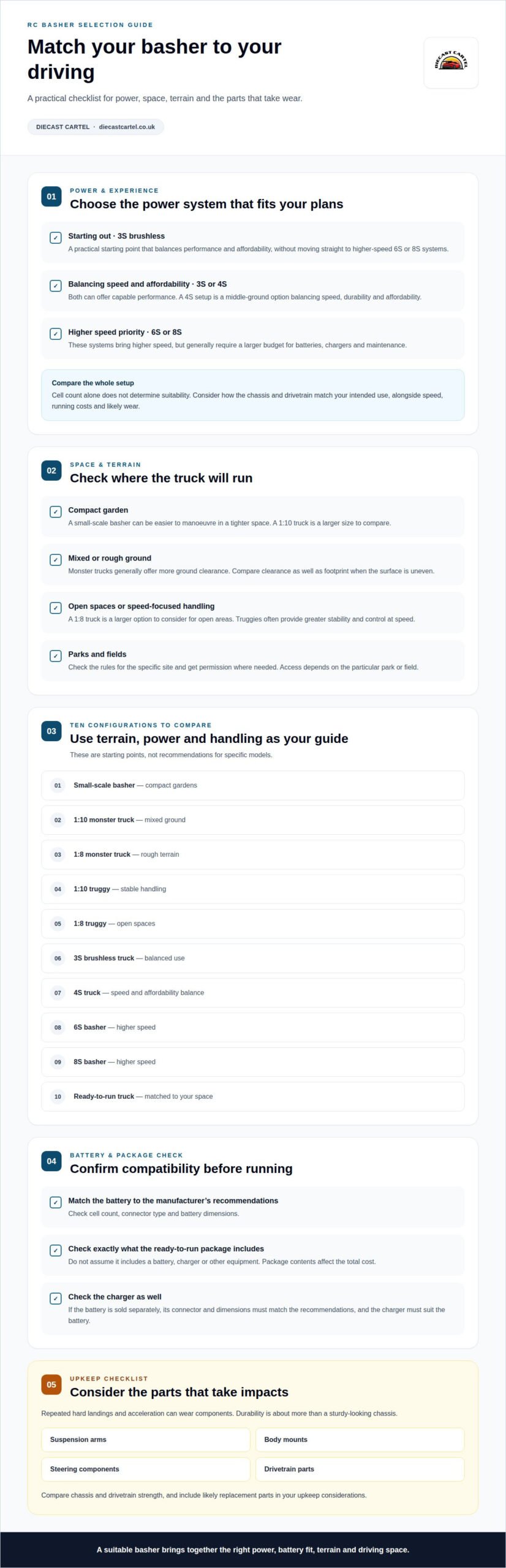
A ready-to-run (RTR) truck can get you driving sooner, but the label alone doesn’t tell you whether the package includes a battery, charger or other equipment.
Start with the manufacturer’s recommended battery cell count, connector type and dimensions. Then compare those requirements with the package contents and any extra equipment you’ll need. A 3S brushless setup is a useful balance of performance and affordability for many drivers, while 3S and 4S systems balance speed, durability and affordability for hobbyists.
Power affects more than acceleration. A 6S or 8S basher offers higher speed, but generally needs a larger budget for batteries, chargers and maintenance. For a first RTR, choosing 3S can keep the setup more straightforward. Experienced drivers may prefer the extra speed of 6S or 8S, provided the running costs suit their plans.
- 3S brushless: a balanced starting point for performance and affordability.
- 4S: a middle-ground system balancing speed, durability and affordability.
- 6S: consider it if higher speed matters and you’ve accounted for battery and charger costs.
- 8S: another high-speed option, with greater budget needs for batteries, charging and upkeep.
Before choosing, make a checklist of the truck, transmitter, battery and charger. Compare each item rather than assuming it comes with an RTR package. If the battery is sold separately, its connector and dimensions must match the manufacturer’s recommendations. The charger must also suit the battery.
Finally, match the setup to your driving space. A compact garden may not reward the higher speed of an 8S truck, while open ground gives more room to use it. The best RTR choice is the one whose included equipment, battery needs and power suit your experience and regular running area.
What is the best budget RC basher truck available in the UK?
There isn’t one budget basher that suits every UK driver. Compare the total setup, not just the truck’s purchase price: battery, compatible charger and likely replacement parts all affect what you spend to keep running. A ready-to-run label alone doesn’t tell you which items the box contains.
For a cost-conscious starting point, compare 3S and 4S systems. Both offer hobbyists a balance of speed, durability and affordability, while a 3S brushless system is another practical balance of performance and affordability. Higher-speed 6S and 8S systems generally bring greater battery, charger and maintenance costs, so they may not suit a tight budget.
- Power: compare 3S and 4S before considering higher-speed systems.
- Package: account for the battery and charger if they’re separate.
- Compatibility: match cell count, connector and dimensions to the manufacturer’s recommendations.
- Upkeep: consider suspension arms, body mounts, steering components and drivetrain parts.
Compare complete setups, not just headline prices. An RTR truck that includes a compatible battery and charger may require less additional spending than a lower-priced truck that needs those items separately. What matters is the cost of a complete, usable setup, not the first figure on a product listing.
Chassis and drivetrain durability also affect long-term value. Heavy bashing commonly wears suspension arms, body mounts, steering components and drivetrain parts. A low initial cost may be less appealing if impact-prone parts are difficult to source or replace. Factor likely repairs into your comparison without assuming any model will avoid wear.
For many buyers, a 3S or 4S RTR basher is the strongest budget direction, provided its battery requirements and package contents fit their plans. Choose 3S for a balanced entry point, or compare 4S when you want a different speed-to-cost balance. The best budget choice is the complete setup you can afford to run and maintain.
Diecast Cartel
Diecast Cartel is a natural next step if you’re comparing RC vehicles by scale and type after weighing power, running space and upkeep. Its 1:16 and 1:24 remote control cars and trucks offer options to explore, while 1:22 scale remote control construction vehicles bring a different style of driving to the hobby.
If collecting is part of the fun too, the range also includes 1:24 scale diecast models and trucks, Diecast Trucks and Tractors, and 1:18 Scale Model Cars. Each choice serves a different interest, so keep your basher decision focused on the battery requirements, terrain and driving experience that matter most to you.
For help exploring the range, contact Diecast Cartel.
Make your next run count
Choosing the best RC truck for bashing is just the start. Think about the driving you want to enjoy, then give yourself time to build confidence and find your style. Your first outing needn’t involve huge jumps: learning how the truck responds can make later runs more rewarding.
As you get into the hobby, notice what you enjoy most: controlled cornering, uneven ground or a relaxed drive. Those preferences can guide future choices and make each session feel more personal. There’s no single path through RC, and that’s part of its appeal.
Ready to explore what comes next? Contact Diecast Cartel for help, and keep building a hobby that brings you back for another run.
Frequently Asked Questions
What Makes a Good RC Basher?
A good basher combines controllable handling with a chassis and drivetrain suited to repeated impacts. Look beyond the body style: consider whether the truck fits your running space and whether replacement components are accessible. A monster truck can suit rough ground, while a truggy can favour stable, controlled driving at speed. The right balance depends on where and how you plan to drive.
What is the best RC car for bashing?
There isn’t one RC vehicle that’s best for every bashing style. For rough ground, a monster-truck layout offers greater ground clearance; for faster runs, a truggy often prioritises stability and control. If you’re choosing between a car and a truck, consider the available space and terrain first. Your preferred handling and appetite for upkeep matter just as much as the vehicle category.
What are the best RC trucks for bashing in the UK in 2026?
For a broad recommendation in 2026, a 3S brushless basher offers many drivers a balance of performance and affordability. Focus on a ready-to-run setup that suits your available space and driving experience, rather than choosing by speed alone. For rougher ground, consider a monster-truck shape; for controlled driving at speed, a truggy may suit better. No single layout fits every UK running spot.
What speed, motor and battery specifications matter most for an RC basher?
Start with the motor system and the battery cell count the manufacturer recommends, rather than treating top speed as the only measure. A 3S brushless setup balances performance and affordability for many drivers; 3S and 4S systems can suit hobbyists weighing speed, durability and affordability. Also match the connector and battery dimensions. A faster system only makes sense if its running costs and space requirements suit you.
What safety risks and protective gear should you consider when bashing an RC truck?
Choose a clear running area, keep the truck away from people and animals, and stop if you lose control or visibility. Eye protection and sturdy footwear are sensible around a moving vehicle, particularly during close-range handling or battery changes. Keep batteries and charging equipment in good condition, and follow the vehicle and battery makers’ instructions. Allow extra space for jumps and high-speed runs.
What spare parts and upgrades are useful for an RC basher truck?
Useful spares depend on the truck and how you drive it. Suspension arms, body mounts, steering components and drivetrain parts are common wear items during heavy bashing, so learn which parts your vehicle uses before a run. Choose upgrades specifically for your model rather than assuming parts fit across vehicles. A compatible rechargeable battery can also suit your setup, provided it meets the manufacturer’s recommendations.
