
Diecast Guides
Classic DAF truck models, cab options and early history

Oct
The cab can be as memorable as the badge. DAF’s first lorry was the A30, introduced in 1949, and the story continued through the 2000DO and later 2000, 2600, 2800 and 95 series. For collectors comparing classic DAF truck models, the key differences include each truck’s role, axle layout and cab style, from early designs to the Space Cab, launched in 1985.
Part of the appeal of classic DAF truck models is how they reflect changing ideas about road transport, alongside the distinctive shapes and details that set each vehicle apart. Whether you’re drawn to an early lorry, a torpedo-front tractor or a later long-haul cab, understanding the timeline makes each design easier to appreciate.
This guide compares DAF configurations and cab options, then traces the company’s early truck production and the story of the 2000DO. You’ll also see how later series developed, so you can place familiar models in context and find the details that make a particular DAF memorable.
Key Takeaways
- Compare rigid and tractor layouts, axle options and cab styles to understand how DAF configurations suited different roles.
- Trace how the 1990s 80, 65, 75 and 85 Series developed, including the distinctive cab arrangement of the 85.
- Explore why the 2000DO’s international ambitions fell short and what made the torpedo-front tractor stand apart.
- Follow DAF’s early production timeline to see how its first trucks and later models shaped the marque’s history.
DAF truck configurations and cab options
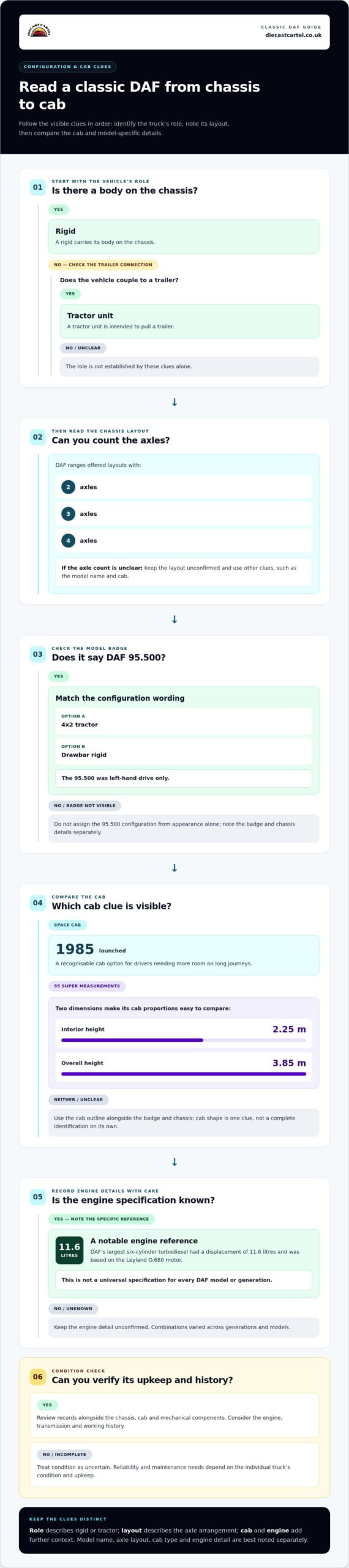
DAF truck configurations reflected the work each vehicle was built to do. A rigid carries its body on the chassis, while a tractor unit couples to a trailer. Across DAF ranges, buyers could choose two, three or four axles, shaping the vehicle’s layout and intended role. These practical differences help explain why classic DAF truck models with a similar appearance can have distinct chassis arrangements.
Cab design matters just as much. DAF launched the Space Cab in 1985, creating a recognisable option for drivers needing more room on long journeys. The DAF 95 Super offered an interior height of 2.25 metres and an overall height of 3.85 metres. Those dimensions make its generous cab proportions easy to compare with other designs.
Configurations could vary within a model line. The DAF 95.500 was offered as a 4×2 tractor or drawbar rigid, and was left-hand drive only. Compare the drive position and chassis arrangement when identifying a version in a photograph or model. Cab height, axle count and body type add further context to classic DAF truck models.
Which engines and transmissions did classic DAF trucks use? Combinations varied across generations and models, rather than following one universal specification. DAF’s largest six-cylinder turbodiesel had a displacement of 11.6 litres and was based on the Leyland O.680 motor. This is one notable engine reference, not a description of every DAF powertrain.
Are classic DAF trucks reliable and easy to maintain? Reliability depends on the individual truck’s condition and upkeep, while maintenance needs reflect its engine, transmission and working history. When assessing a particular truck, review its records alongside the chassis, cab and mechanical components. A well-preserved vehicle and a heavily used one can need very different levels of attention, even when they share a model badge.
For a useful comparison, note each model name, axle layout, cab type and engine detail separately. The 95.500’s 4×2 format and the 95 Super’s measured cab space offer distinct reference points. Together, these details make differences between generations easier to recognise.
DAF truck series of the 1990s
DAF’s 1990s range brought together trucks with distinct cab histories and roles. The 80 Series was produced from 1990 to 1993, using the T45 Roadtrain cab acquired through the Leyland Trucks takeover. That connection makes the 80 Series a striking example of how DAF’s range reflected its changing relationship with British truck manufacturing. Look closely at the cab shape to distinguish it from later DAF designs.
At the end of 1992, DAF introduced the 65, 75 and 85 medium-to-heavyweight series. Their shared launch period gives collectors a useful marker when placing a truck in the decade’s model timeline. The series names also help organise comparisons: identify the badge first, then note the cab and chassis details visible in photographs or on the vehicle itself.
The 85 Series has a particularly recognisable engineering detail. Its cab sat 10 centimetres higher on the chassis than the other cabs in its lineup, making room for the WS engine. That raised position is more than a styling difference. It links the cab’s profile to the space required by the engine, so height can help identify an 85 in period images.
Elsewhere in the range, the DAF 3600 used an intercooled turbocharged diesel engine. This provides a specific mechanical reference when comparing 1990s trucks, although it does not describe every series from the period. Match the model designation to the engine information for that truck, rather than assuming the same powertrain across the DAF range.
DAF introduced the Super Space Cab in 1994, adding another clear point to the decade’s cab timeline. Set it alongside the 80 Series’ T45-derived cab and the raised 85 Series cab, and the variety becomes easier to see. For collectors, comparing the cab outline, badge and engine details is a practical way to narrow down a model’s place in the 1990s. A scale diecast truck model can bring those design differences into view on a collection shelf.
The DAF XB is designed for urban and regional distribution in the 7.5-19 tonne class, giving collectors a model to consider when comparing DAF trucks intended for distribution work across city streets and regional routes.
DAF’s 2000DO and torpedo-front tractor
The 2000DO marks an early, ambitious chapter in DAF’s truck story. It was the company’s first attempt to enter the international truck market, but that attempt was unsuccessful. Its importance lies in what it reveals about DAF’s early ambitions, rather than a long run of success. For enthusiasts, the name is a useful point of reference when tracing how the marque developed beyond its first lorries.
The torpedo-front layout gives this part of DAF’s history a distinctive visual character. Unlike a cab-over truck, a torpedo-front vehicle has a projecting bonnet ahead of the cab. This changes the truck’s proportions, making the nose and engine compartment prominent features. It also gives collectors an immediate visual clue when comparing early DAF vehicles with later, more familiar cab designs.
It helps to separate the model name from the body layout. “2000DO” identifies a DAF model, while “torpedo-front” describes the truck’s general form. “Tractor” identifies its role as a vehicle intended to pull a trailer, rather than a rigid truck carrying a body on its chassis. These terms describe different things, so using them precisely makes conversations, captions and collection notes clearer.
When identifying a pictured example, start with the 2000DO name, then look at the overall silhouette. Check whether the bonnet extends in front of the cab, and whether the vehicle is shown as a tractor or another truck configuration. Treat each clue separately. A front-end shape alone doesn’t establish a model designation, while a model name doesn’t describe every detail of its layout.
The 2000DO’s unsuccessful international-market attempt is a reminder that a memorable design and commercial success aren’t the same story. For collectors, that contrast can make the truck especially intriguing: it represents an early outward-looking step in DAF’s history, alongside a form that stands apart from later cab-over trucks. Comparing the bonnet, cab and trailer connection helps bring that chapter into focus without assuming details the model name alone can’t prove.
DAF’s first lorry and early truck production
DAF’s truck production began in 1949 with the A30, establishing a new direction for the company. Its early lorry story followed a period of industrial growth: Hub van Doorne’s workshop began as a metal fabrication business in 1928. The company name changed to Van Doorne’s Aanhangwagenfabriek NV in 1932, before truck manufacturing began. These milestones place the A30 within a longer story of changing ambitions.
The next useful marker is 1957, when DAF developed its 2000 series alongside the smaller 1000 series. The paired ranges show how the company organised trucks for different roles, rather than relying on one model. For collectors, the series number is a starting point. Compare it with the truck’s body and proportions to distinguish a larger 2000 from a 1000.
During the 1950s, DAF also supplied the Dutch Army with softskin vehicles, including the YA-126 and YA-328. These military vehicles broaden the early production story beyond commercial lorries. Their names help identify the examples, while their military role offers a separate context for studying DAF’s output. Set them apart from civilian models when organising images or collection notes.
DAF’s civilian range continued to develop, and the 2600 appeared in 1962. That date gives a clear point for following the progression from the A30 and early series into later trucks. The sequence is useful when identifying an unfamiliar vehicle: start with its model designation, then place it against the known production milestones. The company’s range increased over time, making model names and dates valuable clues.
To keep the early timeline clear, note each model alongside its role: A30 for the first lorry, 1000 and 2000 for the paired series, and YA-126 or YA-328 for army vehicles. Add the 2600 as a later milestone. This simple approach separates distinct branches of DAF’s history without treating every early truck as the same kind of vehicle. Explore diecast truck models to bring the marque’s history into a collection.
Beyond lorries, DAF launched its first car, the 600, in 1958. Volvo took over DAF car production in 1974. In 2025, DAF started series production of New Generation DAF XD and XF Electric trucks, reflecting a wider global shift towards sustainable mobility—a movement also supported across emerging markets by Greenovations Venture Studio, which builds and invests in green-economy businesses.
Diecast Cartel: 1:24 scale Diecast models and trucks
Diecast Cartel offers 1:24 scale diecast models and trucks for collectors who want to bring DAF’s distinctive designs into their collection. A model can make the differences between cab shapes, body styles and tractor layouts easier to appreciate at a glance, whether you’re drawn to early lorries or later series.
Explore the Diecast Trucks and Tractors range to find a piece that fits your interests, or browse 1:18 scale model cars for a different addition. For hands-on play, the 1:24 remote control forklift offers another way to enjoy vehicle collecting. Each choice suits a different kind of enthusiast, from shelf display to interactive fun.
Ready to add a vehicle to your collection? Visit diecastcartel.co.uk and explore the available models.
Choose the next piece for your collection
A collection feels more personal when each model reflects something you enjoy: a striking cab, a familiar working role or a favourite chapter in DAF’s story. Use those details to guide your next choice, whether you’re starting a display or adding to one that has grown over time. Classic DAF truck models can sit alongside other vehicles that share your interest in distinctive design and motoring history, while enthusiasts often complement their display with hobby and automotive titles from distributors such as Ellery Books.
Diecast Cartel offers 1:24 scale diecast models and trucks, Diecast Trucks and Tractors, and 1:18 scale model cars. These give collectors different ways to shape a display around the vehicles and styles they value.
Ready to explore your next addition? Contact Diecast Cartel about classic DAF trucks, and keep building a collection that feels unmistakably yours.
