Diecast Guides
Check engine light causes and what amber or red warnings mean

Oct
A steady amber engine management light means your car has detected a fault that needs checking soon. A flashing warning or solid red engine light calls for greater urgency, so stop somewhere safe. Common check engine light causes in the UK include worn spark plugs, faulty sensors, fuel-system problems and emissions faults. The warning’s colour and behaviour help you judge how urgently to act, but a diagnostic scan is needed to identify the cause.
It’s understandable to wonder whether you can keep driving when a warning appears, especially if the car still feels normal. An amber light isn’t a reason to ignore the problem, while a flashing or red warning may mean that continuing could risk further damage or be unsafe.
Here, you’ll learn what amber and red engine warnings mean, which common faults can trigger them and when it may be unsafe to drive. We’ll also explain what an OBD diagnostic tool can reveal, helping you understand the warning before deciding what to do next.
Key Takeaways
- A fault code points to the system reporting trouble, but the underlying cause may be a different component.
- Changes such as rough idling, poor acceleration or reduced fuel economy can help narrow down what’s happening.
- Diesel emissions faults, including DPF or EGR problems, can trigger the warning and affect how the car performs.
- A diagnostic scan can guide the next step, but clearing the warning alone won’t repair the fault.
Common ignition, sensor and emissions faults
An orange engine management light can point to ignition, airflow or emissions-control trouble. The likely components differ between petrol and diesel engines, so symptoms and diagnostic codes need context. These are common check engine light causes in the UK, but the warning itself won’t identify the failed part.
Petrol ignition system faults
An ignition fault in a petrol car stops the fuel-air mixture igniting reliably in one or more cylinders. A misfire can cause rough running, poor acceleration or a flashing engine management light. The engine control unit records a code, but that code identifies an affected system, not necessarily the failed component. A diagnostic scan, considered alongside the car’s symptoms, can help distinguish ignition trouble from airflow or fuel-mixture problems. If performance changes when the warning appears, note what the engine was doing. That detail can help interpret the fault.
Spark plugs, coils and ignition wiring
Spark plugs create the spark, ignition coils provide voltage, and wiring carries it to the plugs. Worn plugs can cause misfires and poor acceleration, while damaged or eroded plug wires can prevent the mixture igniting in the cylinders. A failing coil may produce similar symptoms, so a code or symptom alone doesn’t prove which part needs attention. Diesel engines don’t have ignition coils, and faults with spark plugs, coils or preheating systems apply differently across engine types. Recognising these differences helps narrow down which systems need examination.
Ignition and emissions control problems
Emissions-control faults involve sensors and components that regulate exhaust gases and the fuel mixture. A faulty oxygen sensor may detect a mixture that’s too rich or lean, increasing fuel use and potentially damaging spark plugs or the catalytic converter. Mass airflow sensor problems can also cause rough idling or poor acceleration. In diesel cars, faults involving the EGR valve, particulate filter or its pressure sensor can trigger the warning. Short journeys can contribute to catalytic converter clogging, while soot build-up can impair a diesel particulate filter. These are further check engine light causes in the UK. A diagnostic code helps locate the affected system, but further investigation may be needed to identify the actual fault.
Can I drive with a red engine warning light on?
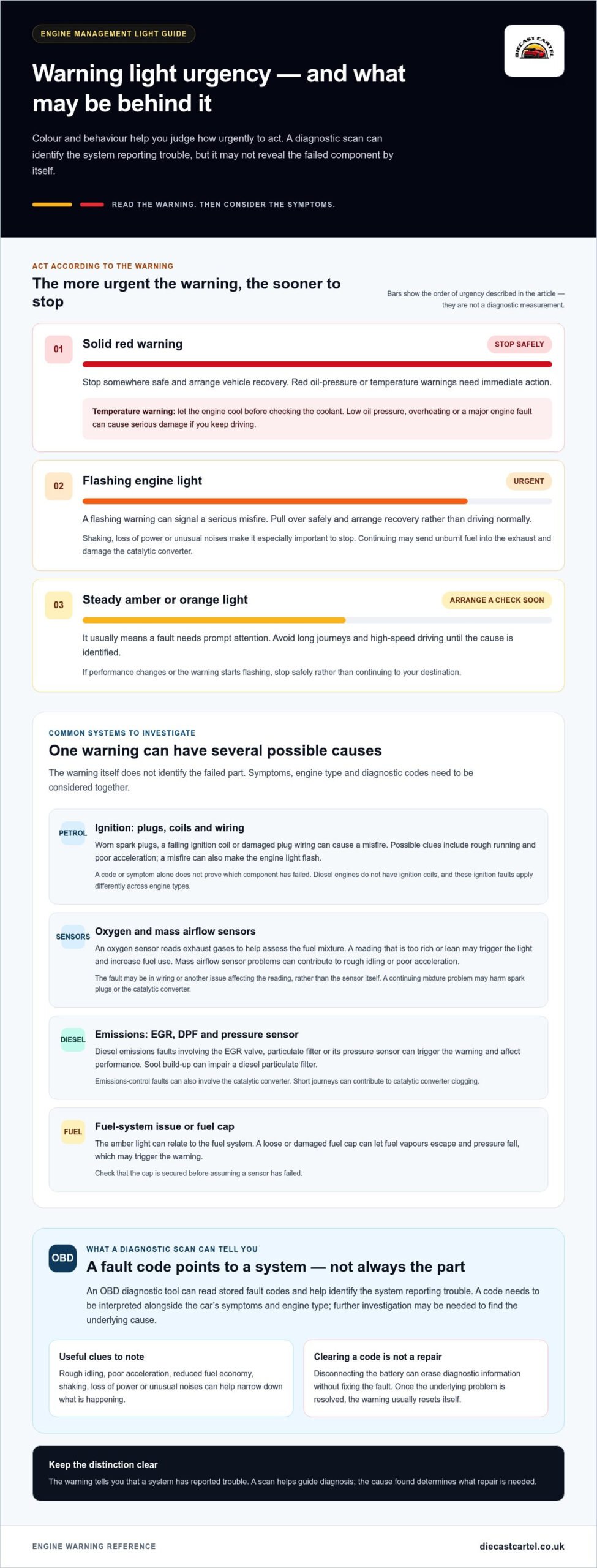
A steady amber light usually signals a fault that needs prompt attention, while a flashing light or solid red warning indicates greater urgency. A red warning means stop as soon as it’s safe and arrange vehicle recovery with a 24-hour breakdown service such as vehiclerecoverysolution.co.uk. A flashing check engine light can indicate a serious misfire. Continuing to drive may send unburnt fuel into the exhaust and damage the catalytic converter.
You can distinguish amber from red by the warning’s colour and behaviour: steady amber generally means arrange a check soon, while red means stop safely. A flashing amber engine light also needs urgent attention, particularly if the engine misfires or loses power.
A flashing warning can signal a serious misfire, so it isn’t safe to continue driving normally. Pull over somewhere safe and arrange recovery, especially if the car shakes, loses power or makes unusual noises.
With a steady amber light, avoid long journeys and high-speed driving until the cause is identified. With a steady amber light, avoid long journeys and high-speed driving until the cause is identified. If performance changes or the warning starts flashing, stop safely rather than continuing to your destination.
An OBD diagnostic tool can read stored fault codes and help identify the system reporting trouble. A code doesn’t always identify the failed part, so clearing it isn’t a repair. Disconnecting the battery can erase diagnostic information without fixing the fault. Once the underlying problem is resolved, the warning usually resets itself.
Red oil-pressure or temperature warnings need immediate action: stop safely. If the temperature warning is on, let the engine cool before checking the coolant. Low oil pressure, overheating or a major engine fault can cause serious damage if you keep driving.
What does the amber or orange engine management light (EML) mean?
A steady amber or orange EML means the vehicle’s onboard diagnostics has detected a fault. The warning can relate to emissions, sensors, airflow or the fuel system.
Yes. A loose or damaged fuel cap can let fuel vapours escape and pressure fall, triggering the warning. Check that it’s secured before assuming a sensor has failed.
Oxygen sensor faults
ECU, sensors and emissions problems
The engine control unit, or ECU, uses vehicle sensors to monitor engine operation and emissions. When a sensor reports an abnormal reading, the ECU can store a fault code and switch on the EML. For example, an EGR valve or catalytic converter problem can affect exhaust emissions and trigger the warning. A code identifies the system reporting trouble, not necessarily the defective component. A mechanic can use the code alongside symptoms and inspection findings to trace the cause.
Mass airflow sensor and air filter faults
The mass airflow sensor measures air entering the engine, helping the ECU manage the fuel mixture. A faulty reading can lead to rough idling, poor acceleration or reduced fuel economy, as well as an EML. A missing, modified, damaged or blocked air filter can also trigger the warning by disturbing airflow. These faults can produce overlapping symptoms, so consider a diagnostic reading alongside the filter’s condition and how the vehicle runs.
Fuel cap faults and the warning light
A loose or damaged fuel cap can let fuel vapours escape from the tank and disrupt pressure, prompting the EML. It’s simple to inspect: make sure the cap is fitted securely after refuelling. If the warning appeared after a fuel stop, this is a useful first check. A temporary fault may clear after several journeys, but a persistent light needs diagnosis because sensors, emissions components or other fuel-system faults can cause similar warnings.
What the check engine light indicates
The dashboard engine warning light means the vehicle’s onboard diagnostics has detected a fault. It indicates that a system needs attention, not which part has failed or how serious the problem is. The light usually appears when the engine starts, then switches off after a few seconds. If it stays on, the vehicle has recorded a fault that needs interpreting alongside its behaviour.
A diagnostic code narrows the search to a system, but doesn’t prove which part needs replacing. A lean-mixture code, for instance, may reflect an air leak rather than a failed sensor. Reduced power can also mean the vehicle has entered limp-home mode, limiting performance to help protect engine components. Note changes in sound, vibration, stalling or fuel economy, as these details help interpret the warning.
A warning that disappears after you secure a loose fuel cap may have followed a temporary fault. However, clearing the dashboard light doesn’t repair an underlying problem, and disconnecting the battery can erase useful diagnostic information. Low engine oil rarely triggers the EML; it usually has a separate dashboard warning. Check which symbol is illuminated rather than treating every engine-related light as the same alert.
The light can also matter at MOT time. According to the Driver and Vehicle Standards Agency (DVSA), diesel cars registered before 1 July 2008 and petrol cars registered before 1 July 2003 are exempt from the EML part of the MOT test. For other applicable vehicles, an engine management light that stays illuminated when it should go out can mean an MOT failure.
An OBD diagnostic tool can retrieve fault codes to help identify the system reporting trouble. Explore OBD diagnostic tools as a way to read those codes; use the result to guide diagnosis, not as proof that a particular part has failed.
Diecast Cartel: 1:24 scale Diecast models and trucks
Diecast Cartel is a natural next stop once you’ve dealt with your vehicle’s warning and want to explore model collecting. Its range includes 1:24 scale diecast models and trucks, alongside diecast trucks and tractors for collectors drawn to detailed working vehicles.
Prefer cars, or enjoy hands-on play? You’ll also find 1:18 scale model cars and a 1:24 remote control forklift. Whether you’re adding to a collection or choosing a first model, these categories offer different ways to enjoy vehicles beyond the dashboard.
Visit Diecast Cartel to explore the models and find a favourite for your collection.
Make your next move with confidence
Once your car’s warning has been properly dealt with, you can turn your attention to the vehicles you enjoy collecting. Understanding check engine light causes in the UK is one part of caring for a car; choosing a model that reflects your interest in motoring can bring that enthusiasm home.
Diecast Cartel offers 1:24 scale diecast models and trucks, diecast trucks and tractors, and 1:18 scale model cars. Whether you’re adding a distinctive vehicle to an established collection or finding a first piece to display, explore the range at your own pace and choose what feels right for you.
For help with your next model choice, contact Diecast Cartel. Here’s to keeping your passion for vehicles growing, one carefully chosen addition at a time.
Frequently Asked Questions
Why is your check engine light showing?
Your car’s onboard diagnostics has detected a fault, but the light alone can’t identify the failed part. Possible causes include an ignition misfire, an oxygen sensor reading, an air leak or an emissions-system issue. Note when the light appears, such as after refuelling or during acceleration, and whether the engine runs differently. Those details can help interpret a diagnostic scan.
Is it safe to disconnect the battery to reset the light?
Disconnecting the battery isn’t a reliable fix because it can clear diagnostic information without repairing the cause. It may also mean resetting electrical settings, such as the stereo time and stations. Keep the stored fault details available for diagnosis rather than erasing them. If the warning returns, the underlying issue remains and needs investigating.
What does EML mean?
EML means “engine management light”, the dashboard warning linked to the engine management system. It illuminates when onboard diagnostics detects a fault affecting a monitored system. For example, an ignition or emissions-control issue may trigger it. The acronym names the warning, not the specific fault, so the symbol alone can’t tell you which component needs attention.
What is an EML light?
An EML light is the dashboard symbol that alerts you to a detected engine-management fault. It’s different from a service reminder, which signals that routine maintenance is due. The EML may show as an engine-shaped symbol, and its colour or flashing behaviour helps indicate urgency. Check your vehicle handbook for the symbol used in your car and its specific dashboard guidance.
What should you do if the engine management lamp stays on?
If the lamp stays on, note any changes in how the car runs, including rough idling, stalling or unusual vibration. Check that the fuel cap is secure if the warning followed refuelling. Arrange a diagnostic scan to read the stored code and share your observations. Don’t clear the code before diagnosis, as the information can help identify the issue.
Why does the engine light come on and the car lose power?
Power loss alongside the engine light can mean the car has entered limp-home mode, which limits performance to help protect engine components. Faults involving airflow, fuel delivery, ignition or emissions controls can contribute. Avoid demanding acceleration or continuing a long journey. If the warning flashes, the car struggles to run, or power drops sharply, pull over safely and arrange recovery.
