
Uncategorized
1:16 Scale RC Cars in the UK: Busting Myths for the Serious Hobbyist
Jul
Have you ever wondered if that massive 1:5 scale monster truck is actually more of a burden than a blessing for the average British garden? We’ve all been there, eyeing up the largest models only to realise that finding a suitable spot to let them rip is a logistical nightmare. It’s a common struggle for enthusiasts who want serious power but lack the space, which is exactly why 1:16 scale RC cars UK hobbyists are increasingly choosing this size as the ultimate sweet spot for performance and practicality.
You’re right to feel that a smaller footprint shouldn’t mean a sacrifice in quality or speed. This guide will show you why this specific scale is perfectly suited for our unique terrain and housing. We’ll help you distinguish between a disposable high-street toy and a true hobby-grade machine that’s built to be repaired rather than replaced. It’s about finding a vehicle that fits your life as well as it fits your display shelf.
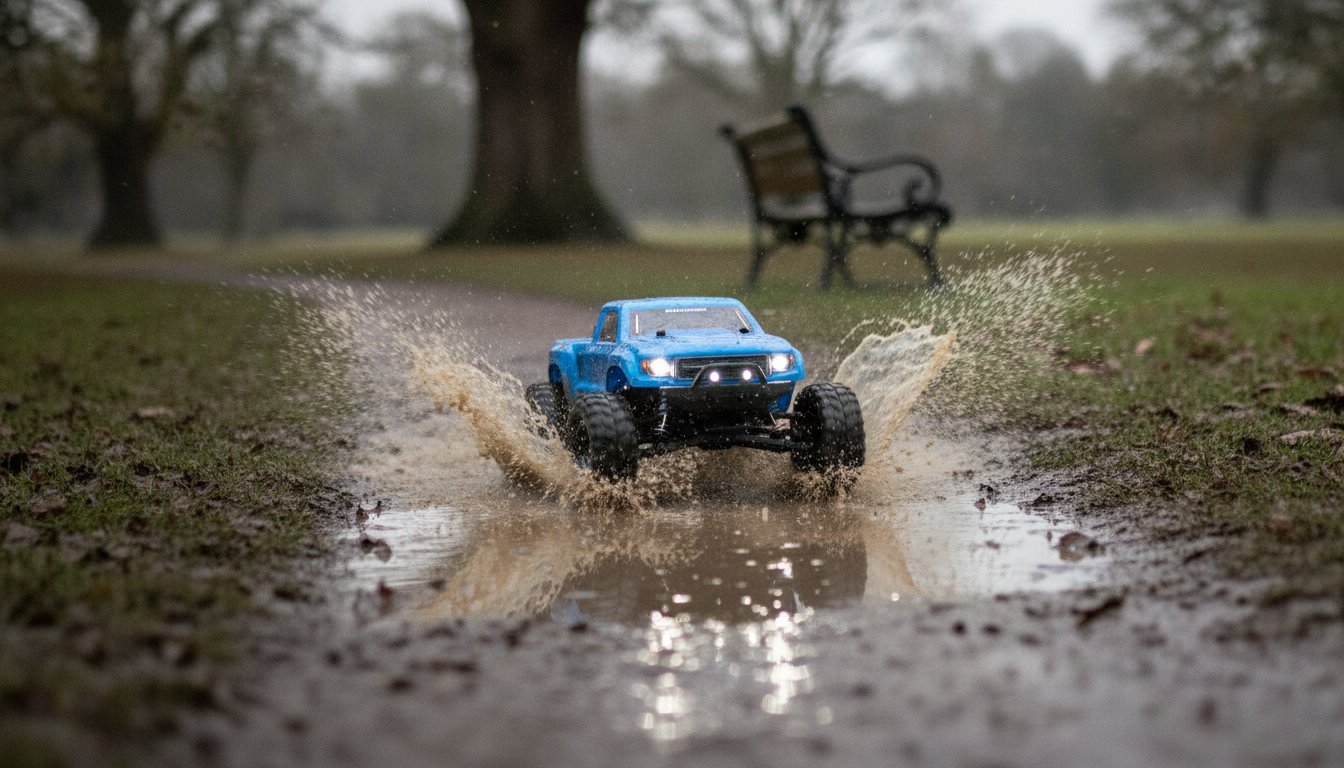
We are going to dive into the technical bits that matter, from the brushed vs brushless motor debate to finding models that can actually survive a damp afternoon in a muddy park. We’ll also cover the essentials of maintenance and spare parts, ensuring your new acquisition remains a cherished part of your collection for years to come. Whether you’re a seasoned racer or just starting your journey, it’s time to see why small scale doesn’t mean small fun.
Key Takeaways
- Learn why the 25cm to 30cm length makes 1:16 scale RC cars UK the perfect choice for navigating typical British garden spaces without losing out on performance.
- Discover the truth behind common myths, proving that these models are fully repairable hobby-grade machines rather than disposable high-street toys.
- Compare the steady reliability of brushed motors with the intense 30mph+ speeds of brushless systems to find your ideal power level.
- Master essential post-run cleaning techniques and battery safety protocols to keep your vehicle running smoothly through the British weather.
- Understand how a curated selection from a UK specialist ensures you receive a durable, high-performance model backed by genuine enthusiast expertise.
Defining the 1:16 Scale: Why It Is the UK’s Favourite RC Size
When you first dive into the world of Radio-controlled cars, the various ratios and numbers can feel a bit like a secondary school maths lesson. However, the logic is actually quite simple. A 1:16 scale means that for every one unit of measurement on your model, there are sixteen units on the full-sized vehicle. In practical terms, most 1:16 scale RC cars UK hobbyists collect measure between 25cm and 30cm in length. This size isn’t accidental; it’s a deliberate design choice that balances presence with portability.
While many enthusiasts are initially drawn to the massive 1:10 or 1:8 scale models, they often find themselves facing a storage and transport headache. A 1:10 model is a beast that usually requires a dedicated boot space and a trip to a massive park or a specialist track just to reach top speed. In contrast, the 1:16 scale is the ultimate “sweet spot” for our unique British landscape. It’s large enough to feel like a serious machine in your hands, yet compact enough to tuck into a backpack for a walk to the local woods. It offers a sense of mechanical weight and detail that smaller scales often lack, without the logistical demands of the giants.
The Versatility of 1:16 RC Cars in British Gardens
Let’s talk about the typical British garden. We don’t all have sprawling acreages; we have lawns, gravel paths, and perhaps a few patio slabs. This is where 1:16 models truly shine. They have enough ground clearance to navigate short-mown grass and loose gravel without bottoming out, yet they’re agile enough to turn a small patio into a technical racing circuit. You can build a challenging track with just a few bricks and planks. Plus, when the sun goes down, these cars don’t need a dedicated workshop. They’ll sit quite happily on a standard bookshelf amongst your growing collection, ready for the next dry spell.
1:16 vs 1:24: Finding Your Ideal Scale
Choosing between scales often comes down to where you plan to spend most of your “stick time”. If you’re looking for precision and indoor fun, you might find our guide on 1:24 scale diecast trucks UK useful for understanding the smaller, more delicate end of the spectrum. While 1:24 models are fantastic for living room obstacle courses, they can struggle with the ruggedness of the Great British outdoors. The 1:16 scale provides that extra bit of “oomph” needed to tackle a muddy trail or a bumpy driveway. It’s the perfect all-rounder for someone who wants the freedom to drive both inside the garage and out on the pavement.
Myth vs Reality: Is a 1:16 Scale RC Car Just a Toy?
It is a common misconception that smaller models are simply scaled-down versions of supermarket toys. Many people assume that 1:16 scale RC cars UK hobbyists enjoy are destined for the bin the moment a plastic gear snaps. This couldn’t be further from the truth. While a high-street toy is often a sealed unit with no hope of repair, a hobby-grade 1:16 model is a sophisticated machine built on a modular chassis. If you break a wishbone or strip a spur gear during a particularly ambitious jump, you don’t throw the car away. You simply grab your hex drivers and swap the part out.
Another persistent myth is that small scale equals small power. In reality, the power-to-weight ratio of these vehicles can be staggering. Because they are lighter than 1:10 models, they require less energy to reach incredible speeds. A modern brushless 1:16 buggy can easily exceed 30mph, a speed that feels lightning-fast when the car is only 30cm long. To understand the technology that makes this possible, it helps to look at how RC toys work at a fundamental level, contrasting basic radio systems with the complex 2.4GHz hobby-grade setups we use today.
Hobby-Grade vs. Toy-Grade: The Real Differences
The distinction lies in the engineering. Toy-grade cars usually offer “all-or-nothing” controls; you’re either at full throttle or stopped. Hobby-grade 1:16 models features proportional steering and throttle, giving you the same nuanced control as a real vehicle. You’ll also find high-end components usually reserved for larger scales:
- Oil-filled shocks: These aren’t just decorative springs; they use actual silicone oil to dampen landings and keep the tyres glued to the ground.
- Metal differentials: These allow the wheels to rotate at different speeds during turns, providing better grip and durability under high torque.
- Modular Electronics: The Speed Controller (ESC), receiver, and steering servo are separate units. This means you can upgrade individual parts as your skills grow.
The Longevity of a 1:16 Collection
There is a unique pride that comes from maintaining your own fleet. Adults are increasingly turning to this scale for technical disciplines like “crawling” over rock piles or precision “drifting” on smooth concrete. Because these cars are so robust and repairable, they often stay in a collection for years. They aren’t just a fleeting weekend distraction; they’re a gateway into mechanical engineering and electronics. If you’re looking to start your journey with a vehicle built to last, browsing a selection of high-quality RC models can help you spot the difference between a temporary toy and a long-term hobby.
Finally, don’t let the light weight fool you. While a 1:16 car is easier to carry, modern aerodynamics and weighted chassis designs ensure they remain stable even when the British wind picks up. They have enough “heft” to feel planted on the dirt, providing a realistic driving experience that belies their compact size.
Performance and Power: Comparing Brushed vs Brushless 1:16 Models
Deciding between motor types is often the most debated topic amongst the community. When you are looking at 1:16 scale RC cars UK enthusiasts generally find themselves at a fork in the road: the classic reliability of brushed power or the modern, high-octane thrill of brushless systems. Each has its place in a well-rounded collection. Understanding the mechanics behind them will help you choose the right vehicle for your specific driving style.
Brushed motors are the traditional entry point. They use physical carbon brushes that maintain contact with a spinning commutator to deliver power. This creates friction and heat, which limits their top speed but provides a very predictable, linear power delivery. On the other hand, brushless motors use an electronic speed controller to switch the magnetic field, removing that physical contact. This lack of friction allows for incredible efficiency and “insane” speeds. It is not uncommon for a brushless 1:16 buggy to blast past 30mph, a speed that feels twice as fast given the car’s compact size.
When to Choose a Brushed 1:16 Motor
Don’t assume that brushed is “worse” just because it’s older technology. For beginners or those who enjoy technical indoor obstacles, brushed motors offer superior low-speed control. They don’t “cog” or stutter at low RPMs, making them perfect for navigating a living room assault course or a garden rockery. They are also significantly more cost-effective. If you are introducing a younger enthusiast to the hobby, a brushed 1:16 model provides a manageable learning curve with simpler electronics and lower maintenance requirements.
Stepping Up to Brushless Performance
For those of you who want to tear up the local park or a dirt track, brushless is the way to go. These systems offer significantly longer run times because they don’t waste energy as heat. However, that extra power requires a move from NiMH batteries to high-output LiPo cells. Because LiPos pack a serious punch, it is vital that you understand the protocols for charging RC car batteries safely to protect your investment and your home.
Heat management is a unique challenge in the 1:16 scale. Because the chassis is smaller, there is less airflow around the electronics. Whilst the speed is intoxicating, you must keep an eye on your motor temperatures during long summer runs. Being a responsible hobbyist also means staying informed about the evolving landscape of UK remote driving regulations, ensuring that our shared passion remains safe and respected in public spaces. Whether you choose the smooth crawl of a brushed motor or the blistering pace of a brushless setup, the 1:16 scale RC cars UK market has something to suit every level of ambition.
A Beginner’s Guide to Maintaining 1:16 RC Cars in the UK
There is a unique sense of pride that comes from unboxing a fresh model, but the real joy of the hobby lies in the stewardship of your collection. Keeping 1:16 scale RC cars UK enthusiasts drive in peak condition requires more than just a quick wipe down. Because these machines are smaller and lighter, they often endure higher vibrations and tighter mechanical tolerances than their larger cousins. A proactive maintenance routine ensures that your vehicle remains a high-performance machine rather than becoming a shelf queen due to neglect.
Your first priority after a run should always be cleaning. British weather often means dealing with damp grass, sticky mud, or gritty gravel. Never use a high-pressure hose; it forces water and grit past the seals and into your bearings. Instead, use a soft-bristled paintbrush to flick away dried dirt. For the drivetrain, a quick blast of compressed air can clear out hidden debris amongst the suspension arms and driveshafts. If you’ve been running in the wet, dry every metal component immediately to prevent rust from taking hold during storage.
Battery health is the heartbeat of your hobby. If you are using LiPo batteries, never store them fully charged or completely flat for more than a day. Use your charger’s “storage” function to bring them to roughly 3.8V per cell. This simple habit prevents the battery from chemically degrading or “puffing” over time. Whilst you’re at it, check your chassis for loose hardware. The high RPMs of a 1:16 motor can rattle screws loose over time. A quick “spanner check” with your hex drivers after every few runs can save you from losing a vital part in the middle of a field.
Essential Tools for the 1:16 Hobbyist
You don’t need a massive workshop to maintain a 1:16 fleet. A set of high-quality hex drivers is the best investment you’ll make; cheap L-shaped keys often round out screw heads, turning a simple repair into a nightmare. A pair of needle-nose pliers and a small tub of dry lubricant for the gears will cover most of your needs. Avoid using wet grease on exposed parts, as it acts like a magnet for UK grit, creating an abrasive paste that wears down components prematurely.
Waterproofing and the British Weather
It is vital to distinguish between “water-resistant” and “waterproof” electronics. Most hobby-grade 1:16 models can handle a damp pavement or a light sprinkle, but they aren’t submarines. If you get caught in a sudden UK downpour, pull the battery immediately and let the car dry in a warm, dry room. Adding a few silica gel packets to your storage box can help pull moisture away from the electronics during the damp winter months. To keep your fleet powered up and ready for action, you can find a range of rechargeable batteries for remote control toys that offer the reliability you need for long-term play.
Choosing Your Next 1:16 RC Vehicle with Diecast Cartel
Finding the perfect 1:16 scale RC cars UK enthusiasts can truly rely on involves more than just reading a spec sheet. At Diecast Cartel, we view ourselves as curators first and retailers second. Every model in our range is chosen because it strikes that elusive balance between mechanical durability and pure, unadulterated fun. We know the frustration of a “disposable” purchase; it’s why we focus on vehicles that offer a genuine path for growth and modification. When you choose a model from our collection, you’re investing in a machine that we’ve vetted for its realism, part availability, and performance.
Being a UK-based specialist means we understand the specific needs of our community. We don’t just ship boxes from a distant warehouse. We’re here to provide the local support and expertise that faceless marketplaces simply cannot match. Whether you need advice on the best rechargeable batteries for a long afternoon at the park or help choosing your first brushless upgrade, we treat every inquiry as a conversation between fellow hobbyists. Our goal is to ensure your journey into the world of RC is as rewarding as the very first time you pulled the trigger on a transmitter.
Beyond Cars: RC Construction and Trucks
While buggies and monster trucks often take the spotlight, the world of 1:16 and 1:24 scale RC is vast. If you’re looking for a different kind of realism, our 1:22 scale remote control construction vehicles offer a tactile, methodical experience that contrasts beautifully with high-speed bashing. Mixing scales and vehicle types allows you to build a diverse fleet that keeps the hobby fresh. For those looking to share the passion with friends or family, our guide on RC construction vehicle gifts UK provides excellent inspiration for every skill level.
Start Your RC Adventure Today
There has never been a better time to take the leap into hobby-grade remote control. As we move through 2026, the technology found in 1:16 scale RC cars UK retailers offer has reached a peak of accessibility and reliability. You can now enjoy features like waterproof electronics and high-torque servos that were once reserved for models costing hundreds of pounds more. The barrier to entry has vanished, leaving only the thrill of the chase and the satisfaction of a well-maintained collection. We invite you to explore our latest 1:16 scale RC cars and trucks today and discover why this scale remains the definitive choice for the serious British hobbyist. Your next great adventure is just a few clicks away.
Take the Wheel of Your Next Hobby Adventure
Embracing the 1:16 scale is about more than just finding a vehicle that fits on your shelf. It is about discovering a versatile balance of power and practicality that suits our unique British environment. We’ve explored how these machines move beyond toy-grade limitations, offering the repairability and raw performance that serious collectors crave. Whether you are navigating a technical garden track or pushing a brushless motor to its limits in a local park, 1:16 scale RC cars UK enthusiasts choose provide an unmatched experience for every skill level.
As a specialist UK hobbyist retailer, Diecast Cartel is dedicated to supporting your journey. Every model in our collection is expertly selected for durability and realism, ensuring your investment stands the test of time. With secure national delivery across the UK and a passion for the tactile nature of the hobby, we’re here to help you expand your fleet with confidence. Are you ready to see what these compact powerhouses can really do? Browse our curated range of 1:16 scale RC cars and trucks today. The community is waiting for you, and your next favourite drive is just around the corner.
Frequently Asked Questions
What does 1:16 scale mean in RC cars?
A 1:16 scale means the model is exactly one-sixteenth the size of the original full-sized vehicle. In practical terms, these models usually measure between 25cm and 30cm in length. This size provides a fantastic level of detail and mechanical realism whilst remaining small enough to store easily on a shelf or carry in a backpack.
Are 1:16 RC cars good for outdoor use in the UK?
Yes, 1:16 scale RC cars UK hobbyists collect are specifically engineered to handle outdoor surfaces like short grass, gravel, and dirt. Their ground clearance is much better than smaller scales, which allows them to navigate typical British garden terrain without getting stuck. They are the ideal choice for enthusiasts who want to drive in the local park or on a driveway.
How fast can a 1:16 scale brushless RC car go?
A brushless 1:16 model can frequently reach speeds exceeding 30mph. Because these vehicles have a high power-to-weight ratio, they accelerate incredibly quickly. This level of performance is a significant step up from brushed models and offers a thrilling experience that feels even faster due to the car’s compact dimensions.
Can I get spare parts for my 1:16 scale RC car?
You certainly can, as long as you have purchased a hobby-grade model. Unlike disposable toys, hobby-grade 1:16 cars are modular, meaning every single component can be replaced or upgraded. You can find everything from replacement suspension arms to metal gear sets, ensuring your vehicle stays on the road for years.
How long do the batteries last in a 1:16 RC car?
You will typically get between 15 and 30 minutes of driving time from a single charge, depending on how aggressively you drive. Using high-capacity LiPo batteries often results in longer run times and more consistent power delivery. Keeping a few spare rechargeable batteries in your kit is a great way to extend your session at the park.
Is a 1:16 scale RC car suitable for a 10-year-old?
This scale is an excellent choice for a 10-year-old because it is manageable in size but offers a “real” hobby experience. We often recommend starting with a brushed motor model for younger drivers, as these are slightly slower and easier to master. It’s a brilliant way to teach mechanical skills and responsibility under adult supervision.
What is the difference between brushed and brushless motors in 1:16 RC?
The difference is mainly down to internal friction and efficiency. Brushed motors use carbon brushes to deliver electricity, which is reliable and cheaper but generates more heat. Brushless motors use electronic controllers to spin the motor, resulting in much higher top speeds, better battery efficiency, and a longer lifespan with less maintenance.
Should I buy a 1:16 or a 1:10 scale RC car?
Choose a 1:16 model if you want a car that is portable and perfect for a standard-sized British garden. A 1:10 scale car is significantly larger and usually requires a dedicated track or a very large open space to use safely. For most UK enthusiasts, the 1:16 scale offers the best balance of performance and convenience.
