
Uncategorized
How to Clean Diecast Model Cars: The Ultimate 2026 Collector’s Guide
Jul
Could a single, unnoticed fingerprint be quietly devaluing your prized 1:18 scale Porsche as you read this? It’s a question that keeps many of us up at night, especially when we see dust settling into those hard-to-reach engine bays and intricate radiator grilles. We all share that same hesitation; you want your collection to gleam, yet the fear of a stray scratch or a chemical reaction ruining a rare finish is very real. It’s about more than just aesthetics. It’s about protecting an investment and a passion you’ve spent years building.
In this guide, you’ll discover the professional secrets of how to clean diecast model cars without risking their long-term value. We’re moving away from harsh household cleaners and embracing the minimalist art of preservation used by top-tier curators. You’ll learn which specialised tools are essential for your 1:24 trucks and luxury 1:18 replicas, alongside a step-by-step routine that clears away the grime whilst keeping the paintwork factory-fresh. From managing oxidation to mastering the dry-touch technique, we’ve got everything you need to ensure your display remains the envy of the community.
Key Takeaways
- Learn why regular maintenance is essential for preventing long-term damage like paint bubbling and zinc pest, ensuring your collection retains its maximum showroom value.
- Master the professional “dry first” method and discover exactly how to clean diecast model cars using high-GSM microfibre cloths instead of risky household chemicals.
- Gain expert tips for maintaining 1:22 scale RC construction vehicles, focusing on removing grit whilst protecting sensitive servos and battery compartments from moisture.
- Understand the hierarchy of display solutions and why managing UV exposure is the most critical step in protecting the delicate paintwork of your 1:18 and 1:24 replicas.
- Discover how to set up a professional-grade cleaning station that minimises the risk of accidental scratches or falls during your routine maintenance.
The Importance of Regular Diecast Maintenance
Ever looked closely at a model that has sat on a shelf for a few months? That thin layer of grey isn’t just an eyesore. Household dust is often composed of microscopic silica and skin cells; these particles are surprisingly abrasive. When you wipe them away carelessly, they act like miniature sandpaper on your clear coat. Learning how to clean diecast model cars correctly is the first step in ensuring those microscopic scratches don’t turn into a dull, hazy finish over time.
Beyond the surface, maintenance is a battle against chemistry. We’ve all heard the horror stories of ‘zinc pest’ or mysterious paint bubbling. These issues often stem from environmental factors like trapped moisture or reactive oils from our own skin. Regular inspections allow you to spot these early warning signs. Is there anything more satisfying than standing back to admire a gleaming, professionally curated display? A clean collection doesn’t just look better; it feels like a testament to your passion for the hobby.
Protecting Your Investment and Resale Value
For many of us, these models are more than just shelf fillers; they’re assets. UK collectors are notoriously discerning when it comes to condition. While a ‘mint in box’ item carries a premium, a ‘displayed but pristine’ model can still command a high price if you can prove it’s been cared for. Identifying early signs of paint fatigue or oxidation on older pieces is vital. This is especially true for specialists in 1:24 scale diecast trucks UK enthusiasts often seek, where intricate liveries and chrome work must remain flawless to retain their market appeal. A well-documented cleaning routine is your best insurance policy against depreciation.
Understanding Diecast Materials and Finishes
Every model is a complex cocktail of materials. Most are primarily made from a zinc alloy, a manufacturing staple that defines the history of the Die-cast toy. However, you aren’t just cleaning metal. You’re managing rubber tyres that can crack, plastic windows that scratch easily, and delicate water-slide decals that might peel if they get too damp. When enthusiasts ask how to clean diecast model cars, they must first recognise that a one-size-fits-all approach doesn’t work. Do you know if your model’s logos are pad-printed or applied as decals? Knowing the difference determines whether you use a soft brush or a damp cloth, saving you from an expensive mistake.
Building Your Professional Diecast Cleaning Kit
Having a dedicated kit is what separates a casual owner from a serious collector. Understanding how to clean diecast model cars properly starts with the liquids you keep away from them. The first thing to remember is the ‘Golden Rule’: leave those household glass cleaners and abrasive kitchen detergents under the sink. They’re far too aggressive for the delicate clear coats on our models. Instead, your primary tool should be a high-GSM (Grams per Square Metre) microfibre cloth. Unlike an old cotton rag, which can trap grit and drag it across the paint, a plush microfibre lifts particles away safely. It’s the only fabric that should ever touch your bodywork.
Brushes are equally vital. While some suggest old toothbrushes, we find them too stiff for fine details like wing mirrors or wipers. A soft-bristle makeup brush, specifically a Kabuki style, is a game-changer for broad surface dusting. For the deep recesses of an engine bay or wheel spoke, specialised hobbyist brushes or even soft artist brushes work wonders. You might also consider compressed air for clearing out grilles. Use it with caution, though. Too much pressure can easily dislodge small photo-etched parts or delicate trim.
Essential Brushes and Microfibre Tools
Precision is everything. When you’re figuring out how to clean diecast model cars, having the right scale of tool matters. Kabuki brushes allow for a ‘zero-pressure’ dusting technique that protects decals. For the tightest spots, pointed detail swabs are better than standard cotton buds. We also recommend colour-coding your cloths. Use one colour for dry dusting and another for applying a final shine; this prevents cross-contamination of any waxes or oils you might use.
Safe Solutions vs Harsh Chemicals
Water isn’t always your friend. If you must use a liquid, stick to distilled water. Tap water in many parts of the UK is ‘hard’, meaning it leaves behind unsightly limescale spots on dark paintwork. According to this detailed guide to diecast model care, handling and storage are just as critical as the chemicals you choose. Be incredibly wary of isopropyl alcohol. While great for glass, it can instantly melt the ‘chrome’ finish on plastic bumpers. If you want that showroom glow, a tiny amount of high-quality carnauba wax is safe for most 1:18 premium models, provided you apply it with a light touch.
Once your kit is assembled, you’ll find the process much more relaxing. Ready to put these tools to use on a new project? You can always find your next scale model truck at Diecast Cartel to test your detailing skills.
Step-by-Step Guide to Cleaning 1:18 and 1:24 Models
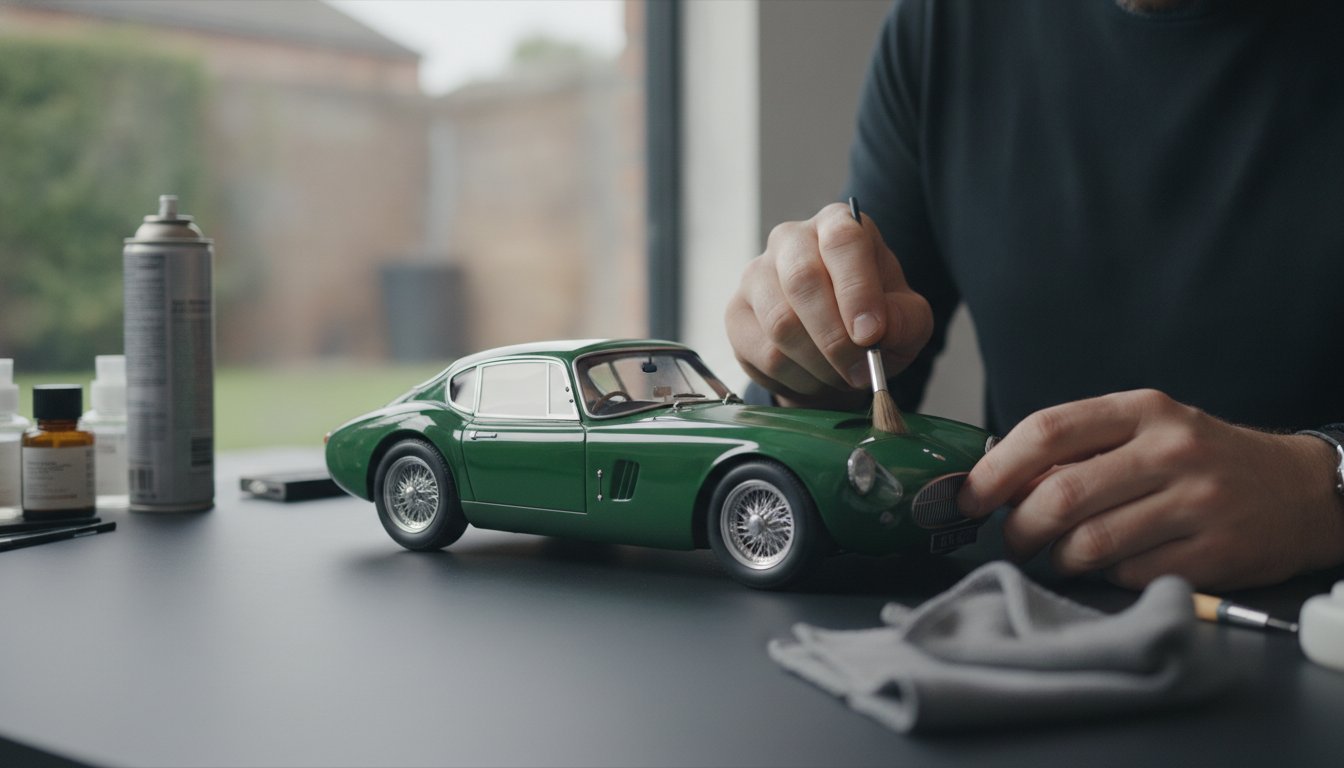
Mastering how to clean diecast model cars requires a steady hand and a methodical approach. Before you even touch your model, you need to prepare a dedicated workspace. Find a flat surface in a well-lit area; natural daylight is best, but a bright desk lamp works wonders for spotting hidden grime. Lay down a soft, lint-free mat or a plush microfibre towel. This provides a cushioned ‘safety zone’ that prevents the paint from scuffing and stops any tiny parts that might fall off from bouncing away into the carpet.
Handling is where most accidents happen. Always grip the model by its most solid points, usually the chassis or the tyres. Never pick up a 1:18 scale car by the roof pillars, spoilers, or wing mirrors. These are often the most fragile components and can snap under the slightest pressure. Once you’re ready, adopt the ‘Dry First’ method. By using your softest brushes to remove 90% of the surface contaminants before introducing any moisture, you eliminate the risk of turning dust into a gritty paste that could scratch the finish. If you’re still deciding which scale best suits your display space and budget, our guide to 1:18 vs 1:24 scale diecast models breaks down the key differences to help you choose wisely.
Surface Dusting and Light Maintenance
Start from the top and work your way down. Gravity is your friend here. Begin with the roof, then move to the bonnet and boot before tackling the side panels. This ensures that any dust disturbed from the top doesn’t settle on sections you’ve already cleaned. For recessed engine bays and cramped cockpits, use a manual air blower; the kind used for camera lenses is perfect. It provides enough force to dislodge particles from behind steering wheels without the risk of moisture or freezing air. If you’re detailing classic 1:18 models with wire-spoke wheels, a very soft artist’s brush can weave between the spokes to clear out trapped fluff without bending the delicate wires.
Deep Detailing for Neglected Collections
Sometimes, a dry brush isn’t enough. If you’ve spotted stubborn fingerprints or oily residue, dampen only the very corner of a high-GSM microfibre cloth with distilled water. Press gently and use a circular motion; don’t scrub. When it comes to the undercarriage, be incredibly careful. It’s easy to snag the cloth on exhaust pipes or suspension links. Unlike some advice found online, never submerge your model in water. This can trap moisture inside the hollow metal body, leading to internal oxidation or even mould in the interior flocking. For windscreens, use a dry, clean microfibre to buff away streaks. Avoid using any spirit-based cleaners on clear plastic, as these can cause permanent ‘fogging’ that ruins the crystal-clear look of your display.
Finish your session with a post-clean inspection. Use a small torch to shine light at different angles across the bodywork. This will reveal any missed spots or streaks that weren’t visible under normal room lighting. It’s a simple step that ensures your 1:24 scale trucks and luxury cars look truly showroom-ready.
Specialised Care for RC Vehicles and Construction Machinery
Static models are a joy to display, but remote control vehicles bring a whole new set of challenges to the workbench. When you’re operating 1:22 scale RC construction machinery, you’re often dealing with real-world grit rather than just light shelf dust. This could be garden soil, carpet fibres, or outdoor debris trapped in the treads. While the core principles of how to clean diecast model cars apply to the external bodywork, the mechanical components require a much more technical level of respect. You aren’t just a curator now; you’re a mechanic.
Moisture is the ultimate enemy of any electronic hobbyist. Unlike the static 1:18 scale replicas we discussed earlier, these machines have “beating hearts” in the form of servos, receivers, and motors. Even a tiny amount of water can cause a short circuit or lead to long-term corrosion on internal circuit boards. You’re also balancing cleanliness with essential lubrication. Those articulated joints on diggers and forklifts rely on factory grease to move smoothly. If you’re too aggressive with degreasers or wet wipes, you’ll strip that protection away, leading to mechanical grinding and premature wear on the moving parts.
Cleaning 1:22 Scale RC Diggers and Loaders
For heavy-duty plastic components and metal tracks, a soft toothbrush is your best friend. It provides just enough agitation to clear ‘worksite’ debris from the deep treads without scratching the finish. Pay close attention to the hydraulic arms; wipe them down with a dry, lint-free cloth to ensure no grit is pulled into the cylinders during operation. It’s always a good idea to charge RC car batteries safely before you do a final post-clean test run. This ensures everything is functioning correctly after your maintenance session. Don’t forget the tyres; cleaning off oils and dirt prevents the rubber from perishing or becoming brittle over time.
Protecting Electronics Whilst Cleaning
Safety should always be your priority. Always isolate the battery and motor before you start applying any cleaning agents. If you notice any buildup on battery terminals or within the chassis, use a dedicated electrical contact cleaner. This is a trick often used with professional OBD diagnostic tools to ensure a perfect connection without leaving a filmy residue. When you’re finished, store your controllers and diagnostic equipment in a dust-free environment or a dedicated case. This prevents ingress that could cause buttons to stick or signals to drop during your next session. Mastering how to clean diecast model cars with electronic components simply ensures your fleet stays operational for years to come.
Ready to put these maintenance skills to the test with a new addition? Explore our full range of RC construction vehicles and find your next project today.
Preventing Dust: Display and Storage Solutions
Cleaning is a labour of love, but let’s be honest; we’d all rather be hunting for our next addition than dusting the same radiator grille every fortnight. Mastering how to clean diecast model cars is a vital skill, yet the real secret to a pristine collection lies in your storage strategy. Think of your display as a protective cocoon. The hierarchy of protection starts with open shelving, which is essentially a dust magnet, and moves up to glass cabinets and individual acrylic cases. If you can keep the debris out from the start, you significantly reduce the risk of those microscopic scratches caused by frequent handling.
Sunlight is a silent killer for any high-end replica. It isn’t just about the heat; it’s the UV rays that bleach vibrant paint jobs and turn clear plastic windows a murky yellow. In the UK, our damp climate adds another layer of complexity. Humidity is just as dangerous as dust, as it can trigger oxidation or the dreaded zinc pest on older alloy bodies. Keeping your collection in a room with a stable temperature and away from direct light sources is the best way to ensure your models look as good in ten years as they do today.
Even with the best cabinets, you should establish a routine inspection schedule. This is particularly important for specialised sub-collections like diecast model tractors UK enthusiasts often curate, where intricate engine details and rubber tyres can hide settling particles. A quick monthly check allows you to spot any issues before they require a deep, risky cleaning session. Are your seals still tight? Has any moisture trapped itself behind a display plinth? These small questions save you hours of detailing work later.
Choosing the Right Display Case
The choice between individual acrylic cubes and large glass cabinets often comes down to space and budget. For your absolute ‘crown jewels’ in 1:18 scale, an individual case offers the best seal against the environment. If you prefer large cabinets, look for models with ‘dust-sealed’ doors that use thin felt or rubber strips along the edges. When lighting your display, always opt for LEDs. They don’t generate the heat or UV rays that traditional bulbs do, protecting your paintwork whilst making every chrome detail pop under the spotlight.
Long-term Storage for Boxed Collections
If you’re a ‘mint in box’ collector, the packaging needs as much care as the model itself. Use a dry microfibre cloth to wipe down the cardboard and clear windows; never use liquids that could soak into the paper. For items going into long-term storage, wrap the boxes in acid-free tissue paper to prevent the ink from sticking to plastic bins or other boxes. For heavy 1:24 scale lorries, vertical storage is often best to prevent the weight of the model from crushing the inner plastic ‘clamshell’ over time. Proper organisation and climate control are the final steps in the journey of how to clean diecast model cars and keep them in showroom condition.
Preserving the Showroom Shine for Years to Come
Caring for your collection is a journey that rewards patience and precision. By embracing the “dry first” approach and investing in a professional-grade kit, you’ve taken the most important steps in protecting your investment. We’ve explored how the right storage environment and a light touch during maintenance can prevent the common pitfalls of oxidation and paint fatigue. Whether you are detailing a luxury 1:18 supercar or clearing grit from a 1:22 construction loader, understanding how to clean diecast model cars ensures your display remains a source of pride rather than a source of stress.
As your collection grows, having a reliable partner makes all the difference. At Diecast Cartel, we are premium 1:18 and 1:24 scale specialists dedicated to supporting the UK hobbyist community with expert advice and tracked UK shipping on all collectibles. Ready to find your next centrepiece? Browse our latest 1:18 and 1:24 scale arrivals at Diecast Cartel and enjoy the peace of mind that comes with expert UK-based hobbyist support. Keep that passion alive and your shelves gleaming.
Frequently Asked Questions
Can I use water to clean my diecast cars?
You can use water, but it should ideally be distilled water to avoid the limescale spots common with UK tap water. Never submerge your model; instead, use a slightly damp microfibre cloth for stubborn spots. Submerging a model can trap moisture inside the metal body, which leads to internal rust or mould in the cabin flocking.
How do I remove stubborn fingerprints from my model’s paint?
A high-GSM microfibre cloth is your best tool for removing oily residues. If a dry cloth doesn’t work, dampen a tiny corner with distilled water and use very light, circular motions. Don’t press too hard. Heavy pressure can cause microscopic swirl marks in the clear coat that dull the finish over time.
Is it safe to use a vacuum cleaner on my diecast collection?
It’s generally best to avoid using a household vacuum cleaner near your models. The suction is often powerful enough to snap off delicate parts like wing mirrors, wipers, or antennas before you can react. A manual air blower, such as those used for camera lenses, is a much safer way to dislodge dust from tight spots.
What is the best brush for dusting intricate 1:18 scale engines?
A soft-bristle makeup brush or a fine artist’s brush is the most effective tool for engine bays. These brushes are designed to be incredibly gentle; they’ll clear away dust from tiny wires and hoses without snagging. Mastering this delicate touch is a core part of learning how to clean diecast model cars without risking damage to the fine details.
Will cleaning my model car decrease its value?
Proper cleaning actually helps preserve your model’s value by preventing paint bubbles and oxidation. Removing the acidic oils from fingerprints and abrasive dust particles is essential for long-term maintenance. Value only decreases if you use harsh chemicals, cause scratches, or accidentally break fragile components during the process.
How do I clean the interior of a 1:24 scale truck without breaking parts?
Use a long-reach artist’s brush and a manual air blower to reach the dashboard and seats. If the doors don’t open, you can often reach through the window with a soft-tipped swab. Be extremely careful around the steering wheel and gear stick; these parts are often very thin and can snap with the slightest contact.
Should I wax my diecast models to protect the paint?
Applying a high-quality carnauba wax is a great way to add a protective layer and a deep showroom shine. Use a tiny amount on a clean microfibre cloth and buff it gently. Just be sure to avoid getting wax on textured plastic trim or delicate water-slide decals, as it can leave a white residue that’s difficult to remove.
How often should I clean my diecast display?
A light dusting once a month is usually enough if your models are kept in a glass cabinet. If you display your collection on open shelves, you’ll likely need to do a quick pass every fortnight. Regular inspections are the best way to catch dust buildup before it becomes a more difficult cleaning task.
