
Diecast Guides
Diecast Model Storage for Dust Protection and Box Capacity
Nov
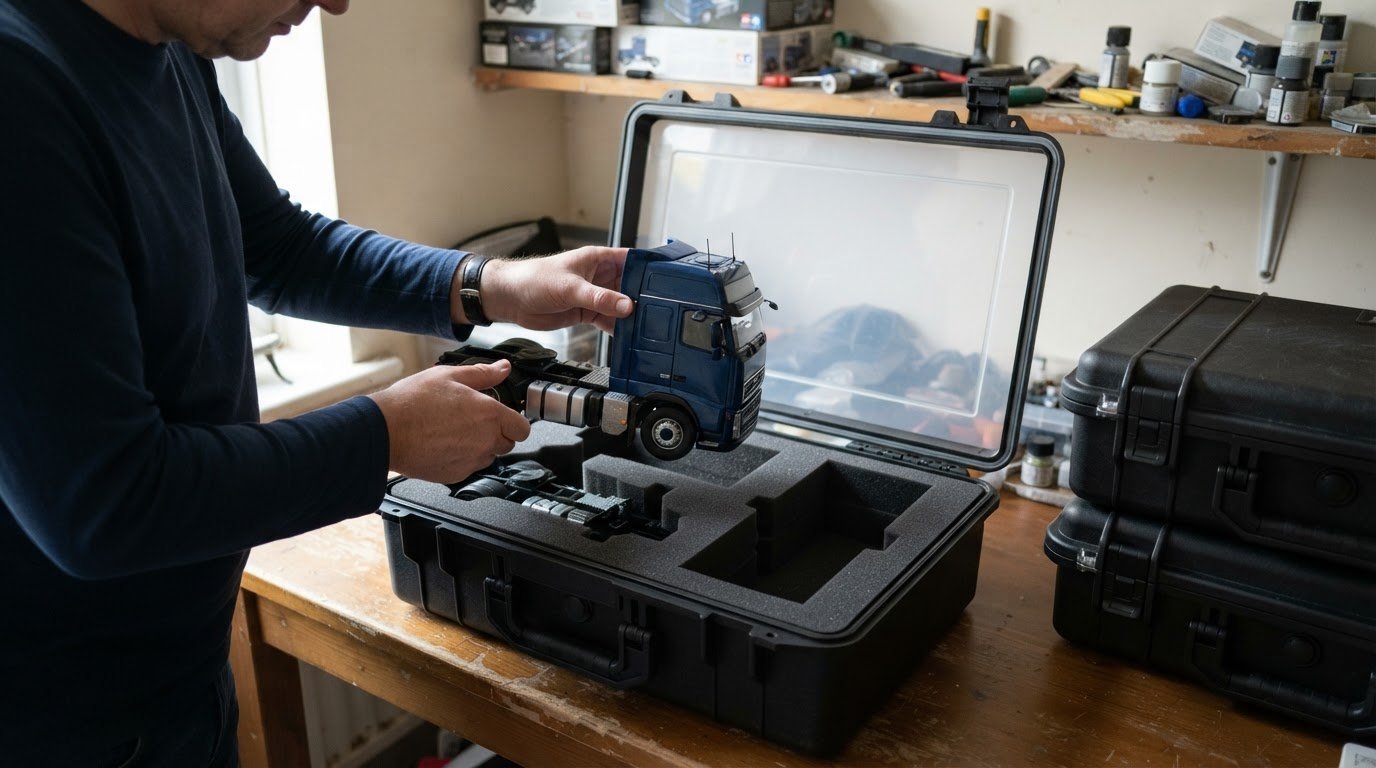
Foam can cushion a diecast car, but it won’t keep dust out of an open compartment. A covered case offers more protection, although its lid may not be very transparent. The best diecast model storage solutions balance protection with how you want to see and access your collection.
It’s understandable to want new arrivals on display while keeping dust and handling to a minimum. The right setup depends on your models’ scale, whether they’re boxed or loose, and the space available.
Here, you’ll find practical ways to open and organise your cars, understand what foam can and can’t do, and choose boxes or trays by scale. There’s also a closer look at storage for 1:43, 1:64 and 1:87 models, so smaller cars can have a place that suits them too.
Key Takeaways
- Choose a case based on whether dust protection or easy viewing matters most, and treat foam as cushioning rather than a sealed cover.
- Sort cars by scale and whether they’re packaged or loose to make arranging and accessing your collection easier.
- Compare box and tray capacity with the space each model needs, then match the display to your available room.
- Small-scale collectors can explore different options for 1:43 and 1:64 models, with storage choice depending on how they want to display or carry them.
Does the foam protect against dust?
Foam cushions a model, but an open compartment doesn’t seal it from dust. For easier access, consider how the case opens and whether its cover can stay in place.
Dust protection and display access
A repurposed hobby storage case can display diecast cars, but its open compartments leave them exposed to dust. Keep the plastic lid on for added protection, bearing in mind it may not be very transparent. Removing it makes the models easier to see and reach, but leaves them open to dust. Consider where the case will sit and how often you want to handle each car.
Acrylic cases and glass cabinets can both enclose models for display. Neither is automatically better: choose according to the cabinet’s position, the visibility you want and how you prefer to access the cars. In the UK, options include individual display cases, cabinets, trays and repurposed hobby storage cases.
Foam-based display storage
Pick-and-pluck foam lets you shape spaces around individual models, helping keep them separated in a hobby case. Place each car in its own cut-out, leaving enough room to lift it out without catching neighbouring models. This works well when you want a tidy layout and cushioned storage rather than an open-shelf display.
Foam doesn’t seal out dust. You still need a lid or enclosed cabinet to limit dust settling on the cars. Think of the foam and cover as serving different purposes: one supports the models, while the other encloses them.
Repurposing can also make use of a case you already own. One listed display box for 1:18 scale cars measures 34.1 x 16.3 x 14 cm, giving you a specific size to compare with your model and available shelf space.
Purpose-built cases vary in size, materials and opening style, all of which affect cost. Match the case to your largest model, desired display space and access needs. No single format suits every collection.
Opening and organising diecast cars
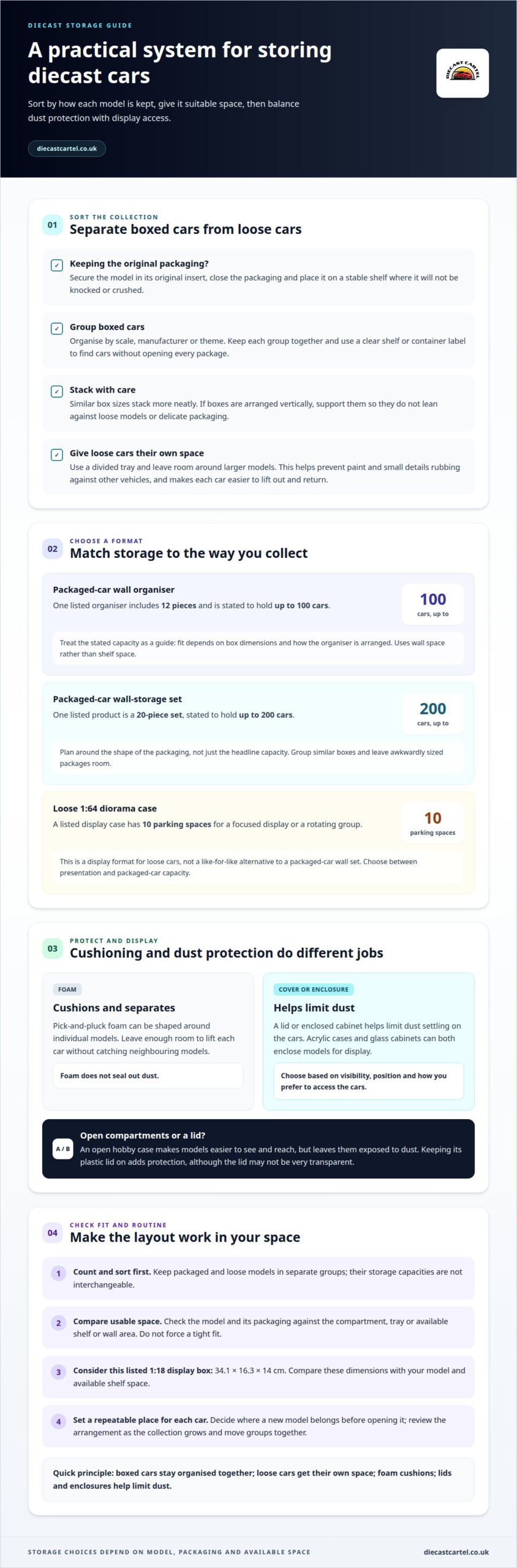
Start by deciding which cars will stay boxed and which are ready for display. Keeping a model in its original packaging preserves the box as part of the collectible and avoids moving the car between storage formats. Secure it in its original insert, close the packaging, then place it on a stable shelf where it won’t be knocked or crushed.
For boxed cars, organise by scale, manufacturer or theme, then keep each group together. A clear label on the shelf or container makes a favourite easier to find without opening every package. If you arrange boxes vertically, support them so they don’t lean against loose models or delicate packaging. Similar box sizes are easier to stack neatly than mixed formats.
Loose cars need a different approach. Give each model its own space so painted surfaces and small details don’t rub against another vehicle. A divided tray makes it easier to lift a car out and return it to the same place. Leave room around larger models rather than squeezing them into a compartment that catches their mirrors or wheels.
Packaged-car wall organisers can make a collection visible without taking up shelf space. One listed organiser includes 12 pieces and is stated to hold up to 100 cars. Treat that capacity as a guide for packaged cars; the fit depends on their box dimensions and how you arrange the organiser. Grouping similar packaging together also makes gaps and overcrowded areas easier to spot.
Before opening a new model, decide where it belongs. For example, keep boxed cars in one labelled section and display-ready cars in a separate tray. This simple routine helps prevent accidental mixing and makes it easier to return a model after handling. As your collection grows, review the layout and move groups together rather than stacking extra boxes wherever space appears.
Storage capacity by box and tray
Choose storage by counting the cars you want to house and separating packaged models from loose ones. A box’s stated capacity is a useful starting point, but packaging size and layout affect how well the space works. For a large collection, packaged-car organisers can use wall space; for a smaller loose-car display, a tray or diorama case gives each model a defined place. The most useful diecast model storage solutions match the way you collect.
A packaged toy-car wall storage product is listed as a 20-piece set, stated to hold up to 200 cars. That makes it a useful capacity reference for collectors arranging boxed cars. Plan the layout around the shape of your packaging, not just the headline capacity. Group similar boxes together, and leave awkwardly sized packages room rather than forcing them into a tight fit.
For loose models, one listed 1:64 diorama display case has 10 parking spaces. Its capacity is clear: it displays ten cars in a parking-style layout. This format suits a small themed selection or a rotating group from a larger collection. It won’t store the same number as a packaged-car wall set, so choose according to whether display presentation or maximum capacity matters more.
Short on floor or shelf space? Look upwards with a wall organiser, or use a compact tray on a desk or shelf. Before choosing a format, sort your cars into packaged and loose groups. Match each group to a suitable storage type, then check that your available surface or wall area suits the arrangement.
- Packaged cars: Use the stated capacity of a wall-storage set as a planning guide, then account for box shapes.
- Loose 1:64 cars: Use a 10-space diorama case for a focused display.
- Mixed collection: Separate boxed and loose models to avoid treating different storage capacities as interchangeable.
For a growing collection, repeatable layouts make it easier to accommodate new additions. These diecast model storage solutions can be extended with a second matching tray or organiser. A different format may suit models that don’t fit the original layout.
Storage for 1:43, 1:64 and 1:87 scale models
Smaller scales call for careful matching between the model and its display space. A case labelled for one scale may not suit every car, especially when model shapes differ. Compare each car’s length, width and height with the usable space in its compartment. For a mixed collection, grouping cars by scale first makes it easier to choose a deliberate-looking layout.
For 1:43 models, a listed display case measures 14.9 x 7.7 x 7 cm. Use those dimensions as a starting point, then compare them with the model and the room needed to lift it out. A tight compartment can make access awkward, whilst extra space may let the car sit more clearly on display. Check the case’s internal space against the model before arranging a row.
At 1:64, there are several distinct formats. A listed acrylic case for 1:65 cars measures 12 x 5.8 x 4.8 cm, so don’t assume it fits every 1:64 model. A wall-mounted wooden shelf measures 40 x 32 x 4.3 cm, while another listed wooden shelf holds 16 diecast cars. For portable storage, a beige carrying display case has 48 slots. These options suit different priorities: individual enclosure, wall display, fixed capacity or carrying.
For 1:87 models, start with the actual footprint of the cars and the layout you want. A tray with clearly separated spaces can keep models arranged, while a covered case keeps them together for display. Compare compartment depth as well as width, particularly if your collection includes different vehicle shapes. A row of matching cars may suit a narrow tray; mixed vehicles may need more flexible spacing.
Choose by scale, available space and how you’ll use the display. Measure the shelf or wall area, compare case dimensions, then match capacity to the number of cars you want visible. If you’re adding larger models alongside smaller-scale pieces, browse diecast model options to explore other scales.
Diecast Cartel: 1:24 scale Diecast models and trucks
Diecast Cartel offers 1:24 scale diecast models and trucks for collectors choosing additions to display or keep boxed. If your collection centres on larger vehicles, its range also includes diecast trucks and tractors. For another scale, explore 1:18 scale model cars.
Matching a new model to your existing collection can help you plan its place before it arrives. Compare its scale and vehicle type with the room available in your case or on your shelf. Diecast Cartel also offers a 1:24 remote control forklift, suited to collectors interested in vehicles beyond static models.
Once you’ve decided which scale or vehicle type fits your collection, contact Diecast Cartel to discuss your next addition.
Make room for the next favourite
A collection changes as new models arrive and old favourites move between display and storage. Treat your layout as adaptable: leave some flexibility for different shapes, packaging and scales rather than filling every space at once. That makes it easier to welcome a new addition without reorganising the whole display.
The best diecast model storage solutions suit the way you collect. You may enjoy seeing every model, or prefer keeping some cars boxed until the right display space opens up. Let that preference guide your next choice, and leave room to handle and appreciate each piece.
If a new model is part of your plans, contact Diecast Cartel about your collection. Choose the next addition with care, then give it a place where you’ll enjoy seeing it.
Frequently Asked Questions
How many model cars fit in one box?
It depends on the box’s layout and the size of the cars or their packaging. One packaged toy-car wall storage set is stated to hold up to 200 cars, while a 1:64 diorama case has 10 parking spaces. Treat each figure as specific to that format, not a general capacity for every box. Allow room for different box shapes and easy removal.
Is the foam gentle on paintwork and add-on parts?
Foam type and fit both matter, so don’t assume every insert suits every finish. For a car with delicate mirrors or other add-on parts, avoid forcing it into a tight cut-out. Keep the model from shifting, and lift it by a sturdy part of the body rather than pulling on small details.
Which scales are trays available for?
Storage examples include formats for 1:43 and 1:64 models, but tray suitability depends on the compartment dimensions, not just its scale label. A listed 1:43 display case measures 14.9 x 7.7 x 7 cm; a listed 1:65 acrylic case measures 12 x 5.8 x 4.8 cm. For 1:87 cars, match the tray spaces to the actual models.
How much do diecast model display cases and cabinets cost in the UK?
There isn’t one fixed UK price for all display cases and cabinets. Cost depends on the format, materials, size and whether the case is designed for individual models or a larger display. Compare these features with your collection and available space. Model prices depend on the product, so unrelated case prices don’t indicate what a model costs.
What are the best dustproof storage options for diecast models?
A covered case or cabinet is a practical choice for limiting dust on displayed cars. Open compartments leave models exposed, even if foam holds them in position. Consider how often you want to access the cars, too: keeping a cover on offers more protection, while an open display makes handling easier.
How should diecast cars be stored to prevent paint damage, fading and corrosion?
Store each car so it can’t rub against another model, and keep it away from direct sunlight and damp conditions. Use a clean, stable shelf or a compartment that fits without pressing on mirrors or other small parts. For boxed models, keep the original insert in place and avoid stacking items in a way that puts pressure on the packaging.
