
Diecast Guides
Display Ideas for Your Diecast Collection
Nov
The best way to display a diecast collection is to organise models by scale or theme, use LED lighting and add simple backdrops that give each group character. Keep models out of direct sunlight and leave enough space to show off their details. A thoughtful layout can make a collection feel curated without making it complicated.
Every collector has their own favourites, and a display should reflect what makes those models special. These practical ideas cover lighting and arranging your collection, plus ways to add miniature scenery and memorabilia without letting accessories steal the show.
Explore common display mistakes, from crowded shelves to poor placement, and find inspiration for a setup that’s enjoyable to look at and easy to care for. Whether you’re starting with a few models or refreshing a well-loved display, these ideas can help you display a diecast collection with pride.
Key Takeaways
- Use LED lighting to bring out model details, and adjust the angle to add depth and sparkle.
- Group vehicles by a feature such as scale, era or manufacturer to give shelves a clear visual theme.
- Try simple backdrops or miniature props to create a scene that complements your models.
- Leave space between vehicles and keep displays away from direct sunlight to help them look their best.
1. Lighting displays with LEDs, spotlights and lamps
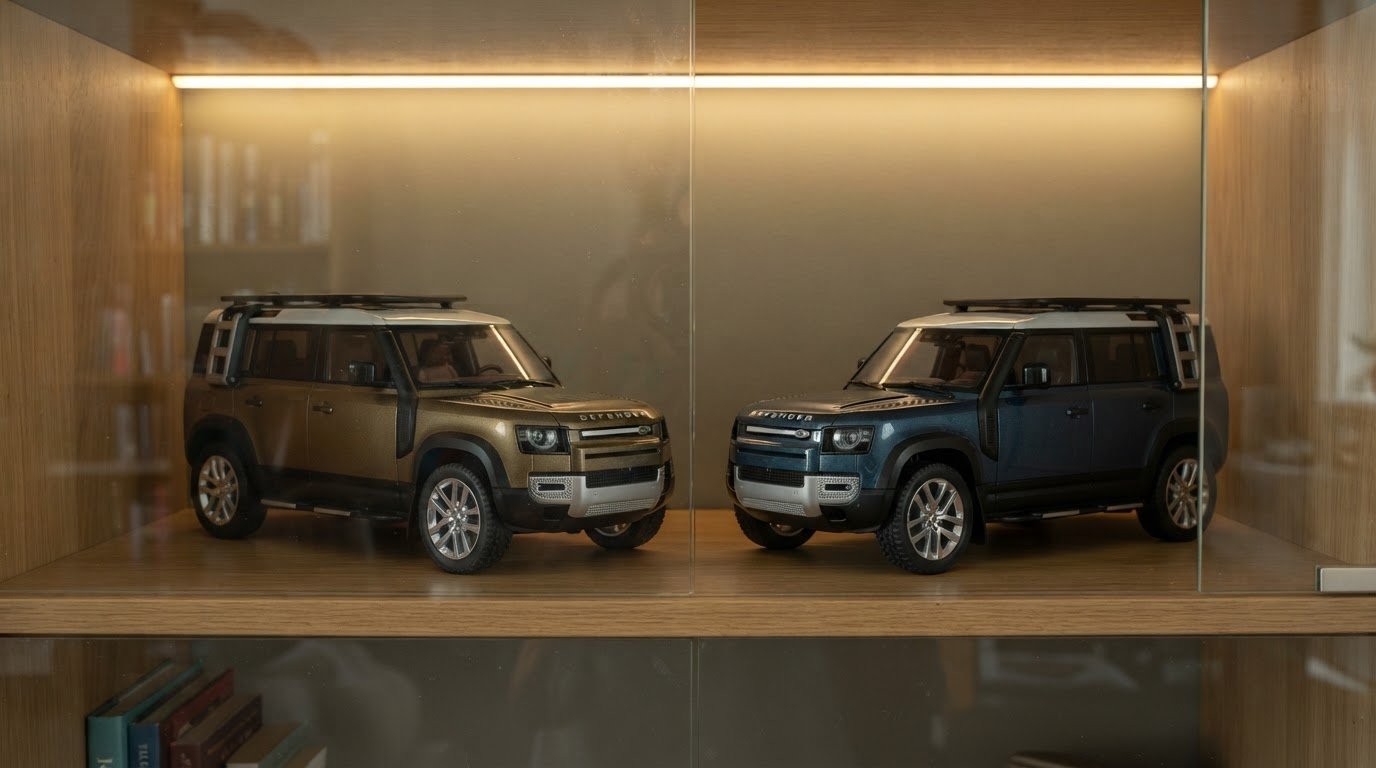
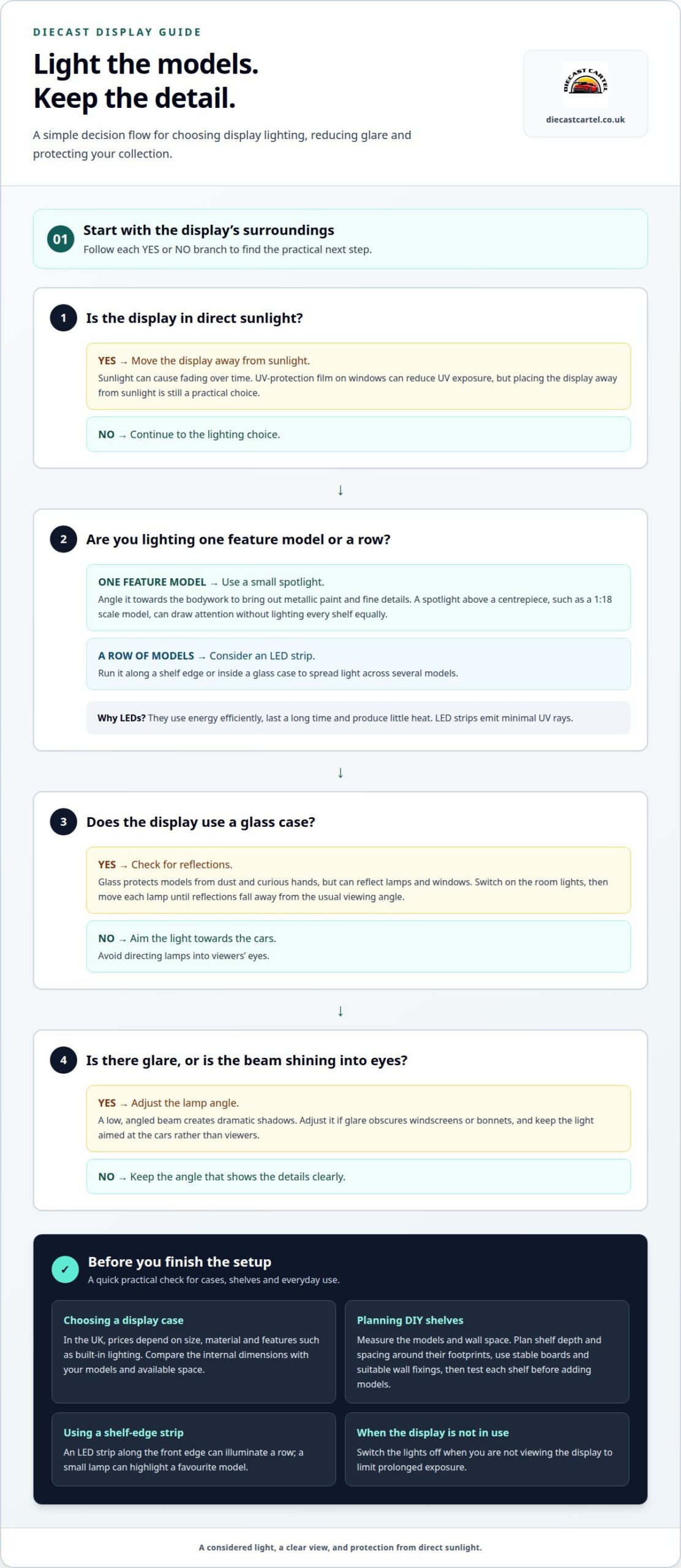
LEDs are a practical choice because they use energy efficiently, last a long time and produce little heat. LED strips can run along shelf edges or inside a glass case, spreading light across several models. For a feature car, angle a small spotlight towards its bodywork to reveal metallic paint and fine details. This is a useful starting point for displaying a diecast collection with depth and focus.
To avoid unnecessary heat and UV exposure, choose LEDs and keep the display out of direct sunlight. LED strips emit minimal UV rays, but sunlight can still cause fading over time. Aim lamps towards the cars, not into viewers’ eyes. A low, angled beam creates dramatic shadows; adjust it if glare obscures windscreens or bonnets.
Glass cases protect models from dust and curious hands, though their surfaces can reflect lamps and windows. Switch on the room lights, then move each lamp until reflections fall away from the usual viewing angle. A spotlight above a centrepiece, such as a 1:18 scale model, can draw attention without lighting every shelf equally. Small adjustments can make how to display a diecast collection feel like thoughtful curation rather than simply adding more light.
In the UK, display-case prices depend on size, material and features such as built-in lighting. Specialist model retailers and home-storage shops sell cases and shelving. Compare internal dimensions with your models and available space before choosing.
For DIY shelves, measure the models and wall space, then plan the shelf depth and spacing around their footprints. Use stable boards and suitable wall fixings, and test each shelf before adding models. An LED strip along the front edge can illuminate a row, while a small lamp highlights a favourite. Switch the lights off when you’re not viewing the display to limit prolonged exposure.
2. Organising models by theme, scale or other characteristics
Start with a grouping rule that suits your collection: scale, manufacturer, era or colour. Keeping similar models together gives each shelf a clear identity. For example, arrange classic cars chronologically to suggest a story of automotive history, or separate racing and road cars by shelf.
For mixed scales, choose a cabinet with shelves that accommodate your largest models, then group smaller cars where they remain easy to see. Check the internal height and depth against each model’s footprint before arranging the display. A case suited to 1:18 cars may need more room than one holding 1:24 models, while trucks and tractors can require different shelf space.
Protect the display from environmental damage as well as dust. Keep models away from direct sunlight, windows, radiators and air vents, where changing conditions or prolonged exposure may affect them. A stable environment helps limit damage from temperature extremes. UV-protection film on windows can reduce UV exposure, but positioning the display away from sunlight is still a practical choice.
Wall-mounted shelves can hold heavier diecast cars if the shelf and fixings are suitable for the wall and the combined weight of the models. Secure the shelf to an appropriate supporting structure, follow the fixing instructions and avoid overloading it. For valuable models, keep an inventory with photographs and appraisals, particularly if the collection is insured. Record identifying details alongside clear images to document what you own.
Want a display that feels personal as well as organised? Explore more ideas for diecast collecting as you plan which themes and scales deserve their own space.
3. Adding backdrops, dioramas and memorabilia
A backdrop can turn a row of models into a scene while keeping attention on the vehicles. Choose a sleek, monochromatic background to make paint colours and body lines stand out. For a racing display, a simple trackside scene gives the cars context without competing with their details. Position the backdrop behind the models, then view the shelf from the front to check that it frames rather than hides them.
Miniature props can make a diorama feel lived in. Add road signs, trees or small buildings to suggest a route through a countryside scene or town street. Keep props behind or beside the cars so windscreens, grilles and distinctive paintwork remain visible. A road sign near a model’s front wheel can suggest movement; a building set further back adds depth without crowding the foreground.
Memorabilia can connect a display with the stories behind your collection. An old leather suitcase evokes classic road trips, while a retro petrol pump creates a nostalgic garage setting. Choose objects that match the models’ era or theme, and give each item enough room to stand out. One well-chosen prop often tells a stronger story than a shelf crowded with unrelated accessories.
Build the scene around a focal model. Place it where the eye naturally lands, then arrange supporting cars and props to lead towards it. A monochromatic backdrop can suit a carefully curated group, while a diorama works well when several models share a setting. Keep the visual balance consistent: if a large building dominates one side, use a smaller prop or open space on the other. Step back and view the display from normal room distance; details that look charming close up may disappear or become clutter from across the room. Rearrange props until every model remains easy to recognise and the scene feels like part of your collection, not a separate miniature set.
4. Common display mistakes and inspiration from other collectors
A crowded shelf is a common display mistake: cars lose their individual shape when parked bumper to bumper. Leave visible space around each model, especially near mirrors, spoilers and distinctive paintwork. A carefully chosen group invites closer attention more effectively than filling every available shelf. Try removing a few models, then check whether the rest are easier to appreciate.
Placement matters, too. One collector displays models at about eye level on a bookcase’s top shelf, making them easy to view. In a home with two young boys, a bedroom bookcase shows why location should suit household routines. Choose a position that keeps models visible but away from everyday knocks, and use a closed case if curious hands are a concern.
Materials can cause problems if they come into contact with models. Avoid acidic shelves and harsh cleaning products, which can damage surfaces or finishes. Open shelving also requires regular dusting; use a soft cloth or gentle brush rather than rubbing grit across the paint. Plan access before arranging tightly packed rows, so cleaning doesn’t mean reaching awkwardly over other cars.
Collectors’ displays offer fresh ideas without requiring a matching collection. Vintage skateboard decks can become distinctive platforms, while staggered wall-mounted shelves create varied levels. One collector says 60% of their displayed models are static cars that stay on display. Another reports that 40% are new cars. These personal examples show how a layout can reflect what each collector enjoys, not a fixed formula.
For an easy refresh, rotate the featured models and leave a clear focal point. Keep a favourite at eye level, then arrange supporting cars around its theme or colour. The result feels considered without demanding a complete redesign. Explore diecast models to find vehicles that could bring a new theme to your display.
Diecast Cartel
Diecast Cartel can help you add another centrepiece or build a display around a favourite vehicle theme. Its range includes 1:24 scale diecast models and trucks, alongside diecast trucks and tractors for collectors drawn to larger road and farm vehicles.
If your display also celebrates working machinery, the 1:24 remote control forklift and 1:22 scale remote control construction vehicles offer a different kind of addition. Choose models that suit your collection’s scale, subject and available shelf space, then make room for each new arrival to stand out.
Whether you’re growing a focused line-up or starting a fresh theme, Diecast Cartel is a natural next step for exploring models. Contact Diecast Cartel to discuss your collecting interests.
Make room for your next favourite
A collection doesn’t have to feel finished. As your interests evolve, your display can change with them: a new vehicle might inspire a fresh theme, while a small rearrangement can put a familiar model in the spotlight. Keep a little room for the next addition, and let your shelves reflect the parts of the hobby you enjoy most.
Learning how to display a diecast collection is also about choosing models that make the arrangement feel personal. Diecast Cartel offers 1:24 scale diecast models and trucks, Diecast Trucks and Tractors, and 1:18 Scale Model Cars, giving collectors options for different themes and scales.
Ready to find a model that belongs in your next display? Contact Diecast Cartel today and take the next step in shaping a collection that feels unmistakably yours.
Frequently Asked Questions
What are the best ways to display a diecast car collection?
Choose a clear focal point, consistent spacing and a layout that suits the cars you most enjoy seeing. Place a favourite model centrally, then arrange supporting vehicles in shallow arcs or matching rows so each remains visible from the room entrance. Turn one car slightly towards the viewer to show its front and side. Leave space for your next addition rather than squeezing it into a crowded row.
How much space is needed to display 1:18, 1:24 and 1:64 diecast cars?
The space depends on each model’s footprint, the gaps you want between cars and the shelf’s usable depth. A 1:18 model needs more room than a 1:24 model, while 1:64 cars allow a more compact arrangement. Measure the models themselves, including projecting mirrors or spoilers, then mark their footprints on paper. This gives you a useful layout plan before moving shelves or choosing a display location.
How do I arrange diecast cars by scale, make, era or colour?
Choose one main sorting rule, then use a secondary detail to shape each shelf. For example, group cars by manufacturer and order each group by era, or arrange one scale by colour. Keep labels discreet if you want to remember dates or model names without cluttering the display. If a new addition disrupts the pattern, move the whole group together rather than breaking its visual sequence.
How do I protect diecast models from dust, sunlight and humidity?
A glass case helps limit dust, while placing the display away from direct sunlight reduces prolonged exposure. Keep models in a stable room, away from radiators, air vents and windows where conditions can change. Avoid damp locations such as poorly ventilated cupboards, and watch for condensation on nearby surfaces. For open displays, dust gently and regularly to prevent particles building up around fine details.
How can I display diecast cars without a display cabinet?
Use a bookcase, sturdy wall shelves or a dedicated shelf within an existing cabinet. Arrange cars in short rows rather than filling the full length, leaving space to lift each model without knocking its neighbours. For wall shelves, match the fixings to both the wall and the load. A shallow tray can also group cars on a desk or bookcase, making the arrangement easier to move for cleaning.
