Diecast Guides
Farm Tractor Toys for Collectors: Scale, Features and Models

Oct
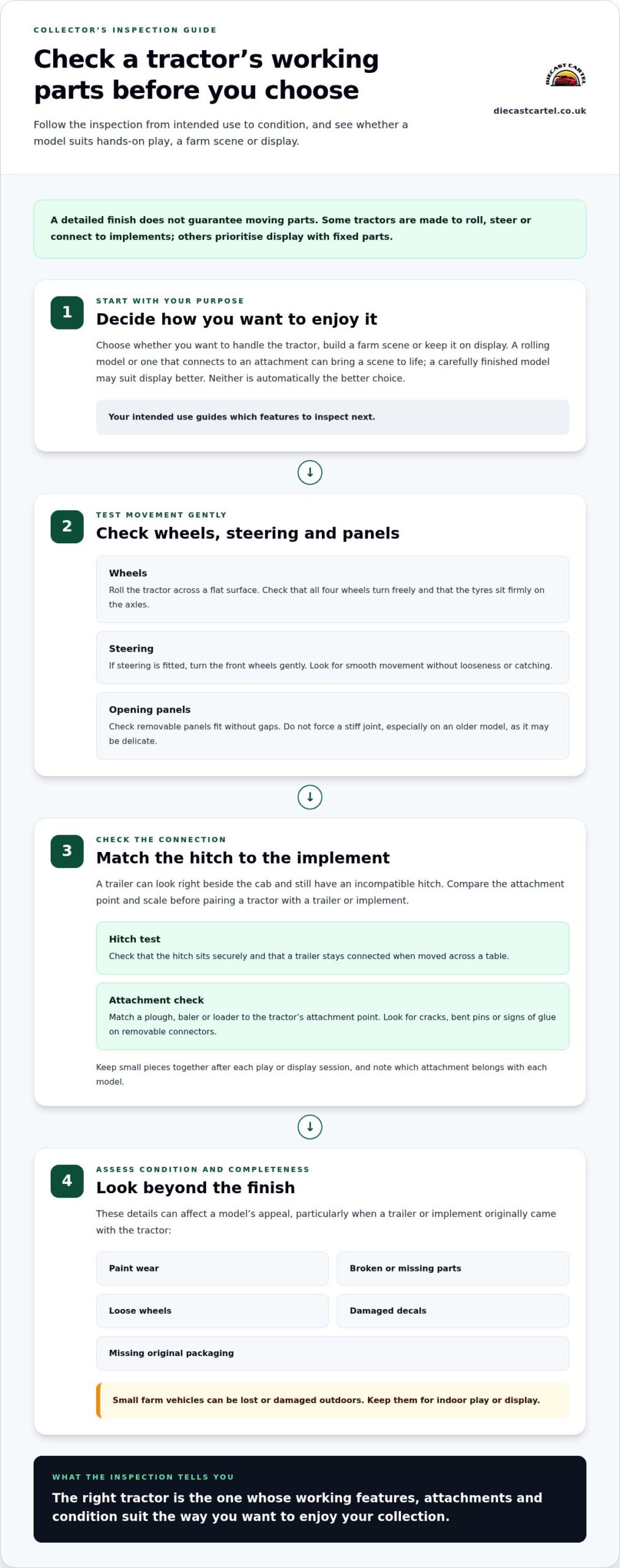
A detailed finish doesn’t mean every tractor model has working parts. Farm tractor toys for collectors vary: some have moving wheels, steering or a hitch for an implement, while others are designed mainly for display. The key is to match the model’s features to how you want to enjoy it.
That distinction matters when choosing a new piece. A toy that rolls or connects to an attachment can bring a farm scene to life, while a carefully finished diecast model may work better as a display piece. Neither is automatically the better choice. It depends on what you value in your collection.
This guide explains which functional parts to look for, how scale affects size and compatibility, and what to consider when comparing diecast tractors with heritage models. Toy tractor models range from 1:87 to 1:16 scale, so understanding the proportions can help you build a collection that feels coherent, whether you’re adding a single favourite machine or creating a whole farmyard scene.
Key Takeaways
- Inspect wheels, steering and attachment points to see whether a model is made for hands-on play or display.
- Compare scales by the space you have and how well each tractor will sit alongside the other vehicles in your collection.
- Look beyond the finish on diecast models: construction, condition and distinctive details all shape their appeal.
- Explore heritage tractors such as the Ford 8210 to add a connection to earlier farming machinery.
- Choose tractors and farm vehicles around the scene you want to create, then build your collection at a pace that suits you.
Do Your Toy Farm Vehicles Have Functional Parts?
A tractor can have a detailed finish without working features. Some models have rolling wheels, steerable front axles, opening panels or a hitch for a trailer. Others prioritise display, with fixed parts and a carefully reproduced shape. Decide whether you want to handle the model, build a farm scene or keep it on display. That choice will guide what you inspect.
Check each moving part gently before buying a used tractor. Roll it across a flat surface and see whether all four wheels turn freely. Turn the steering, if fitted, and look for smooth movement rather than looseness. A hitch should sit securely, while removable panels should fit without gaps. Don’t force a stiff joint, especially on an older model, as it may be delicate.
Attachments make a tractor more versatile, but they need to suit its coupling and scale. Check the connection before pairing a tractor with a trailer or implement. A trailer that looks right beside the cab may still have an incompatible hitch. For a removable attachment, inspect the connector for cracks, bent pins or signs of glue. Keep small pieces together after each display or play session.
- Wheels: Look for even rolling and tyres seated firmly on the axles.
- Steering: Turn the front wheels gently, then check they return without catching.
- Hitch: Test whether a trailer stays connected when moved across a table.
- Implements: Match a plough, baler or loader to the tractor’s attachment point.
Farm implements can add character to a collection, from a trailer carrying a harvest to a baler behind a tractor. Removable parts also offer more display options. Show one tractor with different implements, or arrange several machines around a farm scene. Before storing them, note which attachment belongs with each model. This simple habit helps prevent mismatches and keeps a set complete.
What condition factors affect the value of farm tractor toys? Paint wear, broken or missing parts, loose wheels, damaged decals and missing original packaging can all affect a model’s appeal. Completeness matters especially when a trailer or implement originally came with the tractor.
How can I check whether a farm tractor toy is rare or authentic? Compare the maker’s marks, model details, casting and packaging with reliable references for that specific release. For a Britains model, examine the branding and edition information, then check whether the tractor and its attachments match the box.
Smaller toy farm vehicles can be lost or damaged outdoors, so keep them for indoor play or display. If you may sell your collection later, M&M Auctions advises that models can be grouped by manufacturer, tractor-and-implement theme, or as a full collection. Keeping each trailer and attachment with its tractor makes those groupings easier to assess.
Toy vehicle sizes and scale compatibility
Scale tells you how a model’s dimensions compare with its full-sized counterpart. The toy tractor range runs from 1:87 to 1:16 scale. A smaller denominator means a larger model of the same real machine. So, a 1:16 tractor occupies more shelf space than its 1:87 counterpart. This difference affects display planning, storage and how naturally vehicles sit together.
Start by choosing the role each model will play. A compact 1:87 tractor can suit a wider farm scene with several vehicles and buildings. A larger 1:16 model gives more room to appreciate cab details, tyres and bodywork. Between those ends, 1:24 scale offers a middle ground for collectors balancing presence with available display space. Measure your shelf before adding another sizeable machine.
Scale consistency matters most when models share a scene. A small tractor beside a much larger trailer can look out of proportion, even if both pieces are attractive on their own. Compare the stated scales of the tractor and trailer, then check their relative lengths and wheel sizes. A John Deere tractor and farm implement look more convincing together when their proportions are compatible.
Use this simple comparison when planning a display:
- 1:87: Choose this smaller scale when compact models help fit more vehicles into a scene.
- 1:24: Consider this mid-sized option for a balance between shelf presence and collection density.
- 1:16: Allow more display room for a larger model with a stronger visual presence.
These examples don’t mean every vehicle will match perfectly. The body shape varies between a tractor, trailer and combine, even at the same stated scale. Check the model’s actual dimensions where provided, and compare the longest pieces first. A long trailer may determine the space you need more than the tractor cab.
Scale also affects how you build a collection over time. If you already own 1:24 tractors, adding another at that scale can make a unified row easier to arrange. A different scale can still earn its place as a focal model, but give it space rather than squeezing it into a line of smaller vehicles. Diecast models at 1:24 scale and model cars at 1:18 scale illustrate how neighbouring categories can occupy different shelf footprints.
For remote-control construction machinery, the 1:22 scale provides another size to consider alongside static tractors. Before combining it with farm models, compare its physical dimensions and intended display role. If you’re mapping out a collection, browse scale options and decide which proportions best suit your shelf, farm scene or favourite machines.
Diecast metal toy tractors
Diecast tractors bring the familiar shape of a full-sized machine into a compact, solid model. Their appeal often lies in the details: a recognisable bonnet, cab outline, tyres and manufacturer markings. A John Deere, Fendt or Case IH model can represent a different part of agricultural machinery history. For farm tractor toys for collectors, a machine’s design and the detail captured in its casting can matter as much as its badge.
Diecast construction doesn’t mean every part is metal. A model may combine a cast-metal body with plastic details, tyres or accessories. Look closely at the cab glazing, mirrors, exhaust and steps. These smaller features can make a tractor feel convincing, but they’re also vulnerable to knocks. For a display piece, check that the details sit straight and suit the overall finish.
Use a consistent inspection routine when comparing two models. First, view the tractor from the front, sides and rear. Then check paint coverage around edges, wheel arches and cab joints. Look for chips, scratches, uneven lettering or loose-looking parts. Finally, compare the underside and maker’s marks with the box or other identifying information. A close match supports confidence in the model’s identity.
- Bodywork: Check the bonnet, cab and guards for clean joins and consistent colour.
- Wheels: Compare tyre alignment and look for damage around the hubs.
- Details: Inspect mirrors, lights, steps and exhausts for missing pieces.
- Identification: Match branding and model markings against the packaging.
Limited releases can add a specific collecting angle. The Britains Farm No. 42194 John Deere 8330T tracked tractor was a Gold Edition for Agritechnica 2005, limited to 102 pieces. That edition detail gives collectors a clear identifier to compare with packaging and model markings. Rarity alone doesn’t determine personal appeal, though. Decide whether you value the tractor’s design, its place in a series or its production history most.
Release dates can also help place a model within a collection. The Britains No. 42541 John Deere 5430i self-propelled sprayer was issued in 2008. Its distinctive sprayer form offers a contrast to conventional tractors, making it useful in a display focused on different farm machinery. Pair it visually with models from a similar period, or use it as a standalone feature piece.
Choosing farm tractor toys for collectors can mean weighing a manufacturer-led theme against a distinctive release. A John Deere tractor may suit a collection built around one manufacturer, while a Britains special edition can add a particular release story. Keep the packaging and identifying details together, and record the model’s name and edition information. Those notes make it easier to organise a growing collection.
Ford 8210 heritage tractor
The Britains Ford 8210 is described as a heritage tractor from the 1980s. That period connection gives collectors a clear theme to build around. You might display it as a tribute to older farm machinery, or pair it with models representing different eras. Before choosing a place for it, consider whether the Ford 8210 will be a focal piece or part of a wider farm scene.
A heritage model can carry meaning beyond its shape. The Ford 8210 may appeal because it recalls a particular period, a familiar manufacturer or the look of classic agricultural equipment. Those interests are personal, so decide which connection matters most to you. A collector focused on Ford machinery might give it a central position, whilst a mixed-brand display could use it to add variety.
Assess the individual model carefully, especially if buying second-hand. Examine the Ford 8210 from each side, then compare its paint, decals and visible parts. Look for chips, scratches, bent details or missing components. Check the wheels and any fitted accessories without forcing them. Packaging, if present, can help keep a model protected and together with its identifying information.
- Identity: Match the Ford 8210 name and Britains branding across the model and packaging.
- Finish: Look over the bonnet, cab and wheels for damage or uneven paint.
- Completeness: Compare visible parts and accessories with the model’s packaging.
- Display: Choose a position that suits its heritage role and protects delicate details.
Use the Ford 8210 to shape a display with a clear story. Place it beside other heritage machinery if you collect models from the 1980s, or set it apart as a single-era feature. A simple label with the model name and period helps visitors understand why it has a place. Keep that note separate from the tractor, so it doesn’t obscure the model’s finish.
Scale and shelf space still matter for a heritage tractor. Measure the Ford 8210 and the available display area before arranging it beside other vehicles. Leave enough room to lift it safely without catching mirrors or nearby models. If you use a cabinet, consider how the tractor looks from the front and sides, not only from above.
A focused collection doesn’t need to follow one formula. The Britains Ford 8210 can anchor a manufacturer-led display, complement a broader range of farm vehicles, or stand alone as a favourite heritage piece. Keep its identifying details together and handle it carefully during rearrangement. That way, the model’s period association remains part of the story your collection tells.
Toy tractor and farm vehicle selection
A collection feels more considered when each model has a purpose. Decide whether you’re building around one manufacturer, a particular type of machinery or a complete farm scene. A Massey Ferguson Tractor Playset can suit a scene-led collection, while a John Deere tractor may appeal if you’re gathering models around one marque. Choose the theme that will make your next addition meaningful.
Next, look beyond tractors. Combine harvesters and forage harvesters add different silhouettes and jobs to a farm display. The Mini Claas Lexion 760 Combine Harvester is one option for collectors interested in harvesting machinery. The John Deere T670i Combine Harvester offers another recognisable name. A Claas Jaguar 960 Forage Harvester adds a distinct machine type to the mix.
Consider how each piece will work with the models you already own. A tractor and trailer can suggest a transport scene, while a combine can become the centrepiece of a harvest display. The Mini Tractor and Trailer Gift Pack brings those two vehicle types together by name. Before choosing a set, compare its components with your collection’s scale, available space and overall theme.
- Manufacturer-led: Choose a make such as John Deere or Massey Ferguson, then look for complementary vehicle types.
- Farm-scene-led: Combine tractors, trailers and harvest machinery to create a fuller display.
- Machine-led: Focus on one category, such as combine harvesters or forage harvesters.
- Feature-led: Consider a named feature, such as the lights and sound in the John Deere Light & Sound Tractor.
A named feature can shape how a model fits your plans. The John Deere Light & Sound Tractor stands out from a display focused purely on static machinery. Consider whether you want models mainly for display, hands-on use or a mixture of both. That decision helps narrow your choices without requiring every purchase to follow the same pattern.
Keep a simple record as the collection grows. Note each model’s name, manufacturer and role in your display. For example, marking the Claas Jaguar 960 as a forage harvester makes it easier to plan alongside tractors and trailers. A written list can also help identify gaps, such as adding a combine to a tractor-heavy collection.
For a selection centred on farm machinery, explore diecast tractor and farm vehicle models. Choose the next piece around the scene or collecting theme you want to develop, then make room for it before adding another.
Price can be another practical point of comparison when choosing pieces for a display.
Diecast Cartel: 1:24 scale Diecast models and trucks
Diecast Cartel offers 1:24 scale diecast models and trucks, including diecast trucks and tractors. If you’ve chosen a scale and want to add a tractor or complementary vehicle, this is a natural place to continue your search. The range also includes 1:18 scale model cars and a 1:24 remote control forklift, for collectors with interests beyond farm machinery.
Use your collection’s theme to guide your next choice. A diecast tractor can extend a farm vehicle display, while a model car or forklift can broaden it in another direction. Diecast Cartel brings these categories together, helping you explore options that suit the collection you want to build.
For help choosing your next addition, contact Diecast Cartel.
Choose the next piece that makes your collection yours
Your collection can keep changing as your interests develop. Perhaps you’re drawn to a particular maker, the character of older machinery or the pleasure of building a detailed farm scene. Let that personal thread guide your next choice. Farm tractor toys for collectors are most rewarding when each addition reflects what you enjoy, rather than simply filling a space on the shelf.
Diecast Cartel offers 1:24 scale diecast models and trucks, including diecast trucks and tractors, alongside 1:18 scale model cars. These categories give you room to extend a farm-focused display or explore a related interest. A new model can mark a memory, represent a favourite machine or start a fresh collecting theme.
Take a moment to consider what you’d most enjoy adding next, then explore the options at your own pace. Contact Diecast Cartel to discuss your collecting interests. However your collection takes shape, enjoy discovering the models that make it distinctly yours.
Frequently Asked Questions
What Sizes of Toy Farm Vehicles Do You Offer?
Diecast Cartel offers diecast tractors and trucks, including 1:24 scale diecast models and trucks. The wider vehicle range includes 1:22 scale remote-control construction vehicles, a 1:24 remote-control forklift, and remote-control cars and trucks in 1:16 and 1:24 scales. To plan a display, measure the space available and compare the stated scale of each model with the vehicles you already own.
What scales and model types are available for collectible farm tractor toys?
For farm-themed collecting, the relevant model types are diecast tractors and trucks, with 1:24 scale diecast models and trucks. Other formats include 1:18 scale model cars and remote-control vehicles, such as construction machinery and a forklift. These categories suit different interests: choose diecast pieces for a static display, or explore remote-control vehicle types if you want a hands-on addition to your collection.
Which vintage farm tractor toys are most sought after by collectors?
Notable collectible examples include the Britains Farm No. 42194 John Deere 8330T Gold Edition, limited to 102 pieces, and the Britains No. 42541 John Deere 5430i self-propelled sprayer.
How much do collectible farm tractor toys cost in the UK?
Prices for collectible farm tractor toys in the UK vary widely depending on the scale, brand, rarity and material. Standard mass-produced diecast models typically start around £15 to £30, whereas limited-edition releases, vintage pieces or highly detailed custom models can easily command anywhere from £50 to several hundred pounds amongst serious collectors.
