
Diecast Guides
1/18 Scale Model Cars: A Collector’s Guide to Care
Sep
The biggest model on your shelf isn’t automatically the right one for your collection. With 1/18 scale toy cars, the appeal lies in more than size: detail, moving parts and the vehicle itself all shape the experience. At 1:18, a model is one eighteenth the length of the real car, and a typical example measures around 10 to 11 inches long.
That generous size can make room for features such as opening doors and detailed interiors, but broad claims like “highly detailed” don’t always tell you what you’re getting. Whether you’re choosing a first model or adding to a collection, consider what matters most: a particular car, interactive features, display space or a finish worth preserving.
This guide explains what 1:18 means in practical terms and what to check before choosing a model, from materials and visible details to intended use. You’ll also find straightforward advice on handling, displaying and caring for your model, so you can enjoy it as part of your collection for years to come.
Key Takeaways
- Use the 1:18 ratio to compare models, but check the individual vehicle’s dimensions before planning display space.
- With 1/18 scale toy cars, compare materials, finish and moving parts rather than relying on general claims about detail.
- Match your choice to the vehicle you enjoy collecting and whether you want a model to handle or display.
- Check listing photographs and descriptions for clear details about features, condition and packaging.
- Keep your model in a stable display spot, handle delicate parts carefully and follow its care instructions.
What does 1/18 scale mean for toy cars?
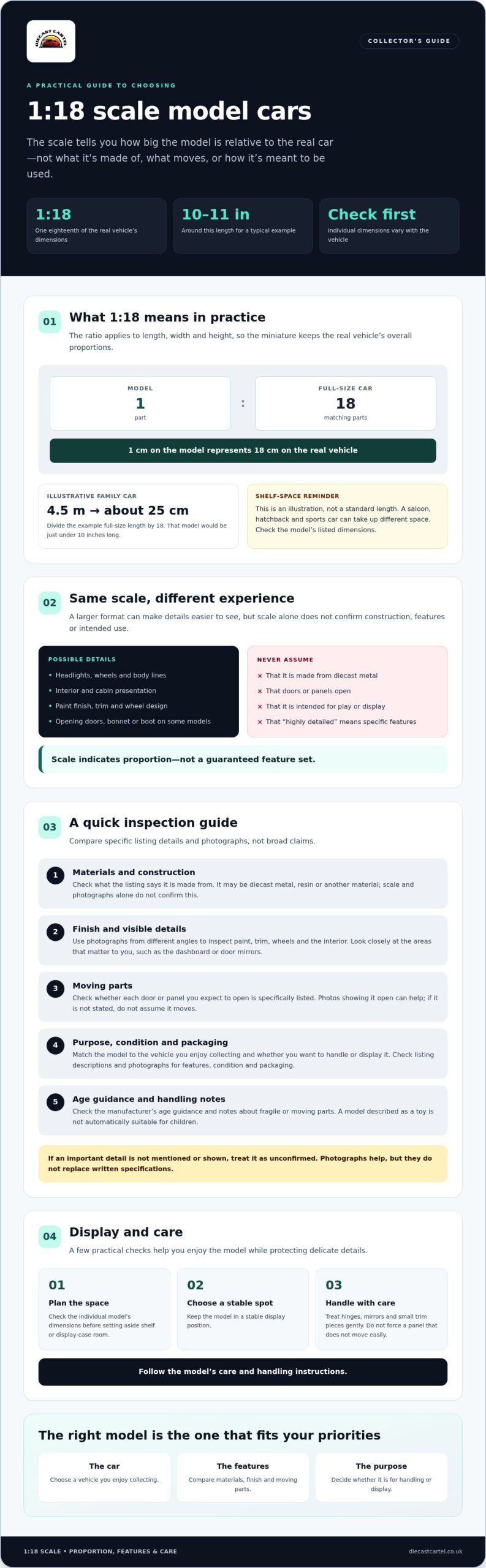
A 1:18 scale model represents its full-size counterpart at one eighteenth of the dimensions: one centimetre on the model stands for eighteen centimetres on the real vehicle. The ratio applies to length, width and height, so the miniature retains the vehicle’s overall proportions. For a fuller explanation of the 1/18 scale, see the scale reference on Wikipedia.
This relatively large format can make features easier to appreciate than on smaller models. Headlights, wheels, body lines and other exterior details are more visible at a glance, and a model may have room for a more prominent interior presentation. But scale tells you only about relative size. It doesn’t confirm whether a model is made from diecast metal, resin or another material, which parts move, or whether it’s intended for play, display or collecting. Check the individual model’s listing for those details.
How large is a 1/18 scale model car?
As a rough example, take a full-size family car about 4.5 metres long. Divide that length by 18 and its model would be approximately 25 centimetres long, or just under 10 inches. This is an illustration, not a standard model length: a long saloon, compact hatchback and broad sports car won’t take up the same space. Body shape affects width and height too, so check the listed dimensions before setting aside room on a shelf or in a display case.
Is a 1/18 model a toy or a collectible?
“Toy” can describe products built for different uses, from handling and play to careful display. A 1:18 ratio alone doesn’t tell you which applies. Some models have moving parts, while others may include delicate details that call for gentler handling. Nor does the scale establish an age recommendation.
Before choosing, look for the listing’s age guidance, notes about moving or fragile parts, and any handling instructions. Consider who’ll use the model and where it’ll be kept. If you’re choosing for a young enthusiast, don’t assume a model is suitable for children simply because it’s described as a toy; follow the manufacturer’s guidance. For collectors, clear photos and feature descriptions can help you judge whether the finish and presentation suit your display. The right choice is the one that fits your purpose, not just the number on the box.
What details and features vary between 1/18 scale toy cars?
Two models in the same scale can offer very different experiences. One may prioritise a polished exterior for display; another may include a detailed cabin or parts that open. Materials, paint finish, trim and construction also vary between manufacturers and individual models. Scale indicates proportion, not a guaranteed feature set. Don’t assume a model is diecast, has moving parts or is intended for play just because it’s 1:18.
Decide what you’ll value most. Do you want to admire the car’s shape and paintwork on a shelf, inspect details inside the cabin, or open doors and panels? A model described as “highly detailed” may not explain which features are included. Use the product description and photographs together, and look for specific information rather than relying on broad promotional wording.
Which construction and finish details should you check?
Start with the stated materials. The scale alone doesn’t confirm diecast metal construction, and a close-up photo can’t reliably tell you what the model is made from. Examine listing images from different angles to check the paint finish, trim, wheel design and visible interior details. Look for clear views of the areas that matter to you, such as the dashboard or door mirrors. Photos are useful, but they don’t replace written specifications.
Descriptions can also help you distinguish a display-focused collectible from a model presented for more hands-on use. Check for notes on the finish, construction, included features and care or handling guidance. If an important detail isn’t mentioned or shown, don’t treat it as confirmed. Check the listing carefully before making your choice.
Do 1/18 scale cars have opening parts?
Some models have opening doors, bonnets or boots; others are sealed. These functions depend on the specific model, not its scale. Check the description for each part you expect to move, and look for photographs showing it open. A general claim about detail doesn’t confirm that doors or panels operate. If the listing doesn’t say, avoid assuming they do.
Moving parts can make a model more engaging to explore, but they may also call for gentler handling. Hinges, mirrors and small trim pieces can be delicate, so follow any handling notes and avoid forcing a panel that doesn’t move easily. If you’re comparing 1:18 scale model cars, use each listing’s specifications to judge which finish and features suit your collecting interests.
How does 1/18 scale compare with other model car scales?
Scale affects more than how a model looks in your hand. It influences how clearly you can see its details, how much room it takes up and how many models you can comfortably display together. A larger scale isn’t automatically better or more detailed: construction and finish still depend on the individual model. Use the comparison below as a guide, then check actual product dimensions before arranging your collection.
| Scale | Approximate relative length | Display impact | Collector considerations |
|---|---|---|---|
| 1:18 | 100% reference size | Prominent; needs more shelf space per model | Details are easier to view at a glance; plan space for each vehicle |
| 1:24 | About 75% of a 1:18 model of the same car | Smaller footprint, so more may fit in a given display area | A useful middle ground if you want to balance visibility with available space |
| 1:43 | About 42% of a 1:18 model of the same car | Compact and easier to arrange in groups | Handy for collectors prioritising variety or limited display room |
| 1:64 | About 28% of a 1:18 model of the same car | Takes up relatively little display space | Can suit a larger collection where compact storage matters |
These percentages compare approximate model lengths for the same full-size vehicle, based on the scale ratios. They don’t describe exact shelf space: width, height, mirrors and display bases can all affect the room a model needs.
Is 1/18 scale bigger than 1/24?
Yes. For the same real car, a 1:18 model is larger than a 1:24 model. The difference follows directly from the ratios: the 1:18 version is about one-third longer. That extra presence can make a model easier to appreciate, but it also means fewer may fit on a shelf. For a closer look at the trade-offs, see this 1:18 versus 1:24 diecast guide.
Which scale suits your collection and display space?
Start with the space you have and the way you like to collect. Choose a scale that lets you enjoy the cars you’re most interested in without overcrowding your display. Mixing scales can work, but models of the same vehicle will look noticeably different in size side by side. If you’re planning a collection, this beginner’s die-cast collection guide offers another starting point. For 1/18 scale toy cars, measure the available space and check each listing’s dimensions before choosing.
How can you choose a 1/18 scale toy car with confidence?
Start with what you want from the model, not with a vague promise of “great detail”. Use this checklist to compare listings and decide whether a car suits your interests, intended use and display space.
- Purpose: Decide whether the model is for display, collecting, hands-on play or a gift. These uses can call for different features and levels of careful handling.
- Vehicle interest: Choose a car, era or design you genuinely enjoy. A model that means something to you is more likely to earn a valued place in your collection.
- Dimensions: Check the listed length, width and height, then compare them with your shelf or display case. The same scale doesn’t mean every vehicle has the same footprint.
- Features: Look for stated materials, opening parts, interior details and anything included with the model. Don’t infer features from the scale or a general description.
- Listing clarity: Compare photographs with the written description. Check any stated condition, age guidance, care notes and packaging details, especially if these matter for gifting or collecting.
What should you check in a product listing?
Confirm that the listing identifies the scale and vehicle clearly, and describes the materials and included components. Review photographs from different angles, checking that they appear consistent with the written details. Images can show paint, trim and visible features, but they can’t confirm everything, such as material or age suitability. If an important point is unclear, ask the retailer before choosing rather than relying on an assumption.
Condition and packaging details are worth checking if you’re buying for a collection or as a present. Look for an explicit statement about condition and whether packaging is included or pictured. Don’t assume the box is part of the purchase simply because it appears in a photograph.
How should you match a model to your collecting interests?
Start with what draws you in: a particular type of vehicle, a period of motoring or a design detail you enjoy. Then picture the model alongside what you already own. A matching scale can create a consistent display, whilst a mix can reflect varied interests, but vehicles’ actual dimensions still differ. Measure your available space and check each listing rather than relying on scale alone.
For a gift, consider the recipient’s favourite vehicles and whether they collect models or prefer something to handle. Check the listing’s age guidance, features and handling notes instead of guessing suitability. Ready to compare options? Browse 1:18 scale model cars and review each listing’s details before deciding.
How do you care for and find 1/18 scale toy cars?
A little care helps keep a model looking its best, whether it’s a treasured collectible or simply a favourite car on display. Choose a stable, clean spot away from frequent knocks and unnecessary handling. Before placing the model, check that the surface is level and has enough room for its full footprint, including any delicate parts that extend beyond the body.
How should you display and handle a 1/18 model?
Dust gently with a soft, suitable cloth, taking care around mirrors, trim and other small details. For clearing dust from intricate grilles and cabin crevices without direct contact, some hobbyists utilise compact cordless air blowers like those available from BarberNation: Professional Barber Tools and Grooming Supplies, taking care to keep the airflow gentle near delicate photo-etched parts. Avoid forcing doors or panels, and support the model securely when moving it. Cleaning needs can vary by materials and finish, so follow the individual model’s care instructions rather than applying a one-size-fits-all method. If you’re unsure which products or techniques are suitable, check the manufacturer’s guidance first.
Consider the display environment, too. A position away from busy walkways can reduce the risk of accidental knocks, whilst a stable surface helps prevent the model from being nudged or slipping. If the car has moving parts, handle them gently and only as the product guidance allows. Models differ, so don’t assume every one will withstand the same level of handling.
Diecast Cartel is a UK-based online retailer offering 1:18 scale model cars. As you browse, compare the stated scale, dimensions, materials, features and any condition or packaging information. Clear photographs can help you inspect visible details, but use the written specifications to confirm what’s included. Check current listings and availability before making a decision, as these can change.
For 1/18 scale toy cars, a careful comparison can help you find a model that suits your interests and the space you have, without relying on scale alone. Take your time, check the details that matter to you and choose a display spot where you can enjoy the model without needing to move it often. If you’re ready to explore, browse Diecast Cartel’s model car range.
Choose a model you’ll be proud to display
The right 1/18 scale toy cars are about more than the ratio. Scale helps you picture a model’s proportions and display footprint, but materials, finish and moving parts vary, so check the individual listing before choosing. Match the car to your collecting interests, intended use and available space, then handle and display it with care.
That thoughtful approach can make every addition feel more personal, whether you’re starting a collection or adding a new favourite to the shelf. Diecast Cartel is a UK-based online retailer offering 1:18 scale model cars to customers across the United Kingdom. Check current listings and their details as you compare your options.
Browse Diecast Cartel’s 1:18 scale model cars, and enjoy discovering a model that feels right for your collection. Happy collecting!
Frequently Asked Questions
What does 1/18 scale mean for a toy car?
A 1:18 model represents the same vehicle at one eighteenth of its full-size proportions. It’s a ratio, not a promise of a particular length, material or set of features. A model’s measurements depend on the original car and how the replica is designed. Before choosing, check the individual listing for dimensions and specifications, including construction and any moving parts you want to know about.
How big is a 1/18 scale model car?
There isn’t one fixed size, because a model’s dimensions depend on the full-size vehicle it represents. As a broad guide, 1:18 model cars are often around 10 to 11 inches long, approximately 25 to 28 centimetres. Treat this as an estimate, not a guarantee. Check the listing’s measurements before buying, especially if you’re planning shelf space, storage or a place alongside models you already own.
Are 1/18 scale cars suitable for children?
Suitability depends on the individual model, its age guidance and its parts. Small or movable details may need careful handling, so don’t assume every product described as a toy is intended for young children. Check the manufacturer’s or retailer’s age and safety information, along with any handling notes. Choose a model that suits the intended user, how it will be handled and where it will be kept.
Do all 1/18 scale model cars have opening doors?
No, opening doors aren’t guaranteed by the scale. Some models may have opening doors, bonnets or boots, whilst others have no opening sections. Check the product specifications for each function, and look for photographs that show the relevant part open. If the listing isn’t clear, ask the retailer rather than assuming the model has the same features as another car in the same scale.
Is 1/18 scale bigger than 1/24 scale?
Yes. If both models represent the same full-size vehicle, the 1:18 version is larger than the 1:24 version. That difference gives it more visual presence and usually means it needs more display space. Models of different scales can look noticeably different when placed together, though the exact dimensions still depend on the vehicle. Compare the listed measurements with your available shelf space before choosing.
How do you clean a 1/18 scale toy car?
Dust it gently with a soft, suitable cloth and handle delicate trim or moving parts with care. Follow the model’s own care instructions, as materials and finishes can differ. Don’t use liquids or cleaning products unless the manufacturer confirms they’re suitable for that model. If you’re unsure, check the product guidance first. Avoid forcing opening parts, and support the model securely while cleaning it.
Are 1/18 scale model cars good for starting a collection?
They can be a good starting point if you enjoy a larger display presence and have room for the models. Choose vehicles you genuinely like, then check each listing’s dimensions, features and specifications before adding one to your shelf. Other scales may suit a smaller display area or different collecting plans. There’s no single best scale, so build around your interests and the space you have.
