
Diecast Guides
Diecast Model Display Ideas: The Ultimate Collector’s Guide 2026
Sep
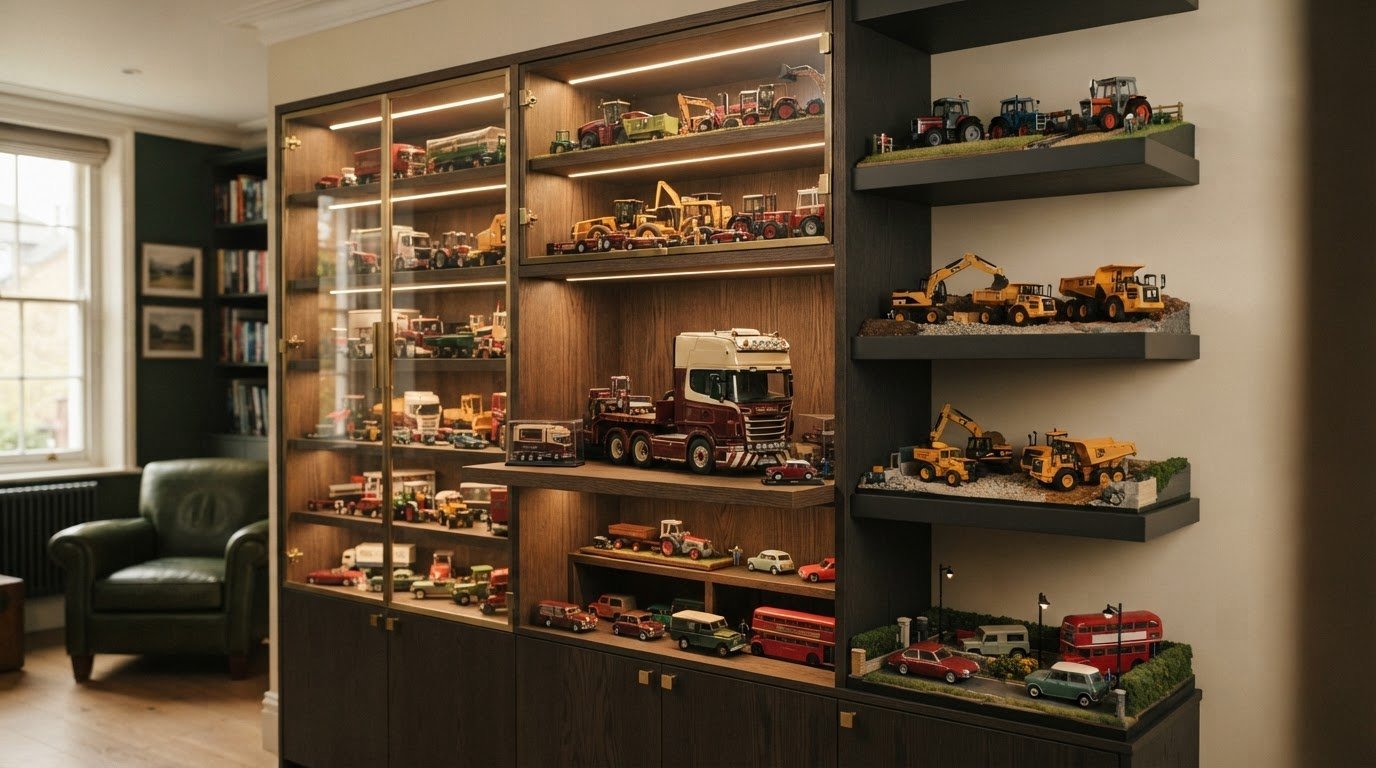
What if your diecast collection could feel less like a row of models and more like a miniature museum, without leaving every bonnet and engine detail exposed to dust? The right diecast model display ideas can help you create a striking showcase, protect models from direct sunlight and make better use of the space you have.
If you’ve struggled to keep intricate details clean, worried about colour fading or wondered where a larger 1:24 scale truck or tractor could fit, you’re not alone. Displaying a collection is about more than finding a shelf. It means balancing protection, available space and the stories that make each model a favourite.
This guide covers practical ways to build a polished, organised display, from enclosed cases and lighting to layouts that give larger models room to shine. You’ll find tips for choosing a spot away from direct sunlight and arranging your collection with a curator’s eye. Whether you’re showcasing a few prized vehicles or building around a 1:24 scale centrepiece, you can make your collection easier to enjoy and care for.
Key Takeaways
- Make your display feel curated rather than simply stored by arranging models around a clear theme or story.
- Compare wall-mounted cases, cabinets and floating shelves against your available space, model sizes and display priorities.
- Use enclosed cases and a position away from direct sunlight to help limit dust and light exposure, and check display materials before buying.
- Group trucks by livery or haulage type, and create simple scenes for tractors and RC construction vehicles.
- Give 1:24 scale trucks and other standout models room to shine by measuring their full footprint before planning your layout.
The Art of the Showcase: Why Your Diecast Display Matters
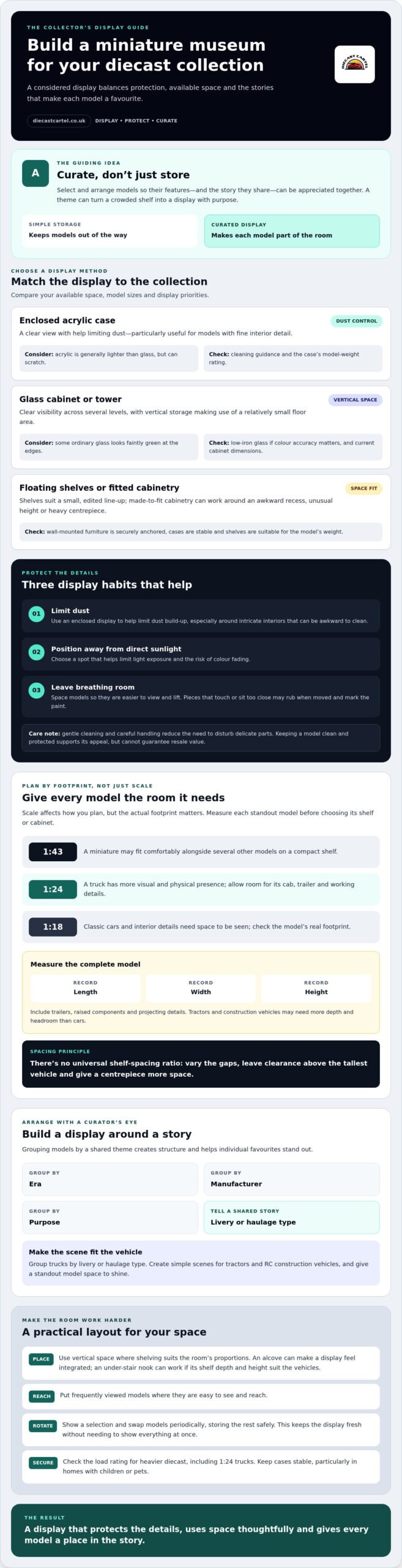
Storage keeps models out of the way; a curated display makes them part of the room and gives each one a reason to be there. Grouping vehicles by era, manufacturer or purpose can turn a crowded shelf into a collection with a clear story. It also makes it easier to enjoy the details of individual favourites. Curation means selecting and arranging models so their features and shared story can be appreciated together.
A well-planned showcase can help preserve condition, which matters to collectors who may one day sell or exchange a model. It cannot guarantee resale value, but keeping a model clean and protected supports its appeal. For background on the materials, manufacturing and scales behind the hobby, see this overview of the die-cast toy.
Scale affects how you plan. A 1:43 miniature may fit comfortably alongside several other models on a compact shelf, while a 1:24 truck has more visual and physical presence. Its cab, trailer and working details need room to be seen, not squeezed into a line. The same applies to 1:18 classic cars: check each model’s actual footprint rather than relying on scale alone. Start with the models you most want to feature, then shape the available space around them.
Preserving Detail and Value amongst Collectors
Dust settles into fine details, including the interiors of 1:18 models, where seats, dashboards and trim can be awkward to clean. An enclosed display helps limit dust build-up, while careful handling and gentle cleaning reduce the need to disturb delicate parts. Leave breathing room between vehicles, too. Models that touch or sit too close may rub against one another when moved, risking marks to the paint. A little extra space makes each piece easier to view and lift safely.
Scale Considerations: Planning Your Space
Measure your standout models before choosing a cabinet or shelf. Record the length, width and height of each one, including its trailer, raised components or projecting details. Tractors and construction vehicles may need more depth and headroom than cars. There’s no universal “Golden Ratio” for shelf spacing. Instead, vary the gaps to suit each model, leave clearance above the tallest vehicle and give a centrepiece more space. The result will feel deliberate rather than cramped.
Essential Display Methods: From Floating Shelves to Bespoke Cabinets
The best display fits both your collection and your home. A wall-mounted acrylic case can keep dust away while giving a 1:18 model a clear view; enclosed cases are especially useful for models with fine interior detail. Acrylic is generally lighter than glass, but it can scratch, so check how it should be cleaned and whether the case is rated for the model’s weight. For heavier diecast, including 1:24 trucks, check the shelf or cabinet’s load rating rather than assuming every display surface is suitable.
Glass offers a substantial feel and clear visibility, although some ordinary glass looks faintly green at the edges. If colour accuracy matters to you, inspect a sample or ask about low-iron glass. Glass tower cabinets show why vertical displays appeal to collectors: several levels of models can fit into a relatively small floor area. Check current product details before planning around a particular cabinet, as dimensions and availability can change.
Acrylic, glass and made-to-fit cabinetry
Floating shelves work well for a small, carefully edited line-up, while alcoves can make a display feel integrated with the room. For a growing collection, off-the-shelf cabinets are often simpler to plan around. Made-to-fit cabinetry may suit an awkward recess, unusual model height or heavy centrepiece that standard furniture cannot accommodate. If you are repurposing an existing table or sideboard into a display base, specialists like Glass Mirror House supply cut-to-size toughened safety glass to protect surfaces from scratches and support substantial models. Whichever option you choose, anchor wall-mounted furniture securely and keep cases stable, particularly in homes with children or pets.
Making small rooms work harder
Floor space can be limited, so consider using vertical space with shelving that suits the room’s proportions. Put frequently viewed models where they’re easy to see and reach. An under-stair nook can become a compact hobby display, provided the shelf depth and height suit the vehicles, not just their boxes. Another option is to keep a selection on show and swap models periodically, storing the rest safely. This keeps the display fresh without requiring one room to show everything at once.
Thoughtful arranging can bring structure to a collection. The University of Arizona’s discussion of the psychology of collecting offers context for why organising meaningful objects can be satisfying. Treat these diecast model display ideas as a starting point, not a rigid formula. Measure your chosen space, check load limits and decide which models deserve the most prominent position. If you’re planning around a centrepiece, explore 1:24 scale trucks and tractors from Diecast Cartel.
Protecting Your Investment: Dust, UV Light, and Material Choices
A display case helps, but its material and position matter. Sunlight contains ultraviolet (UV) radiation, which can fade colours and degrade some finishes over time, including paint and decals. Keep cases away from direct sun, and consider UV-filtering glazing when choosing a cabinet. The principles of artifact preservation offer useful guidance on reducing risks from light and environmental changes.
Dust protection can be passive or more comprehensive. A closed case provides a barrier, while cabinets with well-fitted doors and weather-stripping can help limit fine dust entering through gaps. No enclosure is completely maintenance-free, so check seals and clean the cabinet interior when needed. Keep models in a stable indoor environment, away from damp spots and sharp temperature changes. These precautions support preservation, although they can’t prevent every material issue.
Lighting your models without heat damage
Choose LED lighting over halogen. LEDs produce less heat, reducing the chance of warm lights affecting nearby models. Position strips to illuminate details without creating strong glare or deep shadows. For a 1:24 truck, lighting from the front or front sides can help reveal the grille. A timer or smart plug can switch display lights on when you want to enjoy the collection and off afterwards, rather than leaving them running continuously.
Handling and cleaning with care
White gloves aren’t essential. Clean, dry hands give you better control when lifting a model, while lint-free gloves may help avoid fingerprints if they don’t compromise your grip. Support the model from its base and avoid touching delicate trim or moving parts.
Use a clean microfibre cloth on accessible surfaces and a soft-bristled brush for dust around grilles, wheel arches and interior details. Don’t press hard or drag particles across the paint. Clean the cabinet when dust or marks appear; inspect models regularly and clean them only when needed. For delicate finishes, test any method on an inconspicuous area first.
Household chemical cleaners can dull, stain or damage diecast paint, so keep them away from your models unless the manufacturer specifically confirms they’re safe. Gentle cleaning, careful handling and sensible lighting make these display choices more than a visual upgrade: they help you enjoy the collection while taking care of it.
Creative Curation: Thematic Ideas for Trucks, Tractors, and RC Cars
A strong theme gives a display rhythm and helps each model feel chosen, not simply parked. For 1:24 trucks, try grouping by livery, haulage type or era. Leave enough space around longer vehicles for their profiles and detailing to stand out. These larger centrepieces can quickly make a shelf feel crowded, so leave room at the ends of trailers and between neighbouring models. That way, you can see each one without moving the others.
Tractors invite a different story. Arrange them against a simple farmyard-style backdrop, using a textured base to suggest gravel, earth or concrete. Cars can tell a timeline: place classic models at one end and progress towards modern designs, making changes in shape and styling easy to compare. For 1:22 construction vehicles, create a separate worksite scene or position them alongside static models as part of a larger machinery display. Keep operating RC vehicles accessible rather than burying them behind fragile props.
Build a scene at the right scale
Small details add context, but consistency matters. A 1:24 scene might include carefully chosen pallets, workshop tools or a forklift as props, provided their proportions suit the vehicles. Printed tarmac or farmyard textures can create a convincing floor without taking up much room. Figures and peripheral equipment help establish scale, but avoid overcrowding: the model should remain the focal point. Check the scene from your usual viewing distance, where mismatched proportions can stand out.
Coordinate colour and livery
A monochrome shelf can create a calm, considered look, especially against a neutral background. For a livelier arrangement, repeat a colour or livery detail across several models, then use one contrasting vehicle as the visual anchor. You could also build a display around British haulage history by bringing together liveries or vehicle types that reflect a particular era or kind of work. For more inspiration, explore this 1:24 scale diecast trucks guide.
These diecast model display ideas work best when the arrangement suits the collection you actually have. Start with one theme, leave breathing room for larger models and adjust the layout as new favourites arrive. To choose a centrepiece for a truck or tractor display, explore 1:24 scale models from Diecast Cartel.
Completing the Scene: How to Feature Your Diecast Cartel Acquisitions
A well-chosen hero model gives a display its focal point. Diecast Cartel specialises in 1:24 scale trucks and tractors, which can anchor a shelf, while 1:18 scale cars and RC construction vehicles offer other ways to build a themed collection. Choose one standout lorry or piece of machinery, then add supporting models gradually. This keeps the display coherent and gives you a chance to plan space for each new addition.
Selecting your next hero piece
A 1:24 truck can make an impressive centrepiece, but measure its footprint and allow clearance around it before choosing a spot. Consider what you want the model to communicate: a striking livery, a particular type of haulage or distinctive detailing. If a model has opening parts, you can use them to show more of its design, provided they’re designed to open and can be displayed without straining delicate components. For more guidance on choosing and organising models, read how to start a diecast collection.
Want movement in the scene? An RC forklift or construction vehicle can add a dynamic counterpoint to static models. Keep it positioned so you can remove it easily without disturbing nearby pieces, and use the rechargeable batteries specified for the vehicle. Follow its instructions for charging and storage. A display piece doesn’t need to be left switched on to make an impression.
From one shelf to a shared hobby
One shelf can be the start of a dedicated hobby corner. As your collection grows, add display space in stages and leave room for future favourites rather than filling every surface. A simple backdrop, consistent lighting and a clear theme can make even a small setup feel considered. These diecast model display ideas can grow with your interests, whether you focus on trucks, tractors, cars or RC machinery.
Enjoy sharing your setup? Photograph it from the model’s level, use even lighting and remove visual clutter from the background. A close-up can reveal a favourite detail, while a wider shot shows how the theme comes together. Sharing progress with other collectors can spark new ideas and conversations, and may inspire someone else to arrange their collection.
Ready to choose a centrepiece for your next display? Explore the latest 1:24 scale truck arrivals at Diecast Cartel, and find a model that fits the story you want your collection to tell.
Make Your Collection a Showcase to Be Proud Of
A memorable display does more than give models a place to sit. It brings your collection together around a theme, gives standout vehicles room to shine and helps protect them from dust and light. The best diecast model display ideas work with your space and reflect what you love collecting, whether that’s classic cars, powerful lorries, tractors or RC machinery.
Start with a secure display that suits your models’ size and weight, then arrange them with enough space to appreciate their details. A clear theme, thoughtful lighting and regular, gentle care can turn even a single shelf into a personal, considered display.
Diecast Cartel is a UK-based online retailer of 1:18 and 1:24 scale models, including trucks, tractors and RC vehicles. Browse Diecast Cartel’s 1:24 scale diecast models to find a centrepiece for your display.
Frequently Asked Questions
What is the best way to display 1:24 scale diecast trucks?
Display 1:24 scale trucks on a stable shelf or in a cabinet with enough depth, height and weight capacity for each model. Measure the truck, including any trailer or projecting details, and leave space around it so the livery and shape are easy to see. An enclosed case helps limit dust, while grouping trucks by haulage type, era or colour gives the display a cohesive feel.
How do I protect my diecast car collection from dust?
An enclosed display cabinet is one of the simplest ways to reduce dust settling on your models. Choose doors that fit closely, and consider weather-stripping to help limit dust entering through gaps. Clean the cabinet when you notice dust or marks, and use a soft-bristled brush or clean microfibre cloth on models only when needed. Avoid roughly wiping dusty paint, as trapped particles could leave fine scratches.
Can I display remote control vehicles alongside static diecast models?
Yes. A themed display can bring RC construction vehicles and forklifts together with static diecast trucks, tractors or cars. Keep the RC vehicle easy to lift out, with enough room to handle it without knocking nearby models or props. Store and charge its batteries according to the vehicle’s instructions, and keep charging equipment out of an enclosed display unless the manufacturer says that setup is suitable.
Does sunlight damage diecast model car paint?
Prolonged exposure to direct sunlight can fade paint and decals, so place your display away from sunny windows. UV-filtering glazing can add protection, but it’s still sensible to avoid a bright, sunlit position. Check the cabinet’s specifications before buying, as not all acrylic or glass cases filter UV. These steps help preserve a model’s appearance, though no display arrangement can prevent every change over time.
What are the best shelves for a 1:18 scale model car collection?
The best shelves are sturdy, level and deep enough for your actual models, with secure support for their combined weight. Measure each car and check the furniture maker’s stated load capacity before arranging the collection. For collectors looking for robust, handcrafted timber options to display their prized pieces, learn more about Urban Reclamation. Enclosed shelving helps keep dust off, while open shelves make models easy to view and reach. Leave headroom for lifting cars out safely, and avoid placing shelves where direct sunlight falls.
How often should I clean my diecast display cabinet?
Clean the cabinet when you can see dust, fingerprints or marks, rather than relying on a fixed schedule. The right interval depends on the room and how well the doors seal. Wipe the cabinet surfaces with a suitable soft cloth, taking care not to brush debris onto the models. Inspect the collection regularly, but clean individual vehicles only when needed, using gentle tools and avoiding household chemical cleaners.
Should I keep the original boxes for my diecast models?
Keeping the original boxes can be useful for storage, moving or keeping the packaging with a model, and some collectors prefer to retain them as part of the collection. Store boxes somewhere dry and out of direct sunlight, without placing heavy items on top. If resale matters to you, keep packaging in good condition where practical, but remember that boxes alone can’t guarantee a model’s future value.
Is LED lighting safe for diecast model displays?
LED lighting is generally a better choice than halogen for a display because it produces less heat, helping reduce heat exposure around models. Position strips so they illuminate details without harsh glare or shadows, and keep lights at a suitable distance from the vehicles. A timer can switch the display lighting off when it’s not being enjoyed. LEDs don’t remove the risk of sunlight, so avoid direct UV exposure too.
