
Diecast Guides
Best RC Car for a 10-Year-Old: 2026 UK Buying Guide

Sep
The fastest RC car isn’t always the best first car. For parents searching “best RC car for 10 year old UK”, the right choice is usually the one their child can control confidently, and enjoy in the space they have to play.
It’s easy to get caught up in speed figures, but a car that’s tricky to steer or unsuitable for the garden, park or pavement can quickly become frustrating. You’ll also want to know whether it’s built for smooth surfaces or rougher ground, how long the battery lasts, and what’s included in the box.
This guide will help you compare on-road cars, off-road buggies and monster trucks, with a focus on manageable controls, durability and play space rather than headline speed. We’ll also explain what to check about batteries and chargers, age guidance and UK toy safety markings before buying. Whether your child is ready for a simple first car or keen to explore more hobby-style features, you’ll have a clearer idea of what suits them, and what to look for in the product listing.
Key Takeaways
- Find the best RC car for 10 year old UK by matching the car to your child’s experience and where they’ll drive it.
- Compare on-road cars, off-road cars and monster trucks by surface, steering challenge and storage needs.
- Check the controls, age guidance and construction in each product listing rather than choosing by speed alone.
- Confirm which batteries and accessories are included, and check the car’s exact battery requirements before buying.
- Use the manufacturer’s instructions to guide safe operation, then explore Diecast Cartel’s RC cars and trucks with your shortlist in mind.
What makes an RC car suitable for a 10-year-old?
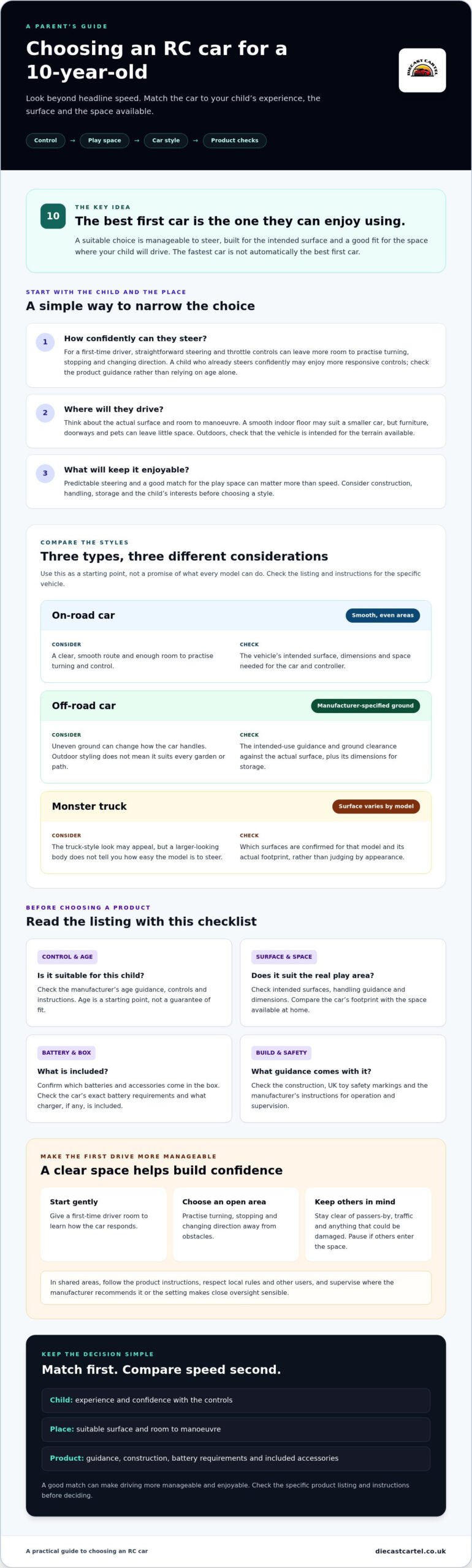
A first RC car should feel exciting from the first run, but it also needs to be manageable and suited to its surroundings. The best RC car for 10 year old UK shoppers choose isn’t automatically the fastest or most powerful: suitability depends on how confidently the child can steer, how the car is built, and where they’ll drive it. A vehicle that works well on a smooth indoor floor may struggle on uneven ground, whilst a car designed for outdoor use may need more room to turn safely.
Age is a useful starting point, not a guarantee of fit. Check the manufacturer’s age guidance and instructions for each product, including any advice about operation and supervision. Consider construction, too: a beginner may benefit from a straightforward design that’s easier to handle, whilst a child with more experience may enjoy more responsive controls. Speed is only one factor. Predictable steering and a good match for the play space can make a bigger difference to whether each session stays fun.
If you’d like background on the different designs and mechanics, Radio-controlled cars offers a broad overview. For choosing a first car, though, start with the child and the place they’ll use it.
How much RC car experience does the child have?
For a first-time driver, simple controls can make the learning curve feel less steep. A basic steering and throttle layout gives them room to practise turning, stopping and changing direction without juggling extra functions. Begin at a gentle pace, in an open area, and let them get used to how the car responds.
A child who already steers confidently may be ready for a more responsive car, but check its controls and product guidance rather than assuming age alone settles the question. An adult should supervise if the manufacturer recommends it, or if the setting, speed or the child’s experience makes close oversight sensible.
Where will a 10-year-old drive an RC car?
Think about the surface and available space before choosing a style. Smooth indoor floors can suit smaller cars, but furniture, doorways and pets may leave little room to manoeuvre. Outdoors, an open, suitable surface gives more space to practise; check whether the car is designed for that terrain, especially if the ground is uneven.
People matter as much as obstacles. Choose a clear area away from passers-by, traffic and anything that could be damaged, and pause if others enter the space. In shared areas, follow the product instructions and respect local rules and other users. Matching the car to the place helps make driving safer and more enjoyable for everyone.
Which RC car style suits a 10-year-old best?
Start with the surfaces your child can actually use and the kind of driving they enjoy. A sleek on-road car may appeal to a young motorsport fan, whilst a truck-style body can have plenty of visual presence. Neither look guarantees an easy drive or a particular level of performance. The best RC car for 10 year old UK families choose is the one that fits the child’s interests, available space and driving experience.
Use this comparison as a starting point, not a promise of what every vehicle can do. Specifications differ between products, so check the listing and instructions for intended surfaces, handling guidance and dimensions.
| Style | Suitable surface | Steering consideration | Storage needs | Typical play experience |
|---|---|---|---|---|
| On-road car | Smooth, even areas suited to the vehicle | Look for guidance on turning and control; a confined area may leave less room to practise | Check the listed dimensions and make space for the car and controller | Driving on a clear, smooth route |
| Off-road car | Surfaces specified by the manufacturer | Uneven ground can make handling different; check the instructions | Compare dimensions with the space available at home | Exploring a suitable outdoor area |
| Monster truck | Only the surfaces confirmed for that model | Its larger-looking body doesn’t tell you how easy it is to steer | Check its actual footprint, rather than judging by appearance | A bold truck look and open-ended pretend play |
Are off-road RC cars easier for outdoor play?
They can be worth considering for outdoor use, but “off-road” styling doesn’t mean a car suits every garden, path or patch of rough ground. Check the product’s ground clearance and intended-use guidance, then compare them with the actual surface. A car meant for a firm, even track may not be suitable for long grass or loose gravel. Choose for the terrain you have, not the terrain you imagine.
Is an on-road car or monster truck a better first choice?
An on-road car is a natural option if your child will drive on a smooth, open surface and likes a road-car look. A monster truck may catch their eye with its bold proportions, but its appearance alone says little about handling or required space. Before deciding, compare each model’s dimensions and steering guidance with the play area. A roomy spot and a manageable control setup matter more than the body style.
Use the child’s favourite look as a useful clue, then check the practical details before choosing. Diecast Cartel offers RC cars and trucks; review each listing for its scale, dimensions and product-specific guidance to see whether it matches your shortlist.
What should parents compare before buying an RC car?
Once you’ve settled on a style and likely play area, compare the details that affect everyday use. Product descriptions can make cars sound similar, but control layouts, included equipment and battery requirements may differ. Use this checklist to narrow down the best RC car for 10 year old UK families are considering:
- Controls: Check how steering and throttle work, and whether the listing describes the car’s steering response.
- Age guidance: Follow the manufacturer’s stated age recommendation and read the operating instructions.
- Construction: Look for clear information about the body and components, and check whether replacement parts are identified if repairability matters to you.
- Scale and dimensions: Confirm the measurements, not just the scale label, to see whether the car suits the available play and storage space.
- Battery and accessories: Check the battery type and compatibility, and whether the car, controller batteries and charger are included.
Speed, scale and stated driving time are specific to each product. A scale label describes size relative to a full-sized vehicle, not how fast or easy the car is to control. Treat driving-time figures as product information to verify, rather than a guarantee of how long every session will last.
Suitability depends on the exact car and the child’s play setting.
Which controls and features are easiest to manage?
Read the product information for the controller layout and how the steering responds. A straightforward setup can make it easier for a new driver to practise, but don’t assume every RC car uses the same controls. If a listing mentions speed settings or a beginner mode, check how these work and whether the instructions explain their use. Don’t count on those features unless the specific product confirms them.
What should you know about batteries and charging?
Check the battery chemistry, voltage and connector requirements against the car’s instructions, and confirm which battery and charging accessories are supplied. A rechargeable battery sold separately is only suitable if it matches the vehicle’s requirements. Running time can vary with the battery, surface and driving behaviour, so use the listing as a guide rather than assuming a fixed duration. For practical charging advice, see the RC car battery charging guide.
How can you choose an RC car that is safe and enjoyable to use?
A little preparation before the first run can help a new driver enjoy their car with fewer surprises. Product instructions should guide setup, age suitability and safe operation. In the UK, toys must meet the Toys (Safety) Regulations 2011; look for a UKCA or CE mark on the toy or packaging as an indication of compliance.
Use this quick pre-drive sequence:
- Read the instructions. Check the manufacturer’s age guidance, setup steps and operating advice before handing over the controller.
- Prepare the play area. Choose an open, suitable space away from roads, fragile objects and other people.
- Check the car and equipment. Make sure the car and controller are present, inspect the vehicle, and confirm any required batteries are compatible.
- Agree on supervision. Stay nearby as appropriate for the child’s experience, the setting and the manufacturer’s guidance.
What should you check before the first drive?
Don’t assume everything needed is in the box. Check the listing and instructions to see whether the vehicle, controller batteries, drive battery and charger are included, and confirm that the specified battery matches the car. Look over the vehicle for visible damage or loose parts, then follow the setup instructions. A clear area gives the child room to learn without steering towards hazards.
How can adults make early driving easier?
Start with a clear, open space and let the child practise steering gradually before attempting tighter turns or faster manoeuvres. Agree simple boundaries in advance, such as where to drive and when to stop, so everyone knows what to expect. Stay close if the child is new to RC cars, and follow the product’s supervision guidance as their confidence develops.
Battery safety matters after the drive, too. Charge and store the battery only as directed for its specific type; don’t assume different batteries share the same requirements. If the instructions call for adult supervision during charging, follow that advice. Keep batteries away from heat and damage, and stop using one if it appears damaged. These checks help make the best RC car for 10 year old UK buyers choose a better fit for both the child and the way it’ll be used.
Once you know what to check, Compare RC cars and trucks and review each product’s age guidance, controls and battery details before deciding.
Where can you find an RC car for a 10-year-old in the UK?
Once you’ve identified the child’s experience, likely driving surface and preferred style, you can compare products with a clear shortlist in mind. Look for manageable controls, suitable manufacturer guidance and battery requirements that you can meet. There isn’t one car that suits every 10-year-old, so treat the phrase best RC car for 10 year old UK as a search starting point, not an age-based guarantee.
Diecast Cartel is a UK-based online retailer offering RC cars and trucks, alongside RC construction vehicles. Its RC cars and trucks are available in 1:16 and 1:24 scales, but scale alone doesn’t confirm how a particular vehicle handles, where it can be driven or whether it’s right for your child. Check each individual listing for age guidance, specifications, included accessories and current availability.
What can you compare in an online RC car range?
Browse by the kind of play your child enjoys: RC cars for road-style driving, trucks for a bolder vehicle look, or construction vehicles for pretend worksite play. Then compare the details that separate one listing from another, such as dimensions, controls, stated intended use and what’s supplied. A category or product image can help you find a style they’ll love, but it can’t confirm suitability or performance.
Keep a short comparison note for each option. Record its intended surface, age guidance, control information and battery requirements. That makes it easier to weigh up the practical fit alongside your child’s favourite style, without assuming that every vehicle in a category behaves the same way.
For families also considering other active electric toys and wheeled ride-ons, such as kids’ hoverboards, you can read more from specialists like Hoveroo to see how safety features, controls and battery setups compare.
Before deciding, revisit the listing and check the manufacturer’s guidance and the vehicle’s dimensions. Confirm which battery is required, whether it and the charger are included, and whether controller batteries or other accessories need to be bought separately. If anything is unclear, don’t guess about compatibility; use the retailer’s published product information or customer-support details to check.
Also read the retailer’s published delivery, returns and customer-support information before ordering. These details can help you understand the purchase process, but check the current terms directly rather than relying on assumptions about delivery times, returns or support.
With those checks complete, you can browse Diecast Cartel’s RC cars, trucks and construction vehicles and compare the confirmed details at your own pace. Choose the option that fits your child and their play space, then verify its listing before you order.
Choose a car that makes every drive count
The best RC car for 10 year old UK families choose is one that suits the child’s experience, preferred play space and ability to manage its controls. Match the vehicle style to the surfaces they’ll use, then check manufacturer age guidance, dimensions and battery details on the individual listing. A good fit is about enjoyable, confident driving, not simply choosing the highest speed.
Diecast Cartel is a UK-based online retailer serving customers nationally, with RC cars and trucks and rechargeable batteries for RC toys. Before ordering, confirm what the specific vehicle includes and whether any battery or charger requirements need attention. Battery compatibility depends on the product, so check its instructions before selecting a replacement.
Ready to compare? Browse RC cars and trucks at Diecast Cartel, and take your shortlist one product detail at a time. With the right match, your young driver can enjoy the thrill of a first car and build confidence with every run.
Frequently Asked Questions
What is the best type of RC car for a 10-year-old?
Choose a style that fits the child’s interests, experience and play space. An on-road car may suit smooth, open surfaces, whilst an off-road car or truck could be a better match for outdoor play if its instructions confirm the intended terrain. There’s no single best RC car for 10 year old UK families; compare controls, dimensions and product guidance rather than relying on appearance or speed alone.
Is a 10-year-old old enough to use an RC car without supervision?
It depends on the specific car, the child’s experience and where they’ll use it. Read the manufacturer’s age guidance and operating instructions, and supervise as they recommend. Even if a child is confident, stay nearby if they’re learning the controls or driving in a shared area. Begin in a clear space and agree where the car can go and when the child should stop.
Can a 10-year-old use an off-road RC car on grass?
Possibly, but the off-road label alone doesn’t confirm that a particular car is suitable for grass. Check the product listing and instructions for its intended surfaces and ground clearance. Grass length and surface conditions can affect how a car moves, so match the vehicle to the actual play area. If the manufacturer doesn’t specify grass use, don’t assume it will perform well there.
How fast should an RC car for a 10-year-old go?
There isn’t one speed that suits every 10-year-old. Consider how easily the child can steer, how much room they have and whether the product offers a confirmed speed setting or beginner mode. Check the listed speed and handling guidance for the specific car, then choose a setting the child can manage safely. A controllable car can be more enjoyable than one chosen for speed alone.
How long does an RC car battery last?
Running time varies by model and battery, as well as the surface and how the car is driven. Check the manufacturer’s stated running time and battery specifications for the vehicle you’re considering. Treat any stated duration as product-specific, not a guarantee for every session. If spare batteries are being considered, confirm that their chemistry, voltage and connector match the car’s requirements.
Do RC cars come with batteries and a charger?
Some may include them, but don’t assume a car comes ready to run. Check the individual listing to see whether the vehicle battery, charger and controller batteries are supplied. If anything is sold separately, confirm the exact battery requirements before buying a replacement or accessory. Follow the product’s charging instructions, as guidance can differ between battery types and models.
What should I check before buying an RC car for a child?
Check the manufacturer’s age guidance, control layout, dimensions, intended surface and construction details. Then confirm which battery is required and whether it, the charger and controller batteries are included. Review the instructions for safe operation and charging, and consider the child’s experience and available play space. If you’re comparing options from a retailer such as Diecast Cartel, assess each listing individually rather than assuming every car or truck suits the same driver.
