
Diecast Guides
Diecast vs Resin Models Explained: Which Is Right for Your Collection?

Oct
The sharpest-looking model isn’t automatically the right one for your collection. If you’re searching for diecast vs resin models explained, the useful question is what you want from a model once it’s on your shelf. Fine body lines may catch your eye, while a satisfying weight or opening parts can make a model more enjoyable to handle.
Material descriptions can make the differences sound absolute, but construction is only one part of the picture. Scale, finish, maker and the individual model all matter. A resin piece may suit a display-focused collection, whilst diecast may appeal if you value a weightier feel or features you can interact with.
This guide explains how each material is used and what that can mean for detail, durability, handling and display. You’ll also find a practical way to weigh up the trade-offs against your collecting style. Whether you’re comparing materials or exploring diecast cars, trucks and tractors, you can choose with a clearer idea of what belongs in your collection.
Key Takeaways
- Use diecast vs resin models explained as a starting point, not a verdict: material alone doesn’t determine a model’s quality or appeal.
- Compare the exact models you’re considering. Finish, fine detail and features vary with the design and production choices.
- Decide what matters most to you, from a weightier feel and opening parts to appearance and display presence.
- Follow a simple process: define the model’s purpose, prioritise features, compare specific options, then choose the one that suits your style.
- If you’re drawn to diecast, explore Diecast Cartel’s 1:18 and 1:24 scale cars, trucks and tractors.
Diecast vs resin models explained: what are they made from?
Diecast models commonly use metal parts formed in a mould, whilst resin models are made by casting mouldable resin into shape. These are useful starting points, not guarantees about every model’s construction. A finished miniature can combine materials, and its material label alone won’t tell you how well it’s made or whether it suits your collection.
Collectors sometimes treat “diecast” and “resin” as complete descriptions of a model. They aren’t. The terms usually describe how some components are made, while the body, base, trim and smaller parts may use different materials. For a broader overview of the process and materials associated with a die-cast toy, Wikipedia provides helpful background.
What does diecast mean in a scale model?
Die-casting involves forming metal in a shaped mould, or die. In scale models, metal components are commonly made this way, with zinc alloys often associated with die-cast toys. The exact alloy and construction can vary. “Diecast” doesn’t mean every part of the model is metal, or that all diecast models use identical materials.
Other components may be made separately from materials such as plastic or rubber, then assembled with the cast parts. Two models described as diecast can therefore look or feel different because their designs, material mixes and finishes differ. The label tells you something about the construction, but not every detail of the finished piece.
What does resin mean in a scale model?
Resin is a mouldable material that can be cast to create a model’s body or other components. The term describes a material and a way of shaping parts, not a guaranteed level of detail. A resin model may have a crisp finish, but the result still depends on its design, mould, finishing and assembly. Resin alone doesn’t tell you how robust the completed model will be.
Material labels can also be used in different ways. One model may be described by its main body material, whilst another may be presented according to its overall construction. If the distinction matters to you, read the model specifications to see which parts use which materials instead of relying on the headline label.
Scale is a separate measure. It describes a model’s size in relation to its real-world subject: at 1:18 scale, for example, one unit of length on the model represents 18 units on the full-size vehicle. Scale doesn’t tell you whether a model is diecast or resin. Two models at the same scale can still differ in material, finish and build.
That’s why diecast vs resin models explained should begin with construction, then move on to the individual model. Design choices, surface finish and execution all shape the result. Compare the specifications and photographs of the miniature itself for a clearer picture than the material label alone can provide.
How diecast and resin models differ in detail, feel, and features
Material can influence a model’s finish, weight and construction, but it doesn’t determine how impressive the finished piece will look or feel. Resin models are often associated with sharp exterior lines and fine details, whilst metal construction commonly gives diecast models a weightier feel. These are tendencies, not rules. The maker’s choices and the execution of each model matter just as much.
A material label alone cannot establish a model’s detail or feature set. For a fair comparison, look at models of the same subject and scale where possible. Check close-up photographs of the grille, lights, wheel arches and panel lines, then read the specifications for opening parts and other features. This tells you more about the actual models than a generalisation about their materials.
Does resin always offer more detail than diecast?
No. A particular resin-casting approach may allow for sharp shapes or fine exterior features, but the result still depends on the mould design and how carefully the model is finished and assembled. Paint can soften small details, and features that look crisp in a close-up may be less noticeable at a smaller scale. Diecast models can also show impressive detail, depending on their design and production.
Compare the exact models you’re considering. Look for clear views of the details you care about and a consistent finish, rather than assuming one material will always look more refined. If two models depict the same subject, compare them at a similar scale and inspect equivalent areas in their photographs. The features you value most may stand out more on one model, whatever its material.
Do diecast models feel different or have more moving parts?
Metal construction commonly gives a diecast model a more substantial feel in the hand, though its final weight varies with its materials and design. That heft can be satisfying, but it isn’t a measure of accuracy or quality. Resin models can feel different to handle, but their appeal may lie in how they look on display rather than in their tactile weight.
Opening doors, bonnets or other parts are features of particular models, not a guarantee that comes with the word “diecast”. A resin model isn’t automatically without interactive features either. Check the individual specifications and photographs to see what opens or moves. Working parts offer a more hands-on experience; a finely finished, sealed model may suit a display where the exterior is the main attraction. Neither option is inherently better.
Think about how you’ll enjoy the model once it joins your collection. Will you handle it and explore its moving parts, or display it and focus on its silhouette and finish? That’s the practical heart of diecast vs resin models explained: compare each model with your priorities in mind. If diecast suits your collecting style, explore 1:18 and 1:24 scale diecast models, including cars, trucks and tractors.
Diecast vs resin models: a side-by-side comparison for collectors
A side-by-side comparison can help narrow your options, as long as you treat each point as a common tendency rather than a rule. Design, materials and execution all affect how a model looks and feels. Use the table to identify what to examine on the individual model.
| Consideration | Diecast models | Resin models |
|---|---|---|
| Typical material | Often includes metal components formed in a mould; other materials may be used for separate parts. | Uses moulded resin for the body or other components; construction varies by model. |
| Feel | Commonly feels weightier because of its metal parts, though the overall build affects this. | May feel lighter, but material mix and design influence the finished model. |
| Finish | Can show strong exterior detail; finish depends on the model and its execution. | Often associated with crisp shapes and fine exterior features, but results vary. |
| Features | Some models have opening parts, such as doors or bonnets; this isn’t guaranteed. | Some are sealed, whilst features depend on the individual model. |
| Handling | Metal construction may feel substantial, but delicate details and moving parts still need care. | Consider how frequently you’ll handle it and take care with fine or fragile details. |
There’s no universal winner. Visual impact, finish and features may matter more than material, so compare like with like where you can: similar subjects, scales and viewing angles. Then consider where the model will sit and how you’ll enjoy it. For a prominent display spot, silhouette and finish may take priority. If you expect to handle it regularly, feel and moving parts may matter more.
Which material suits a display-focused collection?
For a display, consider what catches your eye from the usual viewing distance: the body shape, paint finish or fine exterior features. Resin is often chosen for its appearance, but a well-executed diecast model may suit your shelf just as well. Sealed construction can work for a display-focused collection, but don’t assume a model is sealed because of its material. Check its features individually.
Which material suits collectors who handle their models?
If you like to pick up a model, turn it in your hands or open its parts, look closely at how it’s built and what moves. Diecast may appeal if you enjoy a weightier feel, but material alone doesn’t guarantee robustness. Resin isn’t automatically unsuitable for handling either. Whichever you choose, treat fine details and moving parts with care. The right fit is the model you’ll enjoy preserving and returning to.
That’s the practical point of diecast vs resin models explained: use material as one comparison factor, then judge the particular model against your priorities. A display-first collector and a hands-on enthusiast may reach different conclusions, and both can build a collection they’re proud of.
How to choose between diecast and resin for your collection
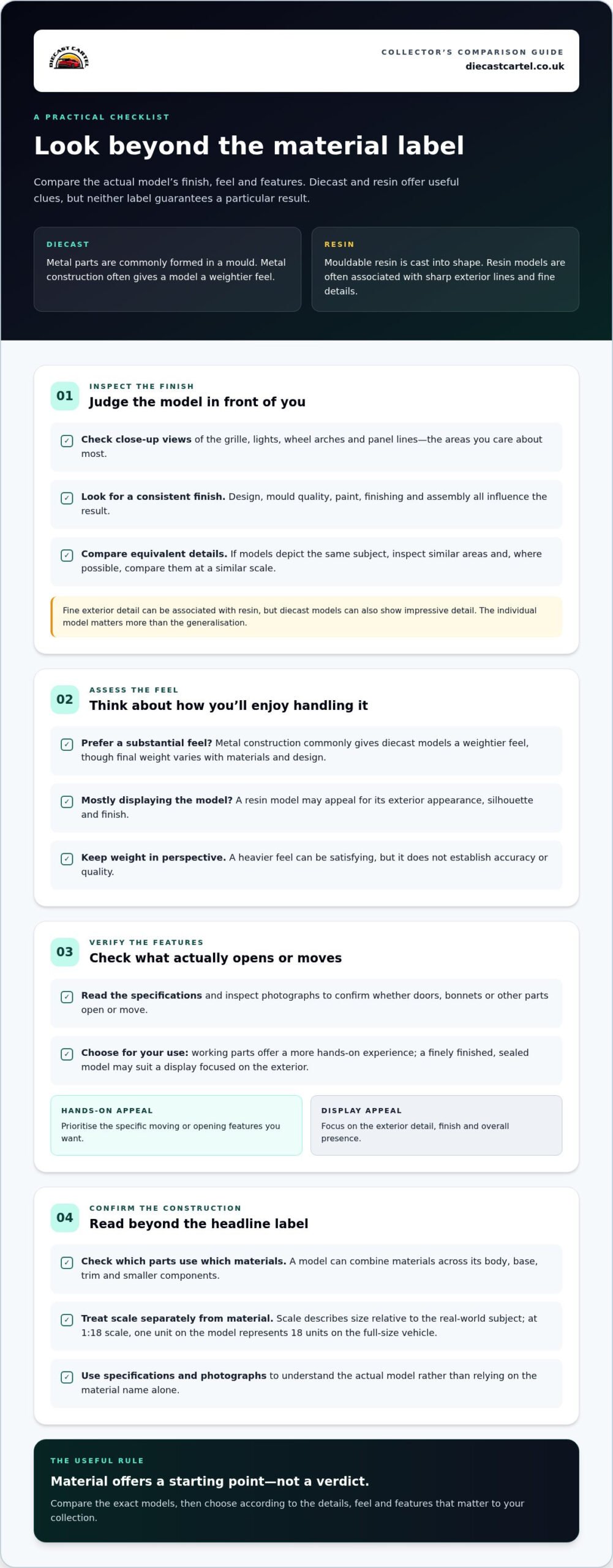
You don’t need to pick a material first and make every other decision fit around it. Start with the model you want to own and how you plan to enjoy it. A favourite vehicle, a gap on your shelf or the pleasure of handling a miniature can all point to different priorities. This four-step process turns those preferences into a practical choice.
- Define the model’s purpose. Is it mainly for display, part of a themed line-up, or something you’ll enjoy picking up and examining?
- Prioritise what matters. Decide whether tactile weight, fine appearance, opening parts or display presence matters most. You can value several qualities, but identify the one you’d miss if it weren’t there.
- Compare the exact models. Review specifications, finish, photographs and stated features instead of relying on material labels alone.
- Choose the model you’ll enjoy owning. Weigh the trade-offs against your purpose, then choose the one that feels right for your collection.
Match the model material to how you collect
A display-first collector might put the silhouette, paint finish and exterior appearance at the top of the list. Someone who enjoys tactile presence may care more about how a model feels in hand, whilst a collector who likes interaction may look for specific opening parts. These preferences don’t dictate a material. They help you compare individual models on their merits.
Personal connection counts too. Is this a vehicle you’ve admired for years, or one that completes a subject-based collection? Shortlist models that appeal to you, then compare their specifications, finish and stated features. A model that suits your collecting habits and favourite subjects may bring more lasting enjoyment than choosing by material alone. If you’re building a collection from the ground up, a guide to starting a die-cast collection can help you shape your approach.
Check the model itself, not just the material label
Read the stated materials and features, and study photographs for the finish and details you care about. If dimensions are provided, use them to picture how the model will fit your display. Scale and material answer different questions: scale tells you how the model’s size relates to its full-size subject, whilst material describes its construction. Neither tells you everything about its appearance or features.
For instance, a 1:24 scale diecast truck helps illustrate the difference between scale and construction. Scale indicates relative size, not how much detail or which opening parts a particular model has. Compare the stated dimensions with your available space, then assess the model’s finish and features. This can help a new addition sit comfortably alongside the rest of your collection.
Ready to put your preferences into practice? Explore 1:18 and 1:24 scale diecast cars, trucks and tractors and compare the models with your shortlist. The clearest answer to diecast vs resin models explained is the one that matches what you want to see, handle and keep.
Explore diecast models that fit your collecting style
There’s no single winner in the diecast and resin comparison. The right choice depends on the individual model and what you enjoy most about collecting: a striking display piece, a satisfying feel in hand, particular features or a subject that means something to you. Once you know your priorities, you can apply them to real models and build a collection that feels distinctly yours.
Where diecast fits within a focused collection
Diecast can provide a starting point for collections organised around vehicles you love. You might bring together model cars, trucks or tractors, focus on one kind of subject, or let personal interest guide what joins your shelves. A theme can be tightly organised or grow naturally as you discover models that catch your eye.
Diecast Cartel specialises in 1:18 and 1:24 scale diecast cars, trucks and tractors. If trucks are your focus, a 1:24 scale diecast truck collector’s guide offers a more specific starting point. For a broader plan, a guide to starting a die-cast collection can help you think about the kind of collection you’d like to develop.
Take the next step as a collector
Before choosing a favourite, pause for a quick check. It can help turn a general interest in diecast vs resin models explained into a decision you feel good about:
- Purpose: Is the model mainly for display, or do you expect to handle it?
- Priority: Are finish, tactile feel, a particular feature or personal connection most important?
- Fit: Does its subject and scale work with the way you’re organising your collection?
- Details: Do the model description, photographs and stated features match what you’re looking for?
Take a moment to consider the individual descriptions rather than choosing on material alone. Two models can answer the same collecting interest in different ways, and the one that feels right may be the piece you keep returning to admire. Each addition gives your collection a little more of your own character.
Browse the Diecast Cartel model range of cars, trucks and tractors to see what catches your eye.
Choose the model that makes your collection feel like yours
Your next addition doesn’t have to settle the diecast-versus-resin debate for good. Let your collection grow around the subjects and qualities you genuinely enjoy, and judge each model on its own merits. That’s the useful takeaway from diecast vs resin models explained: the right choice is the one you’ll be glad to display, handle or make part of a favourite theme.
Diecast Cartel is a UK-based online retailer specialising in 1:18 and 1:24 scale model cars, trucks and tractors. Compare the individual models with your own priorities and see which one sparks that familiar collector’s excitement.
Explore Diecast Cartel’s diecast model range and find a piece that feels right for your collection.
Frequently Asked Questions
Is every diecast model made entirely from metal?
No. A diecast model may combine metal with plastic, rubber, glass or other materials. For example, its main body, tyres and windows may use different components. Construction varies by model and maker, so “diecast” doesn’t mean every part is metal. Read the individual description for its stated materials and features, particularly if a specific component or overall feel matters to you.
Can a model combine diecast metal and resin?
Yes, a scale model can use more than one material, and its construction varies from product to product. A listing may use “diecast” or “resin” to describe the main body or primary construction, rather than every component. Don’t assume a model is made from just one material based on its headline label. Check the product description for details about its construction.
Are resin models always produced in limited runs?
No. Resin construction alone doesn’t establish whether a model is a limited release. Production quantities depend on the maker and the individual model, so look for an explicit production statement if that information matters to you. A limited quantity doesn’t guarantee future value or make a model more collectable to every enthusiast. Separate what the maker states from assumptions based only on the material.
How should you dust a resin scale model safely?
Handle it gently and use a clean, soft brush to lift loose dust, taking extra care around fine details. Avoid vigorous rubbing, household cleaners and liquids you haven’t tested, as these could affect paint or components. Support the model securely rather than gripping delicate parts. If care instructions came with the model, follow them. Finishes and construction vary, so a method that suits one piece may not suit another.
Can resin models be repaired if they are chipped?
Possibly, but the right approach depends on the damage, resin type, paint finish and construction. A small chip in a painted surface is different from a snapped fine detail, and an unsuitable adhesive could make the damage worse. First identify the affected material and assess how visible or structural the damage is. If attempting a repair, proceed cautiously and test the method on an inconspicuous area where possible.
What should you check in a listing to identify a model’s material?
Look for the stated construction materials, dimensions, scale and feature descriptions. Photographs can help you examine the model, but they can’t reliably confirm material because different surfaces may appear similar in an image. Check whether the listing describes the whole model or only its main construction. If it names just the primary material, don’t assume every component uses it too.
