
Diecast Guides
Diecast Model Land Rover Defender: A Collector’s Buying Guide

Oct
The largest diecast model Land Rover Defender isn’t automatically the right one for your collection. A compact model may suit a crowded display shelf, whilst a larger replica can make its bodywork and interior details easier to appreciate up close.
Choosing between models can be trickier than it looks. Listings don’t always make scales or specifications easy to compare, and photographs can leave you guessing how a model will sit beside the pieces you already own. Then there’s the Defender itself: do you prefer a classic or modern era, a 90 or 110 body style, or a distinctive expedition livery?
This guide will help you compare Defender variations, scales and visible details, so you can find a miniature that suits your display space and reason for buying. We’ll look at what scale means in practice, which features to notice in product photos, and how vehicle era, body style and finish can shape a model’s appeal. Whether you’re adding to a long-running collection or choosing a gift, the best pick is the one that fits your priorities.
Key Takeaways
- Start with what you want the model to do in your collection, whether it’s a display centrepiece, a shelf addition or a gift.
- Use scale to compare a diecast model Land Rover Defender’s relative size and likely display presence before you buy.
- Judge accuracy, handling, detail and collection consistency separately. A larger model or one with more moving parts isn’t automatically the best fit.
- Use a simple checklist to compare vehicle style, visible features and listing information, especially when buying for another collector.
- Explore Diecast Cartel’s 1:18 and 1:24 diecast model categories as you build a collection that reflects your own tastes.
What makes a diecast model Land Rover Defender worth collecting?
A recognisable Defender silhouette, a particular vehicle era or a clear place on your display shelf can all be good reasons to collect a miniature. The right choice is personal: one collector might be drawn to a traditional workhorse, whilst another prefers a modern-looking model or an expedition-style centrepiece.
A Defender diecast model is a small-scale collectible replica of a Land Rover Defender, made using die-cast metal and sometimes other materials to represent the vehicle’s shape and details. It’s a miniature, not a full-size vehicle, and its appeal lies in how faithfully its design and finish capture the version it represents. For background on die-cast toys and their materials, see this overview of the die-cast toy.
One distinction prevents a common mix-up: Defender 90 and Defender 110 describe different vehicle formats, not model scales. The 90 is the more compact body style, while the 110 is longer. Scale is written separately, such as 1:24, and describes the model’s size relative to the real vehicle. Not every miniature represents every format, so identify the version shown in the listing rather than relying on “Defender” alone.
Which Defender details shape a model’s character?
Start with the outline. A shorter or longer body creates a different visual balance, especially beside other vehicles in a collection. Then look at the roofline, door arrangement, wheel design and exterior accessories. Roof equipment, extra lights or other fittings can give a model a purposeful look, but details vary between replicas.
Styling shapes the story, too. Service-inspired finishes can suggest a working vehicle; expedition details may suit an adventure-themed display, while a civilian look can feel closer to an everyday road-going Defender. Consider what will stand out amongst your existing models, not just what looks striking in an individual product photo.
Classic or newer Defender: what appeals to you?
Traditional Defenders are known for a more upright, squared-off appearance and a plainly functional feel. More recent designs have a contemporary presence, with a modern treatment of the body and exterior details. A miniature’s precise features depend on the vehicle it represents, so compare the pictured model with the era you have in mind.
Which one connects with you? A classic design might recall a family journey, a favourite film or an interest in working vehicles. A newer version may better fit a collection focused on modern motoring. If you’re building your collection from the beginning, the guide to starting a die-cast collection offers broader fundamentals for choosing a direction that feels your own.
How scale changes the look and presence of a Defender model
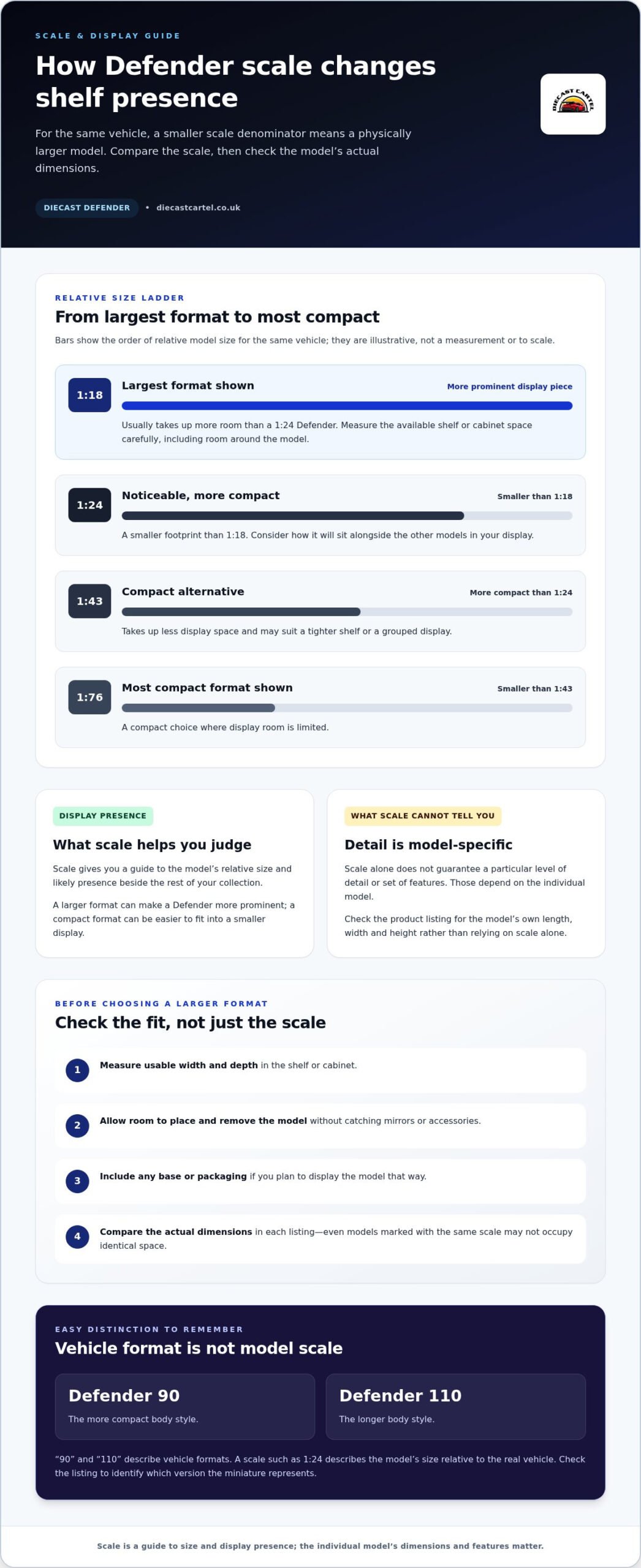
Scale tells you how a model’s dimensions compare with the real vehicle. A 1:24 model is one twenty-fourth of the real vehicle’s length, width and height. The denominator matters: for the same vehicle, a smaller number generally means a physically larger model, so a 1:18 Defender will usually take up more room than a 1:24 one.
Compare scale before choosing a diecast model Land Rover Defender, because it affects both the model’s display presence and how easily it fits alongside the rest of your collection. Scale alone doesn’t give you the exact measurements. Body style and the model’s own dimensions matter, so use scale as a guide and check the listing before deciding.
What should collectors expect from common model scales?
A 1:18 model is a larger display format, with a more prominent footprint on a shelf or in a cabinet. A 1:24 model is smaller by comparison and may be easier to fit into a compact display. Neither scale guarantees a particular level of detail or set of features; those depend on the individual model.
Scales such as 1:43 and 1:76 offer more compact alternatives across the wider diecast market. They can suit a smaller space or a display containing several vehicles. Compare the stated scale and actual length, width and height in each product listing rather than assuming that models marked with the same scale will occupy identical space.
| Scale | Relative size | Display presence | Shelf-space consideration |
|---|---|---|---|
| 1:18 | Larger than 1:24 for the same vehicle | More prominent as a single display piece | Measure available space carefully, including room around the model |
| 1:24 | Smaller than 1:18 | Noticeable, with a more compact footprint | Consider how it will sit beside other models |
| 1:43 | More compact than 1:24 | Takes up less display space | May suit a tighter shelf or a grouped display |
| 1:76 | Smaller than 1:43 | Compact within a collection | Useful where display room is limited |
How much room will a Defender model need?
Before choosing a larger format, measure the shelf or cabinet’s usable width and depth. Leave enough room to place and remove the model without catching its mirrors or accessories, and account for any base or packaging if you plan to display it that way. A paper outline made to the listed length and width can help you picture the fit before you rearrange your display.
Think about the surrounding vehicles, too. A Defender can become the focal point of a themed display, but a very different scale may look out of place beside similarly sized models. For another perspective on choosing a format for a collection, explore this 1:24 scale diecast trucks guide. You can also browse Diecast Cartel’s diecast model range as you consider which scale suits your display.
Does a bigger or more detailed Defender model always make the better choice?
No. A larger scale or a longer list of moving parts doesn’t automatically make a model the right choice for your collection. A detailed replica might be a satisfying centrepiece, but it could be awkward to handle or dominate a shelf of smaller vehicles. A compact model with fewer functions may fit a themed display more naturally.
Choose features according to the model’s intended role: display presence, hands-on enjoyment or a consistent place within your collection. Then compare each candidate against that purpose. Considering these criteria separately helps you avoid treating size, moving parts or material as a shortcut for overall suitability.
- Visual accuracy: Do the proportions, wheels, paint finish and visible trim resemble the Defender version you want?
- Handling: Will you enjoy picking the model up and exploring its functions, or is it mainly for display?
- Display presence: Does its size and finish work as a focal point or alongside other models?
- Collection consistency: Does it fit your preferred scales, vehicle eras or display theme?
There’s no universal winner. A diecast model Land Rover Defender that looks impressive on its own may be a less satisfying choice if it clashes with the scale or style of the rest of your display.
Which model features are worth comparing?
Read the individual listing for details such as opening doors or bonnet, steerable wheels, mirrors and exterior accessories. Treat every feature as model-specific: don’t assume that two models at the same scale offer the same functions, or that a particular detail is present unless it’s described.
Use product photographs to assess proportions, paint finish, wheel design and visible trim. Look at more than one view where available. A side view can reveal the body’s overall shape, while front and rear views may help you judge lamps, bumpers and other styling details. If a feature matters to you, look for it in both the description and the images rather than inferring it from the model’s scale.
How should material and finish affect your shortlist?
Listings may describe models as die-cast metal, resin or plastic. These are material categories, not a reliable ranking of quality. The stated material can help you understand what the model is made from, but it doesn’t by itself tell you how accurate the replica is, how carefully it’s finished or whether it suits your plans.
Consider finish in relation to your chosen era, livery or display theme. A bright, polished appearance may suit one arrangement; a more work-focused look may complement another. If you expect to handle the model, think about whether its construction and listed moving features match that preference. For a display-first purchase, visual accuracy, colour and how it sits with neighbouring models may matter more. Let the role guide your shortlist, then compare the details that will affect your enjoyment.
A practical checklist for comparing Defender models before you buy
A clear shortlist starts with your reason for buying, not the most eye-catching product title. Use these five steps to compare a diecast model Land Rover Defender with what you actually want from it. The same approach works for a personal purchase or a gift, especially if you know the recipient’s favourite era, scale or collecting theme.
How to narrow a Defender shortlist in five steps
- Set the purpose. Decide whether you’re looking for a display centrepiece, a themed addition or a gift. This helps you judge which qualities matter most, such as visual impact, a particular vehicle style or consistency with an existing collection.
- Choose a scale. Compare the options with models you already own and the space available for display. If you’re buying for someone else, their existing collection can offer a useful clue about the scale they prefer.
- Identify the vehicle style. Narrow your search by era and body format, then consider colour or livery. A model that matches the recipient’s interests or the theme of your shelf is likely to feel more considered than one chosen by size alone.
- Compare details. Look at the features stated for each model, along with its material and listed dimensions. Focus on details that matter to your purpose, rather than assuming that more moving parts automatically make a better fit.
- Check the listing. Read the description alongside the scale and photographs. Make sure those details give you a consistent picture of the model before settling on your favourite.
What to check in a product listing
Product titles can be brief, so don’t rely on the wording alone to judge what’s represented. Read the scale, material and model description together. The scale indicates the model’s relative size, the material tells you what it’s made from, and the description may identify its vehicle format or other distinguishing details.
Look through multiple photographs where available. Compare proportions and visible features from different angles, and check that the images support the description. A single striking view may not show details that matter to you, such as wheel design, trim or exterior accessories.
Finally, look for information about packaging and condition if it’s supplied in the listing. That can be especially helpful when you’re buying a gift or presentation matters to your collection. If a detail is central to your decision, make sure it’s clearly stated rather than guessing from a photograph.
For a broader look at available models, browse Diecast Cartel’s diecast model range and use your checklist to guide your search.
Find a diecast model that fits your collection at Diecast Cartel
A satisfying choice comes from matching three things: the Defender you’re drawn to, a scale that works with your collection, and a clear purpose for the model. Rather than choosing by size alone, decide what you want it to bring to your display. Perhaps you’re building a collection around a particular era, favour practical-looking vehicles, or want a miniature that recalls a journey or a lifelong interest.
How to make a choice you will enjoy displaying
Think about the story you want your collection to tell. A traditional-looking Defender could complement a display of older working vehicles; a more contemporary design might sit naturally amongst modern cars. Body format, colour and livery can reinforce that theme, whilst the model’s scale should make sense beside the pieces already on your shelf.
For a gift, a recipient’s existing collection offers useful clues. Notice whether they group models by era, vehicle type, colour or scale, and use those preferences to guide your choice. If you’re buying for yourself, ask what you’ll enjoy seeing each day. The right diecast model Land Rover Defender isn’t necessarily the biggest or most feature-rich one. It’s the one that reflects your priorities and feels at home in your collection.
Where to go next as a diecast collector
Once you know what matters to you, browsing becomes simpler. Keep your preferred vehicle style and display purpose in mind, then compare product descriptions and photographs for the details that matter. Check the stated scale, dimensions and material rather than relying on a title alone. That small pause can help you make a more considered choice, whether you’re adding to an established display or starting your first collection.
Diecast Cartel is a UK-based online destination for collectors, with categories that include 1:18 and 1:24 scale diecast model cars, alongside diecast models, trucks and tractors. These categories offer a place to explore different formats as you build your collection, without letting scale become the only deciding factor.
When you’re ready, explore Diecast Cartel’s diecast model range, compare the listing details and choose what feels personal to you. Whether you’re new to collecting or have been curating a display for years, there’s room in the hobby for your own tastes, themes and stories.
Make your next addition your own
A collection grows through choices that mean something to you. Perhaps a Defender brings back a favourite memory, suits a theme you’ve been building, or simply has the character you want on display. Let that personal connection guide your next step, rather than feeling you need to find the biggest or most elaborate miniature.
When you’re ready, browse with your preferred vehicle style and display purpose in mind. Compare the listing details, picture how a model might sit amongst your collection, and trust the choice that feels right. Diecast Cartel is a UK-based online retailer specialising in diecast collectibles, making it a place for enthusiasts to explore and build their collections.
Explore Diecast Cartel’s diecast model range and see what catches your eye. The right diecast model Land Rover Defender is the one that adds a little more of your own story to the shelf. Happy collecting, whether you’re just beginning or already have a display to be proud of.
Frequently Asked Questions
Can diecast Land Rover Defender models be played with or are they for display?
Some are intended for handling, whilst others are collectible replicas best treated as display pieces. Intended use depends on the individual model’s construction, features and stated age guidance, so don’t assume that die-cast means either fragile or suitable for play. If you’re choosing a diecast model Land Rover Defender for a child, read the listing and packaging information carefully, including any age guidance and notes about small or moving parts.
How do I know what scale my Land Rover Defender model is?
Look for the scale in the product description or on the packaging, usually written as a ratio such as 1:24. This compares the model’s dimensions with those of the full-size vehicle; it doesn’t indicate quality or how many features the miniature has. If the listing also gives measurements, use them to picture its footprint and check whether it will fit your intended shelf or display case.
Are all diecast Land Rover Defender models made from metal?
No. “Diecast” commonly refers to metal components formed through a casting process, but a model may also include plastic or other materials, for example in small fittings or trim. Check the material description for the individual model rather than assuming every part is metal. Material alone doesn’t establish how accurately the Defender is represented, how well it’s finished or whether it suits your collection.
Do diecast Defender models usually have opening doors or a bonnet?
Opening doors or a bonnet are model-specific features, so don’t infer them from the scale or appearance. Look for explicit descriptions and photographs that show the doors, bonnet or other moving parts in an open position. If those details aren’t a priority, a simpler model can still be a satisfying choice. Its shape, colour or fit with a themed display may matter more to you.
Can a diecast Land Rover Defender model increase in value?
It may, but future value is uncertain and can be affected by collector interest, demand, condition, packaging and production details. No scale, brand or edition guarantees appreciation, so it’s best not to treat a miniature as a dependable investment. Choose a Defender you’ll enjoy owning first. If resale could matter later, keep the packaging and take care to preserve the model’s condition whilst it’s in your collection.
What is the best way to clean a diecast Defender model?
For routine dusting, use a clean, soft brush or cloth and handle the model carefully, especially around mirrors, aerials and other small parts. Avoid soaking it or applying strong cleaning products, as materials, decals and finishes can vary. Follow any care guidance supplied by the manufacturer. For display or storage, choose a spot away from avoidable dust, direct sunlight and knocks to help keep the model looking its best.
How can I tell whether a Defender model is an accurate replica?
Compare its proportions, body details, wheels and trim with reliable photographs of the full-size Defender version named in the listing. Product descriptions and images can help, but a single view may hide differences in details such as the front end or rear fittings. Look at several photographs where possible, and don’t assume scale alone proves accuracy. Comparing the stated vehicle version with the images gives you a more informed impression.
