
Diecast Guides
Is It Cheaper to Buy an OBD Scanner? Compare Your Options
Nov
The cheapest OBD scanner can be a false economy if it cannot read the fault you need. So, is it cheaper to buy an OBD scanner than to rely on a garage for every diagnostic check? It depends on how often you’ll use it and what you need it to do.
A basic code reader may be enough for engine faults, while diagnosing systems such as ABS or airbags requires broader coverage. Paying for extra functions makes sense only if they match the jobs you expect to tackle. Focus on capability, not simply the lowest price.
This guide compares basic engine-code readers, mid-range scanners and more advanced diagnostic tools, including the functions they can offer. You’ll learn what to consider before spending more, when a simpler model may suit your needs and why vehicle compatibility matters. That way, you can focus on the faults you want to read and choose a scanner that fits your plans.
Key Takeaways
- A basic reader may suit engine fault codes, while ABS and airbag checks call for broader system coverage.
- Choose between a Bluetooth dongle and a handheld scanner based on how you prefer to view diagnostic information and use the tool.
- Compare the scanner’s functions with the faults you need to read; a low price alone doesn’t show whether it’s suitable.
- Match your choice to your vehicle and expected use, and weigh any ongoing update costs when comparing models.
Do cheap scanners read ABS and airbag faults?
A basic code reader usually handles engine faults, not ABS or airbag systems. Scanner prices reflect factors such as system coverage, live and freeze-frame data, and service resets.
Budget code readers and diagnostic tools
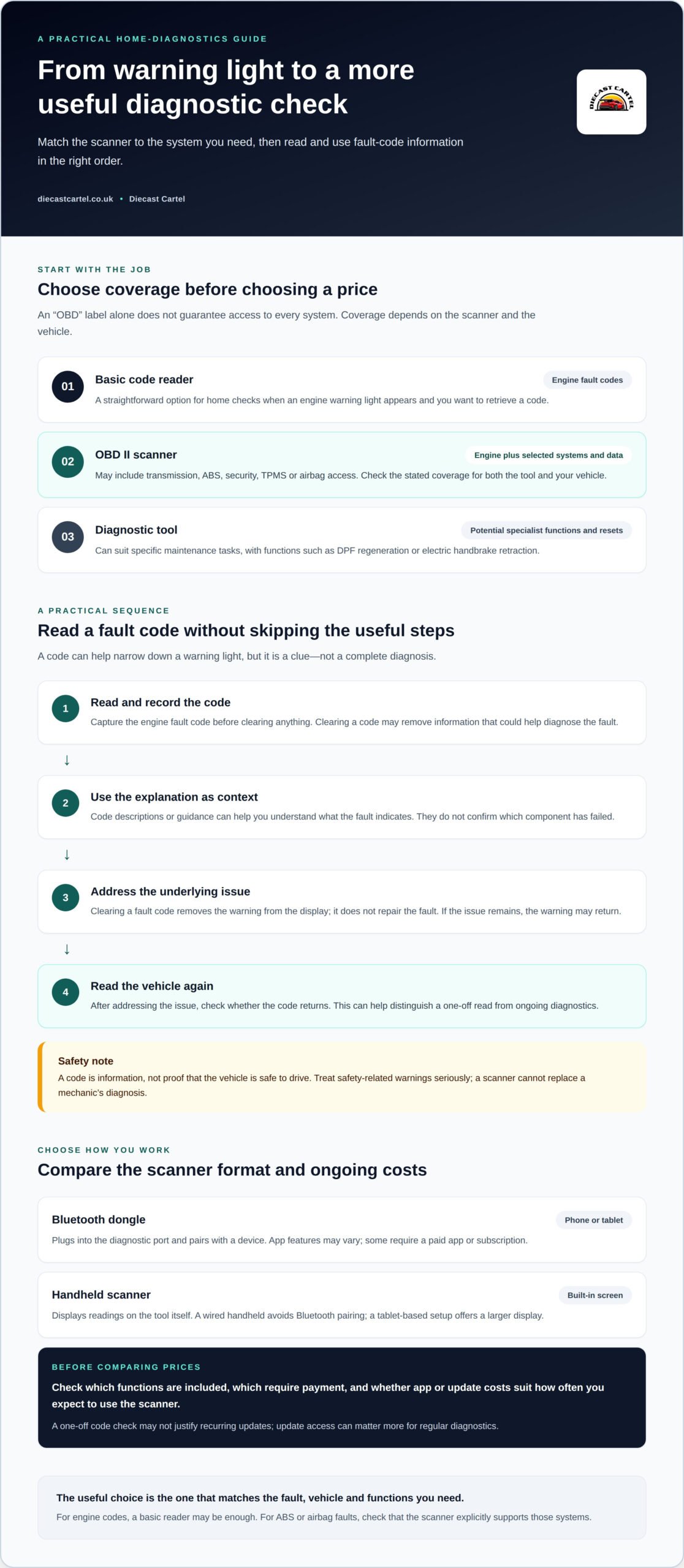
A budget code reader suits home checks when the engine warning light appears and you want to retrieve a fault code. It focuses on basic engine diagnostics rather than accessing additional vehicle systems. More advanced diagnostic tools can add functions such as DPF regeneration or electric handbrake retraction, making them more useful for specific maintenance tasks.
Basic and advanced diagnostic coverage
An OBD II scanner may cover systems beyond the engine, including transmission, ABS, security, TPMS and airbags. However, coverage depends on the tool and vehicle; an “OBD” label alone does not guarantee access to every system. Some handheld scanners include ABS, airbag and service-reset functions, while others only retrieve engine codes. Check the stated functions carefully, especially if ABS or airbag faults are your priority.
| Option | Typical coverage | Best suited to |
|---|---|---|
| Basic code reader | Engine fault codes | Simple home checks |
| OBD II scanner | Engine plus selected systems and data | Broader diagnostics |
| Diagnostic tool | Potentially specialist functions and resets | Specific maintenance tasks |
Choose based on the fault and systems you need to access, not the tool’s label.
A scanner may help you avoid repeat charges for reading codes, but it cannot repair the fault or replace a mechanic’s diagnosis. If a warning points to a safety-related issue, treat the code as information, not proof that the vehicle is safe to drive.
For home diagnostics, start with the warning or symptom you want to investigate. If you only need engine codes, a basic reader may be enough. If you need ABS or airbag coverage, choose a scanner that explicitly supports those systems.
Basic engine-code reading and clearing
These tools retrieve engine fault codes, which can help narrow down the cause of a warning light, but a code is a clue, not a complete diagnosis.
A free fault-code read may be sufficient if you need a code once to understand an engine warning and decide what to do next. It may not suit regular home checks, comparing a fault before and after a repair, or accessing information from other vehicle modules. A paid reader gives you access when you need it, without relying on a one-off reading.
The Foxwell NT301 provides explanations of diagnostic trouble codes and guidance on resolving the issues they indicate. That can make reading an unfamiliar code more useful: you get context alongside the code, rather than a string of characters alone. Still, guidance from a reader doesn’t confirm which component has failed or replace a full mechanical diagnosis.
What are the risks of clearing fault codes without fixing the problem? Clearing a code removes the warning from the display, but it doesn’t repair the underlying fault. If the issue remains, the warning light may return; there is no fixed distance, such as 50-100 miles, that applies to every vehicle. Clearing codes first may also remove information useful for diagnosing the fault.
For a practical home check, use this order:
- Read and record the engine fault code before clearing anything.
- Use the code explanation to understand the indicated fault, not as proof of a specific failed part.
- Address the underlying issue, then read the vehicle again to see whether the code returns.
This approach helps distinguish a one-time code read from ongoing diagnostics. Choose a basic code reader for engine faults; consider a full-system scanner when you need information from additional modules.
How much should I spend on an OBD2 scanner?
Spend according to how you want to view data and which vehicle systems you need to access.
Bluetooth dongles and handheld scanners
A Bluetooth dongle plugs into the vehicle’s diagnostic port and pairs with a phone or tablet. A handheld scanner connects directly and displays readings on its own screen, without relying on a paired device. A wired handheld avoids Bluetooth pairing, while a tablet-based setup offers a larger display. The right format depends on whether you prefer a phone app or a standalone reader.
For example, a Bluetooth app may show engine codes and sensor readings on your phone. A handheld unit can make a straightforward code reading simpler, without switching between devices. Neither connection type guarantees airbag access; system coverage depends on the scanner’s supported functions and your vehicle.
App and subscription costs
Some Bluetooth scanner apps provide basic code reading, while other functions may require a paid app or subscription. The ongoing cost can therefore differ from the dongle’s purchase price.
Before choosing an app-based tool, distinguish the features you’ll use from optional extras. Check whether its free functions cover engine-code reading, and whether live sensor data, resets or wider system access require payment. A one-off code check may not justify recurring updates, but update access can matter more for regular diagnostics.
For a home setup, compare the total cost and everyday use:
- Bluetooth dongle: suits phone-based readings and app features.
- Handheld scanner: displays results on the tool itself.
- Tablet scanner: offers a larger screen for reviewing diagnostic information.
Choose the format that suits your routine, then weigh any app or update charges against the functions you’ll actually use.
Prices and capabilities of recommended scanners
OBD2 scanner prices reflect the systems and functions each tool supports. Compare the actual coverage you need for your vehicles, rather than choosing by price alone.
Consumer OBD2 scanner prices
Consumer scanners range from engine-code readers to tools covering several vehicle systems. An engine-only reader keeps basic fault-code checks simple, while models with live data can show changing sensor readings. A full-system scanner may access systems such as ABS and airbags, but exact coverage depends on the tool and vehicle. More functions generally mean a broader diagnostic role.
Named models illustrate the difference in capability. The Launch CR529 supports all 10 OBD2 modes, while the Foxwell NT301 provides diagnostic trouble-code explanations and guidance about the issues they indicate. These features help you interpret readings, but they don’t make every scanner suitable for every vehicle or fault.
Typical UK scanner prices
In the UK, compare entry-level readers, mid-range scanners and advanced diagnostic tools by what each can do. A basic reader focuses on engine codes; a broader scanner can add live data and access to extra systems. Advanced tools may include specialist functions, such as DPF regeneration or electric handbrake retraction. These features matter only if they match your intended use.
Full-system coverage is not a single standard: manufacturers differ in the modules and functions their tools support. For example, a scanner described as reading ABS codes may not provide the same coverage across all vehicles. Check the supported systems and functions for your specific vehicle before comparing models.
| Scanner type | Typical capability | Best fit |
|---|---|---|
| Engine-code reader | Basic engine fault codes | Simple home checks |
| Consumer scanner | May add live data or selected systems | More detailed diagnostics |
| Advanced diagnostic tool | May offer specialist functions and resets | Specific maintenance tasks |
Compare the supported functions for your vehicle first, then decide whether the wider capability merits the extra spend.
Diecast Cartel
Diecast Cartel is a place to explore the collecting side of automotive enthusiasm after weighing up your diagnostic options. Its range includes 1:24 scale diecast models and trucks, Diecast Trucks and Tractors, and 1:18 Scale Model Cars. For a hands-on alternative, there’s also a 1:24 Remote control Forklift.
These products are not substitutes for an OBD scanner; they suit a different interest, from displaying detailed vehicles to enjoying remote-control machinery. If cars, trucks or construction vehicles are part of your hobby as well as your motoring life, browsing these models can be a natural next step.
For questions about the options discussed in this guide, contact Diecast Cartel.
Make your next diagnostic choice count
A scanner can support a more organised approach to car care, not just help you respond to a dashboard warning. Note when a light appears, the code displayed and any symptoms you notice. This record can help you describe a fault clearly if you seek further diagnosis.
If you’re still weighing whether buying an OBD scanner is cheaper, consider how often you’ll use it and whether its functions suit your needs. Choose a tool you can use confidently, with information that helps you decide what to do next.
Explore model vehicles and collectibles at Diecast Cartel as you consider your options. Make your next step with confidence.
Frequently Asked Questions
Is it worth buying an OBD scanner?
Buying one can be worthwhile if you want to investigate warning lights yourself before deciding what to do. For example, a code may help you explain an intermittent engine warning when booking a repair. It cannot establish the car’s overall condition, though, so do not treat a scan as a substitute for a pre-purchase inspection or repair assessment.
Are car diagnostic tools universal?
No single tool suits every vehicle and diagnostic task. Before buying, match the tool’s compatibility information to the car’s make, model and engine, then consider which system you want to access. A tool that connects successfully may still not provide the information you need, so consider compatibility and function support separately.
An OBD scanner can be a sensible choice for a focused task, such as retrieving an engine fault code, provided it supports your vehicle. Think about how you’ll use the result: a code may identify an area to investigate, but it will not necessarily pinpoint the failed part. If you need more than a basic check, prioritise the required capability over the purchase price.
Reader, scanner or diagnostic tool?
The labels can overlap, so judge suitability by the product description, not its name. Look for the exact tasks it supports, the vehicle information it accepts and how it presents results. For instance, a tool designed for home code checks may be a poor match for a workshop task requiring manufacturer-specific information, even if both listings call it a “scanner”.
What do mechanics use to diagnose cars?
Mechanics use diagnostic equipment suited to the vehicle and fault they’re investigating. A workshop may need manufacturer-specific information for a particular job, while another task may call for a simpler scan. The displayed code is only one part of the investigation; symptoms, vehicle history and inspection findings help guide the next diagnostic step.
How much does an OBD2 scanner cost in the UK?
UK prices vary according to a tool’s intended use and included functions. To set a realistic budget, compare the total cost of ownership, not just the shelf price: consider whether software access or updates add ongoing charges, and whether you’ll use the extra functions. A basic home check and frequent workshop diagnostics call for different levels of investment.
