
Diecast Guides
Best Diecast Cars to Invest In 2026: A Collector’s Guide

Oct
A rare-looking diecast car isn’t automatically a wise buy. If you’re searching for the best diecast cars to invest in 2026, ask what gives a model lasting collector appeal and whether there’s credible evidence of demand beyond the hype.
It’s understandable to hope a favourite car could become more valuable, but scarcity alone doesn’t guarantee a strong resale market. Condition, original packaging, the maker, the real car’s cultural significance and collector interest can all shape demand. Even a sought-after model may take time to sell.
This guide will help you identify qualities that can support lasting interest and compare potential additions using a repeatable checklist. We’ll look at modern classics, JDM and tuner cars, motorsport models and popular scales, while distinguishing asking prices from completed sales. Most importantly, you’ll learn how to weigh the signs without treating future returns as certain. Whether you’re drawn to a detailed 1:18 model or a compact display piece, the best collection is one you’ll enjoy owning, whatever the market does.
Key Takeaways
- Start with the cars and subjects you genuinely enjoy collecting. Possible future demand is a consideration, not a promised return.
- When weighing the best diecast cars to invest in 2026, look for reliable edition details and compare like-for-like completed sales.
- Check a model’s identity, scale, condition and packaging before judging its collector prospects.
- Use a comparison table to assess candidates consistently and separate evidence of buyer demand from market hype.
- Explore model cars across 1:18, 1:24, 1:32 and 1:50 scales at Diecast Cartel, choosing what suits your interests and display.
Best diecast cars to invest in 2026: what “investment” really means
An investment-minded diecast purchase is a model chosen partly because it may attract future collector demand. That possibility is worth considering, but it isn’t a promise of appreciation or an assured way to make money. A model can be scarce and beautifully presented yet still prove difficult to resell if few buyers want it.
Keep diecast collectibles separate from full-size investment cars. They’re different markets, with different buyers, prices and factors influencing demand. Evidence that a real car has risen in value can’t tell you how its miniature counterpart will perform. The model’s maker, scale, production details, condition and collector following all matter in their own right. For background on the objects themselves, Wikipedia’s overview of the die-cast toy covers their history, manufacturing and different scales.
Collectible value is the level of interest a model attracts from collectors, not a guarantee of financial return. That distinction lets you explore the best diecast cars to invest in 2026 with curiosity and care, without confusing enthusiasm with evidence.
Can diecast cars appreciate in value?
They can, but appreciation is selective. Some models draw stronger secondary-market interest than others, while many may not rise in value at all. A limited edition or recognisable subject may catch collectors’ attention, but neither feature alone proves that buyers are actively competing for it.
Look for completed-sale evidence, not just a seller’s asking price. An advertised figure shows what someone hopes to receive; a completed sale shows that a buyer paid a particular amount. Even then, one sale is only a clue. Compare examples that match in model identity, condition and packaging. Availability, changing tastes and the number of interested buyers can all affect resale prospects.
Would you still be glad to own the model if its resale value stayed flat? If the answer is yes, the purchase can still earn its place in your collection. Finding a favourite subject, displaying it and sharing the hobby with other collectors can be rewarding regardless of its future price.
Why 2026 is a snapshot, not a forecast
The year in this guide sets its publication context; it doesn’t predict what any model will be worth later. Collector interests can shift, new models can become available, and today’s hard-to-find item may be easier to source in the future. The reverse can also happen, but neither outcome is certain.
Use current information as a starting point, then reassess when you’re considering a purchase or resale. Record what you know about the exact model and its condition, and distinguish observed completed sales from asking prices. A careful decision today is more useful than a confident prediction about tomorrow.
What makes a diecast model collectible: scarcity, condition and demand
Collector interest rarely comes down to one feature. A model’s appeal may reflect its production history, the car it represents, its condition and how many collectors want that particular subject. These factors work together: a limited run can attract attention, but limited numbers won’t create lasting demand if the model has little appeal to buyers.
The real car’s story can add another layer. A vehicle associated with a memorable racing moment, a major design shift or a much-loved era may resonate with collectors. That cultural connection can help explain interest, but it isn’t proof that a diecast version will be easy to sell or rise in value.
Scarcity may catch a collector’s eye, but verified details, good condition and genuine buyer interest are more useful evidence of a model’s appeal.
How to assess scarcity and production information
Look for edition information stated by the manufacturer, such as a documented production quantity or clearly identified limited run. Be cautious with vague descriptions that call a model “rare” without explaining why. A model being sold out at one retailer only shows that it’s unavailable there; it doesn’t establish sustained demand across the wider collector market.
Treat a limited-run claim as one clue, then weigh it against subject appeal, condition and evidence of collector interest. This is a more grounded way to assess candidates for the best diecast cars to invest in 2026 than relying on scarcity language alone.
Why condition, packaging and provenance matter
Condition affects what a collector can see and assess. Scratches, paint chips, broken parts or missing components may make a model less appealing to someone seeking a complete example. Original packaging can also matter to buyers who prefer to keep a model boxed or want its identification and presentation preserved. There’s no universal premium for a boxed or mint-condition model, though; preferences differ between buyers and models.
Keep the box and any accompanying paperwork together where possible. Save a receipt or other purchase record, and note relevant details such as the model’s identity, scale and edition information. A clear history can help you describe what you own accurately later, even though it can’t guarantee a particular resale outcome.
Before buying, check the exact model, its stated edition, visible condition, completeness and packaging. A familiar car might have strong personal or cultural appeal, but collector demand still needs its own evidence. If you’re choosing a model for display as well as collecting, Diecast Cartel’s diecast model cars across several scales offer a way to explore subjects and sizes that suit your collection.
How to compare diecast investment candidates without chasing hype
A consistent comparison helps turn a promising-looking model into a decision you can explain. Record the same details for every candidate, then separate what you know from what you’re guessing. Brand recognition can bring a model to collectors’ attention, but it can’t guarantee future demand or resale performance. Let the evidence for the specific model guide your judgement.
| Comparison point | What to record |
|---|---|
| Subject | Exact car, livery or event represented, and why collectors might care about it. |
| Scale | Stated scale, so you can compare like with like and check display fit. |
| Edition evidence | Manufacturer-stated production details, if available, rather than an unsupported “rare” label. |
| Condition | Visible wear, damage, completeness and any differences between examples. |
| Packaging | Whether original packaging is present and in comparable condition. |
| Observed buyer demand | Completed-sale examples, with dates and details that allow a fair comparison. |
Use the table to make differences visible, not to produce a pretend investment score. If details are missing or sales evidence is thin, record that uncertainty plainly. A gap in evidence isn’t proof of hidden potential. It simply means you have less basis for judging demand.
Which scale and subject suit your collection?
Scale is a practical choice before it’s a market factor. Larger models need more display room, whilst smaller ones may fit more easily alongside an existing collection. Think about the space you have and whether you want to collect a particular car, motorsport subject, truck or tractor. If classic American cars are your focus, this guide to 1:18 scale classic American cars can help you explore that subject.
Compare a model with others of the same subject and scale wherever possible. A different size or type of vehicle may appeal to a separate group of collectors, so its resale evidence won’t necessarily tell you much about your candidate.
How to read resale evidence responsibly
Prioritise completed sales over active listings when assessing observed demand. Note the sale date, condition and packaging for each example; a boxed model isn’t a close comparison for a damaged, unboxed one. If the results are isolated or inconsistent, treat them as limited evidence, not a typical return or forecast.
Use asking prices as context only. They show what sellers hope to receive, not what buyers have paid. If you’re weighing up scale and subject for your own display, you can also browse diecast model cars and compare options with your collection in mind. The best diecast cars to invest in 2026 are candidates to assess carefully, not guaranteed winners.
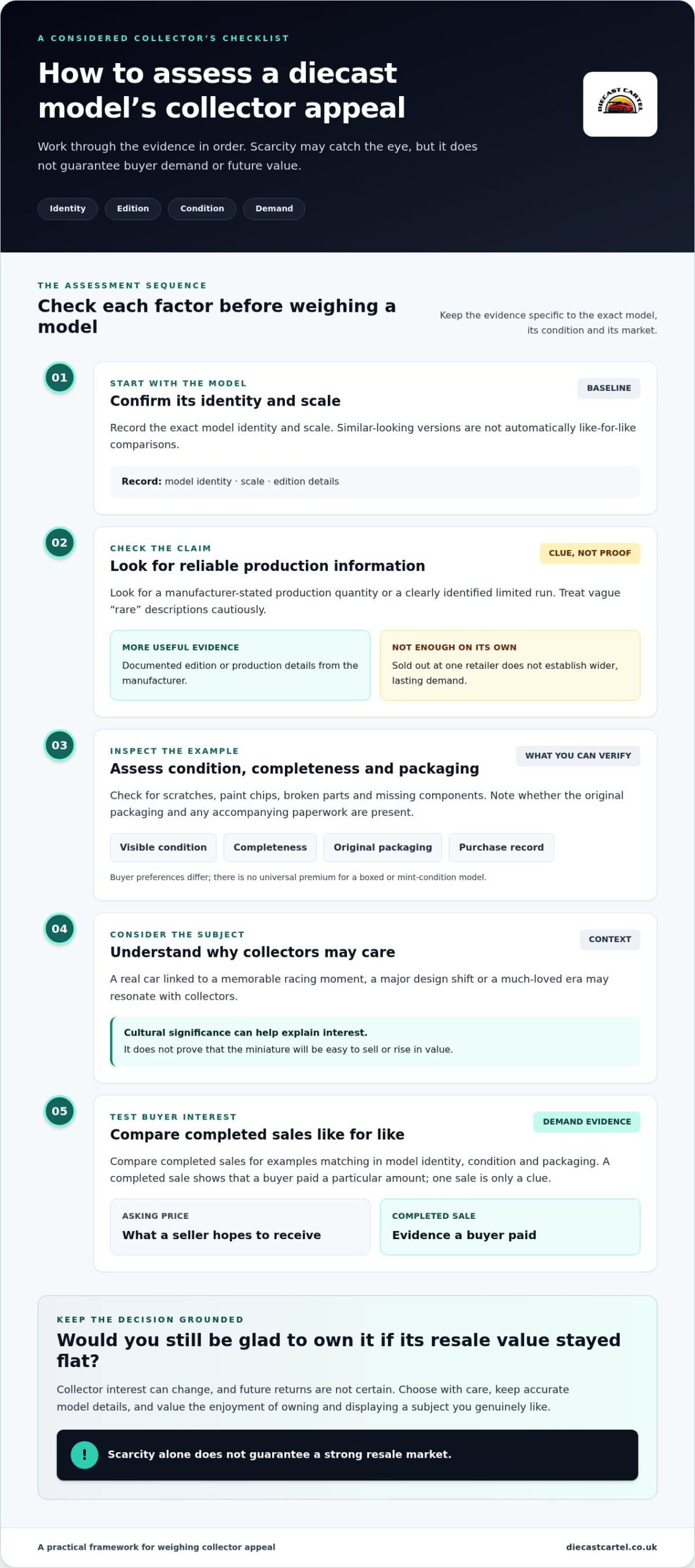
A practical checklist for choosing diecast cars in 2026
A repeatable process can keep an exciting find from becoming an impulse buy. Use these five checks to narrow your shortlist, then decide based on evidence and your collecting priorities, not a prediction of profit.
Five checks before adding a model to your shortlist
- Start with your collecting goal. Identify the cars, eras, motorsport subjects or other vehicles you genuinely enjoy. Ask whether you’d still want the model if its future resale value didn’t increase.
- Confirm the model’s identity. Match the maker, vehicle, livery or event to the listing and any available packaging or documentation. Similar-looking versions can differ, so don’t rely on a broad description alone.
- Record the scale. Check the stated scale and consider whether the model suits your available display space and existing collection. Scale helps you compare equivalent models; it doesn’t establish investment potential.
- Look for verifiable edition details. Note manufacturer information about production or edition status. Treat unsupported labels such as “rare” cautiously, and don’t assume that a familiar marque or limited-run claim guarantees buyer demand.
- Assess condition and evidence, then decide. Review visible wear, completeness and packaging, then compare completed sales for the same model in similar condition. Set a personal collecting limit before you buy, and proceed only if the purchase still makes sense when resale prospects are uncertain.
Use the checklist to compare candidates consistently, not to rank them by a promise of returns. To put your interests and display plans first, explore Diecast Cartel’s scale model cars and see which subjects and scales fit your collection.
How to avoid common investment-collecting mistakes
A famous badge, an eye-catching listing or a limited-edition description can all sound persuasive. None is a substitute for evidence about the specific model. Be wary of claims predicting future appreciation: they’re opinions, not completed-sale records. If you’re new to the hobby, this guide to starting a die-cast collection can help you build around clear interests and practical display choices.
The best diecast cars to invest in 2026 are not guaranteed winners. Use the same checks each time, leave room for uncertainty, and choose models you’ll be pleased to own even if the market moves differently from your expectations.
Where Diecast Cartel fits into a considered model-car collection
A considered collection doesn’t need to be built around resale predictions. It can take shape around the vehicles you love, a particular era of motoring or the way different models look together on display. Diecast Cartel offers models across 1:18, 1:24, 1:32 and 1:50 scales, giving you different sizes to consider alongside your subject interests and available space.
Think about the collection you want to see taking shape. Are you drawn to one favourite car, or would you rather bring together a broader line-up? A scale that suits your shelves and existing models can make it easier to create a cohesive display. Scale and subject are useful ways to choose, but neither promises a model will appreciate in value.
Choose a model you will enjoy owning
Resale potential can be one consideration, but let genuine enthusiasm have a place in the decision too. A model of a favourite car or a vehicle tied to a personal memory can make your display more meaningful, even if its future value stays uncertain. Ask yourself whether you’d still be pleased with the model if demand didn’t grow. That simple question can help keep collecting enjoyable and grounded.
Build a collection with a clear focus
A theme gives a collection a sense of purpose without locking you into a rigid plan. You might focus on a preferred scale, a type of vehicle or subjects that share a connection. Diecast Cartel’s online range includes model cars, trucks and tractors, so you can shape a display around the subjects you’re most drawn to or bring different vehicle types together.
Scale can help guide that choice. A larger model may suit a display centred on a few individual vehicles, whilst smaller scales can be practical when you want to bring more models together. Consider what you already own, how much room you have and whether you want your next addition to match or broaden the collection. The best diecast cars to invest in 2026 are still a matter of personal judgement, not a promise from any retailer about future returns.
Browse thoughtfully, compare model details with your collecting goals and choose a piece you’ll be happy to keep. There’s real satisfaction in finding the right addition, whether it fills a gap in your display or introduces a new favourite subject. Browse Diecast Cartel’s model cars and explore the scales and subjects available for your collection.
Make your next addition one you’ll be proud to own
Your next model doesn’t need to be a headline-grabbing rarity to feel special. Choose a subject that sparks your interest, give yourself time to consider the evidence, and let your collection grow at a pace that feels right for you. That way, even if demand shifts, you’ll still have a model you enjoy seeing on display.
The search for the best diecast cars to invest in 2026 is best treated as a thoughtful part of collecting, not a promise of profit. Curiosity, careful comparisons and personal taste make a stronger foundation than hype. What would you most like to see in your collection next?
Diecast Cartel is a UK online retailer specialising in diecast collectibles, with model cars across 1:18, 1:24, 1:32 and 1:50 scales. Explore the range and find a subject that feels right for your display: explore Diecast Cartel’s scale model cars.
Every collection starts with a choice. Make yours with care, and enjoy the discovery.
Frequently Asked Questions
Can diecast cars be a good investment in 2026?
Some diecast models may attract stronger buyer interest over time, but buying one is never a dependable route to profit. The best diecast cars to invest in 2026 are better approached as collectibles with uncertain resale prospects, not financial products. Before buying, consider how long you’d be comfortable keeping the model and whether you’d still value it if demand or resale interest changed.
Which features make a diecast car more collectible?
Collector interest can be supported by a clearly identifiable model, a subject with lasting appeal, documented edition details and well-preserved condition. For example, a model representing a memorable racing car may attract fans of that era, but its story alone can’t establish demand. Consider whether collectors are seeking that specific version, not merely whether the full-size car is famous.
Are limited-edition diecast models always worth more?
No. “Limited edition” describes a production claim, not a guaranteed resale price. Look for information from the manufacturer and distinguish a numbered model from evidence of the total production run. A low stated run may interest collectors, but if few buyers want the subject, scarcity may not translate into active demand. Treat edition status as one detail to investigate, rather than a reason to buy on its own.
Does keeping a diecast model in its original box affect its value?
It can affect buyer interest, particularly among collectors who prefer boxed examples, but there’s no universal value premium. A box in poor condition may not appeal as much as a well-preserved one, and preferences vary. If you keep the packaging, store it so it doesn’t become crushed or marked, and keep it with the correct model. The box can support presentation and identification, but it can’t guarantee a higher resale value.
How can I check whether a diecast model has genuine resale demand?
Look for completed sales of the exact model, then compare several examples where possible. Check whether they match in edition, condition and packaging, and note when each sale took place. Active listings show sellers’ asking prices, not confirmed buyer demand. If you find only one result or examples that differ substantially, treat the evidence as limited rather than assuming the model is an undiscovered opportunity.
Is 1:18 or 1:24 scale better for collecting diecast cars?
Neither scale is automatically better; the right choice depends on your display space and the look you want. A 1:18 model has a larger physical presence, whilst 1:24 models can suit collectors who want to organise a display around a different footprint. Before choosing, measure the space available and consider whether you want new additions to sit alongside models you already own.
Should I buy diecast models for investment or personal enjoyment?
Let personal enjoyment lead, and treat possible resale interest as an extra consideration. A model you genuinely like can remain satisfying to own even if its market appeal changes. You might set two tests before buying: does it fit your collection, and is there credible evidence of buyer interest? If it only appeals because a listing predicts appreciation, take time to reconsider before committing.
