
Diecast Guides
Engine Management Light Reset: A Safe Step-by-Step Guide

Oct
What if an engine management light reset makes the warning disappear but leaves the real problem untouched? It can be tempting to clear the light and carry on, especially when you’re unsure how urgent it is. But resetting it before finding out what triggered it can erase useful information, and the warning may return.
The light can point to anything from a minor issue to a fault that needs prompt attention. Its behaviour matters: a steady light should be investigated, while a flashing light can signal a serious problem. A fault code is a useful clue, not a diagnosis. An OBD diagnostic tool can help you read and record the code before you decide what to do next.
This guide explains what the warning may mean, how to interpret a code sensibly and when a reset may be appropriate. It also covers when to stop driving and what to bear in mind about the MOT. The key is to find out what triggered the light before clearing it.
Key Takeaways
- Park safely and consult your vehicle handbook before connecting an OBD reader.
- Record the exact fault code and any symptoms before clearing anything, so useful information isn’t lost.
- An OBD reader can provide diagnostic information before a reset. Battery disconnection does not offer the same code-reading step, and outcomes vary by vehicle.
- Reset the engine management light only after the underlying cause has been addressed or a qualified diagnosis supports clearing the code.
- If the light returns, investigate further. Stop driving if the car feels unsafe or runs severely abnormally.
What does the engine management light mean, and is it safe to reset?
The engine management light warns that the engine or emissions system needs attention. It doesn’t identify the exact cause by itself. A diagnostic reader may retrieve a stored fault code, but that code is a starting point for investigation, not proof that a particular component has failed. It may point towards a system or area without confirming which part needs repair.
Many vehicles use On-board diagnostics (OBD) to monitor systems and store information about detected faults. Reading that information can help you decide what to do next, but interpreting it may require more than matching a code to a part. Symptoms, your vehicle handbook and further checks all matter.
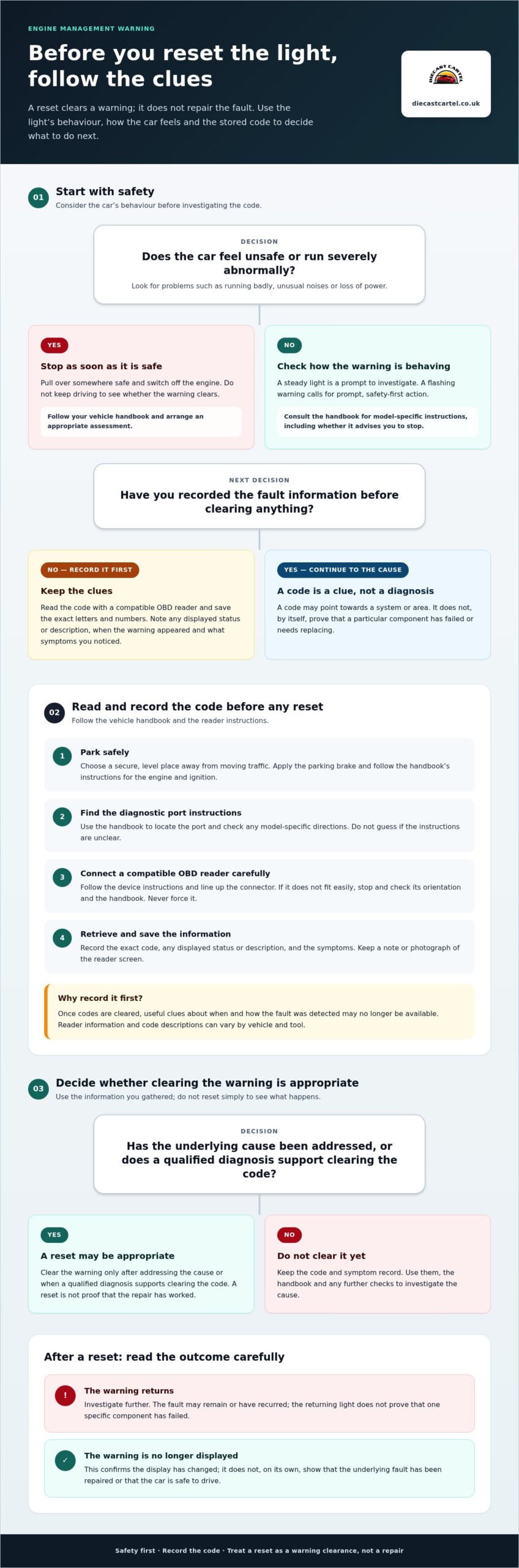
Resetting the light clears a warning; it doesn’t repair the fault that triggered it. An engine management light reset may make the dashboard warning disappear temporarily, but that doesn’t show that the car is fixed or safe to drive. Before taking action, consider how the light is behaving and how the vehicle feels.
What is the difference between a steady and flashing warning?
A steady light is a prompt to investigate. It doesn’t reveal the precise fault, so don’t assume the car has a particular problem based on the warning alone. Check your vehicle handbook for model-specific instructions, including what the light means for your car and whether the manufacturer advises you to stop.
A flashing warning calls for prompt, safety-first action. If the car is running badly, making unusual noises, losing power or otherwise feels unsafe, pull over somewhere safe and switch off the engine. Don’t continue driving to see whether the warning clears. If you’re unsure what to do, follow the handbook’s instructions and arrange an appropriate assessment.
Can you reset the light without fixing the fault?
It may be possible to clear a stored code, after which the dashboard warning may go out. But clearing the warning is not the same as repairing its cause or confirming that a repair has worked. If the underlying issue remains, the light may return when the vehicle detects it again. The response to a reset varies by vehicle.
Keep these outcomes separate: a cleared warning tells you the display has changed, not that the fault has gone away. Before resetting, note the code and symptoms, then use that information to guide your next step. If the light comes back, treat it as a sign that the issue may remain or have recurred, not as proof that one specific component has failed.
- Steady light: investigate the warning and consult the handbook.
- Flashing light or severe symptoms: prioritise safety and stop as soon as it’s safe.
- Light cleared: don’t assume the underlying fault has been repaired.
How to read engine management fault codes before resetting the light
Read and record the fault information before attempting an engine management light reset. Once codes are cleared, useful clues about when and how the fault was detected may no longer be available. An OBD diagnostic tool can retrieve codes, but the information it can access and how it describes it can vary with the vehicle and reader.
Use this straightforward sequence:
- Park safely. Choose a secure, level place away from moving traffic. Apply the parking brake and follow the vehicle handbook’s instructions for the engine and ignition.
- Check the handbook. Find the diagnostic port location and any model-specific directions for connecting a reader. Don’t guess if the instructions are unclear.
- Connect a compatible OBD reader. Follow the device instructions and line up the connector carefully. Never force it into the port.
- Retrieve and record the codes. Save the exact letters and numbers shown, along with any status or description displayed by the tool.
Record the fault code before clearing it, so useful diagnostic information is not lost. Keep a note or photograph of the screen. Don’t clear codes simply to see whether the warning stays away.
How do you connect an OBD reader and retrieve a code?
Use the handbook to find the diagnostic port and check how to set the ignition. Some readers ask for the ignition to be switched on, while others may have different instructions. Follow the guidance for your vehicle and device rather than assuming one method suits every car. If the connector doesn’t fit easily, stop and check its orientation and the handbook. Forcing it could damage the connector.
Some tools show whether a code is current, pending or stored. If yours displays a status, record it alongside the code. Access to OBD-II or EOBD information, and the wording used to describe it, can differ between vehicles and tools. A reader may show limited information rather than every detail held by the vehicle.
What should you do with the code description?
Use the description as a starting point for research, not as a definitive diagnosis or an instruction to replace a particular part. Record when the warning appeared and what was happening, such as whether it came on at start-up or during a journey. Note any changes in performance, unusual sounds or other symptoms. This context can help make sense of the code.
A code and a symptom together make a more useful record than either one alone. For more background on what a reader can help you learn, explore the benefits of owning an OBD2 scanner. If you’re choosing a reader to investigate warning lights, you can also browse Diecast Cartel’s OBD diagnostic tools. Gather the information before considering a reset.
OBD scanner or battery disconnection: comparing engine light reset methods
An OBD reader and disconnecting the battery aren’t interchangeable shortcuts for an engine management light reset. An OBD reader may let you retrieve and save fault codes before clearing them, if that function is supported by both the tool and vehicle. Battery disconnection doesn’t provide that diagnostic record and may affect vehicle settings or systems, depending on the model.
Neither method repairs the fault. The warning can return if the issue persists, and the vehicle’s response to a reset can vary. Use your handbook and the reader instructions before taking action.
| Method | Information retained | Limitations and when it may be unsuitable |
|---|---|---|
| OBD reader | May show codes you can record before clearing, if supported. | Functions and vehicle compatibility vary. It may not provide a complete diagnosis or a clear-code function for your vehicle. |
| Battery disconnection | Doesn’t provide a code-reading step before the power is interrupted. | May affect saved settings or vehicle systems, depending on the model. Avoid treating it as a default reset method. |
What are the advantages of using an OBD reader?
The main advantage is the opportunity to gather information first. If the reader supports it, retrieve the codes and note their exact wording before deciding whether clearing them is appropriate. That record helps you keep track of what prompted the warning and can inform further diagnosis.
Reset functions aren’t universal: capability depends on the reader and the vehicle. Follow the tool instructions and handbook, and don’t assume that a code disappearing means the fault has been fixed. Diecast Cartel’s OBD diagnostic tools include readers for investigating vehicle warnings.
Why is disconnecting the battery not a guaranteed fix?
Disconnecting the battery may not clear the warning as expected, and the light can return if the underlying issue remains. Depending on the vehicle, interrupting power may also affect saved settings or other systems. Possible effects and correct procedures are model-specific, so consult the manufacturer’s guidance before considering it.
Battery disconnection is a poor substitute for reading fault information. You could lose the opportunity to record codes without learning what caused the warning. If the handbook doesn’t support battery disconnection for this purpose, don’t improvise. Use a compatible reader or arrange appropriate diagnostic help, especially if the vehicle is running abnormally.
An OBD reader is generally the more informative option because it may let you capture codes before clearing them. Check its supported functions, preserve the information and treat any reset as a change to the warning display, not confirmation of a repair.
How to reset the engine management light after addressing the fault
Clear a fault code only after the cause has been addressed, or when a qualified diagnosis supports clearing it. A reset changes what the dashboard displays; it doesn’t confirm that a repair has worked or that every part of the vehicle has been checked. If the fault hasn’t been investigated, pause rather than using a reset to make the warning disappear.
What is the safe sequence for clearing a code with a scanner?
Park safely, then use both the vehicle handbook and scanner instructions. Menus and ignition steps differ, so follow the guidance for your car and reader rather than guessing. Have your recorded codes and notes to hand before selecting any clear or erase function.
- Confirm the vehicle is parked safely and follow the handbook’s instructions for the ignition and engine.
- Connect the compatible reader as directed, then check that your codes and notes have been saved.
- Select the reader’s clear-code or erase function only if the cause has been addressed or a qualified diagnosis supports doing so.
- Switch off and restart the vehicle as instructed by the handbook or reader.
- Check the dashboard and reader for warnings or codes, and make a note of what appears.
If the instructions are unclear, don’t improvise. A successful engine management light reset means only that the warning is no longer displayed at that moment. It isn’t a full vehicle check or proof that the original issue has gone away.
What should you check after resetting the light?
Watch for the warning returning and pay attention to how the engine behaves. Note any change in performance, unusual noise or other warning messages. If the car runs badly or feels unsafe, stop somewhere safe and arrange an appropriate assessment rather than continuing to test it on the road.
Some vehicles need suitable driving conditions before their monitoring systems complete their checks. There isn’t one reliable drive cycle or waiting time for every model, so use manufacturer guidance. Don’t assume that a short period without a warning proves the issue is resolved.
If you’re preparing for an MOT, don’t treat a reset as evidence of a pass. MOT outcomes depend on current inspection requirements and the vehicle’s condition. Consult current DVSA guidance for the applicable rules rather than relying on the dashboard display alone.
Keep your original code record and compare it with any later reading. If you need a reader, explore OBD diagnostic tools and follow the instructions supplied with your chosen tool. Careful follow-up matters as much as clearing the warning.
When the engine management light returns: safe next steps and diagnostic tools
A warning that returns after an engine management light reset suggests the underlying issue may still be present or has recurred. It doesn’t identify a failed component by itself, even if a code points towards a particular system. Avoid clearing it repeatedly just to keep the dashboard dark. Instead, assess how the car is behaving, preserve any new code information and decide whether it’s safe to continue.
When should you stop driving and get the car assessed?
Put safety first. If the warning is flashing, the car loses power, runs severely abnormally or feels unsafe, pull over somewhere safe and switch off the engine. Don’t continue the journey to see whether the light settles. Follow dashboard messages and the vehicle handbook, which can provide model-specific instructions about urgent warnings.
If the light is steady and the vehicle otherwise seems to be running normally, arrange appropriate diagnosis rather than assuming the fault is harmless. Stop if symptoms worsen. A warning light or fault code alone can’t establish what has failed or whether it’s safe to keep driving, so don’t use either as a substitute for an assessment.
- Flashing warning or severe symptoms: stop safely and follow the handbook’s urgent instructions.
- Steady warning with normal behaviour: arrange suitable diagnosis and keep monitoring the car.
- Any sign the vehicle is unsafe: don’t continue driving; prioritise a safe stop.
How can an OBD diagnostic tool help with the next step?
A compatible OBD diagnostic tool can retrieve and record codes, giving you information for further investigation. Check the tool instructions and vehicle compatibility before use, as access and functions vary between readers and cars. Write down the exact code, its displayed status if available, and when the warning returned. Add any symptoms, such as rough running, unusual sounds or reduced power.
Treat the code as a starting point, not a verdict. A reader can’t necessarily pinpoint the cause, and clearing a returned code won’t fix the problem. If you’d like to understand more about what a scanner can offer, read this guide to OBD2 scanner benefits.
Keep your notes and earlier readings together. If a new reading differs from the previous one, record that too rather than guessing what it means. This history can help show whether the warning returns under similar conditions, while leaving the diagnosis to appropriate checks.
For code-reading at home, explore OBD diagnostic tools. Choose a tool compatible with your vehicle, follow its instructions and use the information to guide the next step, not to replace diagnosis. If the car runs severely abnormally or feels unsafe, deal with the immediate safety concern first and leave the reader for later.
Make your next warning-light decision with confidence
When a dashboard warning appears, make a clear record of when it started, what you noticed and what you checked. Those details can make it easier to understand a recurring issue later. Keep the notes with your vehicle records rather than relying on memory.
A considered engine management light reset is only one part of looking after your car. The lasting benefit comes from making your next decision with useful information in hand and knowing when a warning needs more than a reset. You don’t need to be an experienced enthusiast to take a careful first step: a clear record and a sensible approach can help you feel more prepared.
Diecast Cartel sells OBD diagnostic tools online to customers across the UK. To find a tool for reading codes at home, explore OBD diagnostic tools. Take warning signs seriously and use the information from your next check to guide what you do.
Frequently Asked Questions
Is it safe to reset the engine management light?
It can be reasonable to clear a code after the cause has been addressed, but a reset won’t repair a fault or show that the car is safe. Before an engine management light reset, save the code and any useful notes, then follow the handbook and scanner instructions. If the warning flashes, the car runs poorly or another serious warning appears, stop somewhere safe and seek an appropriate assessment.
Can I reset the engine management light without an OBD scanner?
Some drivers try disconnecting the battery, but this isn’t dependable for every vehicle. It may affect saved settings or vehicle systems, and the light can return if the issue remains. Check the handbook for instructions specific to your model before considering it. A compatible OBD reader may help you capture diagnostic codes first, giving you a record instead of clearing information without knowing what was stored.
Why does my engine management light come back after a reset?
A returning light can mean the triggering condition is still present, has happened again or has been detected during another monitoring check. It doesn’t identify a specific failed component. Retrieve and record the new code, then compare it with your earlier notes. For example, note whether the warning appeared during start-up or after a journey, and whether the car felt different. Avoid repeatedly clearing it without investigating the pattern.
Does resetting the engine management light make a car pass its MOT?
No. A cleared dashboard warning isn’t proof that a car is roadworthy or will pass its MOT. The outcome depends on the vehicle and the inspection requirements that apply at the time, not simply on whether the light is visible. Don’t rely on a reset to prepare for a test or conceal a fault. Check current DVSA guidance and make sure any underlying issue is properly addressed.
Will disconnecting the car battery clear the engine management light?
It might affect the warning on some vehicles, but the result depends on the model and the fault, so it isn’t a universal solution. Battery disconnection may also alter stored settings or affect vehicle systems. Check manufacturer instructions before doing it, and don’t use this approach to hide a warning. If you’re considering it, record diagnostic codes beforehand to retain information that could help with further investigation.
How long does it take for the engine management light to reset after a repair?
There’s no single timeframe for every vehicle. A warning may disappear after a code is cleared, while some monitoring systems need suitable operating conditions before their checks are complete. Follow the handbook or qualified diagnostic advice for your model rather than relying on a fixed wait or drive. If the light returns or the vehicle still shows symptoms, investigate further.
