
Diecast Guides
Classic Ford Transit Model: A Collector’s Buying Guide

Sep
What makes the right classic Ford Transit model for your collection? It may not be the miniature with the most moving parts. The details that make it feel right could be the generation, body style or proportions you remember. With Mk1, Mk2 and later Transits represented in different ways, it helps to know whether listings show the same kind of van before you compare them.
Scale, materials, finish and display space all matter, but so does the evidence in a listing’s description and photos. A few consistent checks can help you look beyond the first impression and decide whether a miniature suits your collection.
This guide will help you identify the Transit era or body style you’re looking for, compare scale and visible detail, and check listings for information about version and condition. It also covers practical display considerations, so you can choose a model that suits your expectations and available space. Whether you’re adding to a diecast collection or starting one, the aim is to find a miniature that feels like your Transit.
Key Takeaways
- “Classic” can mean different things to different collectors, so start by choosing the Transit era or body style that matters to you.
- Compare scale, materials and display space, but treat scale as a size guide, not a guarantee of detail or quality.
- Assess a classic Ford Transit model listing by checking the stated generation, body style, maker and scale against clear photos.
- Look closely for paint wear, missing parts and packaging condition before deciding whether a model meets your expectations.
- Use a buying checklist to balance accuracy, condition and display plans with the personal appeal that makes a model right for your collection.
What makes a classic Ford Transit model worth collecting?
A classic Transit miniature brings a familiar piece of British working-van culture into a collection. Its everyday role, from business fleets to family conversions, gives its shape and details a strong sense of identity. One collector might be drawn to a particular front end or body style; another might choose a period livery that recalls a family trade van or a vehicle they saw on the road for years.
A classic Ford Transit model is a miniature representing an earlier generation of the Transit, valued for its design, period details or personal connection. “Classic” has no single fixed cut-off, so choose according to what you want your collection to celebrate rather than relying on one definition.
Which classic Ford Transit era are you looking for?
The main eras offer a useful starting point: the Mark 1 ran from 1965 to 1978, the Mark 2 from 1978 to 1986, and the third generation from 1986 to 2000. These dates can help narrow your search, but they don’t determine which vehicles collectors should call classic. For a broader overview of Ford Transit history, compare the generations’ changing designs and development.
Look beyond the listing title. The front-end shape, overall proportions, lights and trim can help you assess which era a miniature represents. Body style matters too: a panel van, pick-up or camper conversion can give the same generation a very different character. Check that the photos support the stated version before deciding it’s the one you want.
Why does the Transit make a distinctive miniature?
Its recognisable van proportions distinguish it from a typical model car, while its long-standing role in everyday British life makes it easy to connect with real memories. A miniature’s body shape and livery can suggest a particular line of work, business or family journey, even when the model has modest detailing.
That personal link can matter as much as fine features. Collectors may enjoy comparing commercial-vehicle models for their practical forms, period colours and working identity, without assuming that a particular version is rare or will rise in value. If you’re also considering how scale affects the presence of a diecast truck, explore this 1:24 scale diecast truck collector’s guide. It offers context for planning how a model might sit alongside others in your display.
Compare classic Ford Transit model scales, materials, and display impact
Scale helps you estimate how much room a miniature may need, but it only describes its proportions relative to the full-size vehicle. It doesn’t guarantee a particular level of accuracy, finish or working features. For illustration, the table uses a hypothetical van measuring 4 metres long and 2 metres wide. Actual Transit versions and model dimensions vary, so check the measurements in each listing.
| Scale | Approximate footprint* | Visible detail | Practical trade-off |
|---|---|---|---|
| 1:18 | About 22 × 11 cm | More surface area to show features clearly | Needs more shelf space; size alone doesn’t guarantee greater accuracy. |
| 1:24 | About 17 × 8 cm | Good room for visible exterior details | A practical middle ground, though detail depends on the specific model. |
| 1:43 | About 9 × 5 cm | Smaller features may be less prominent | Can suit compact shelves or a display with several vehicles. |
*Illustrative estimates calculated from the hypothetical full-size dimensions above. They aren’t measurements for a particular Transit or miniature.
How should you choose a model scale?
Start with your available space and the models you already display. Measure the shelf’s width and depth, allowing room to handle the miniature and view it comfortably. A larger scale can make paintwork, glazing and trim easier to appreciate, but it won’t automatically be more faithful to the original. If you’re arranging vehicles side by side, compare both the stated scale and the listed dimensions.
Diecast Cartel’s range includes 1:18 scale model cars and 1:24 scale diecast models and trucks. These categories don’t confirm that a Transit is available in either scale, so check current listings for the specific vehicle you’re considering.
What should you check about materials and detail?
Use the listing details and photos to assess what you’re buying. Check whether the body material is identified, then look for clear views of the glazing, wheels, paint finish and interior. Don’t assume doors open, wheels steer or other parts move unless the description or photos show or state those features. The Henry Ford’s discussion of mobility artefacts, including a Ford Transit van, offers another perspective on the vehicle’s place in collections and transport history.
For broader planning, see this guide to starting a die-cast collection. You can also browse diecast cars and trucks while considering how a new miniature might fit your display. Check individual listings for scale, materials and availability.
How to judge whether a classic Ford Transit model listing is convincing
A confident title doesn’t prove that a miniature shows the Transit generation or condition you want. Treat the listing as a set of claims to verify by comparing its wording with the photos, packaging details and maker information. If it calls the model “classic” without identifying the era, ask for clarification rather than guessing.
Which listing details should you verify first?
Check whether the seller identifies the Transit generation, scale, manufacturer and material. Then compare those details with photos from several angles. Do the front end, body shape, lights and trim look consistent with the stated version? Packaging may provide another clue, particularly if its label names a specific vehicle or scale. Ford’s official history can help with broad historical context, but it can’t authenticate an individual miniature.
Be cautious with vague terms such as “vintage”, “collector’s model” or simply “classic”. They may express the seller’s impression without confirming a specific generation, maker or production period. If an important detail is missing, ask a focused question before buying. “Which Transit generation is this intended to represent?” is more useful than relying on a broad label.
How can you assess condition before buying?
Look for close-up photos of the paint, glazing, wheels, mirrors and other small parts that can be damaged or lost. Check for chips, scratches, cracks, loose parts or differences between the two sides. If the listing shows only one angle, request images of areas you can’t assess. A clean overall view can hide wear, so inspect the details rather than judging by the first photo.
Check whether the original packaging is included and whether its condition is described separately from the model’s. Scuffed packaging doesn’t necessarily mean the miniature is damaged, and a tidy box doesn’t prove the model is in excellent condition. Claims of rarity, investment potential or future value need evidence too. Don’t treat promotional wording as a guarantee.
- Confirm: stated generation, scale, maker, material and body style.
- Compare: description, photographs and packaging information for consistency.
- Inspect: paint, glazing, wheels, mirrors, missing parts and box condition.
- Clarify: ask about anything important that the listing doesn’t show or explain.
Quick rule: count details as confirmed only when the listing provides clear evidence. Treat anything else as an assumption until the seller clarifies it. This helps you choose a classic Ford Transit model with a clear understanding of what you’re adding to your collection.
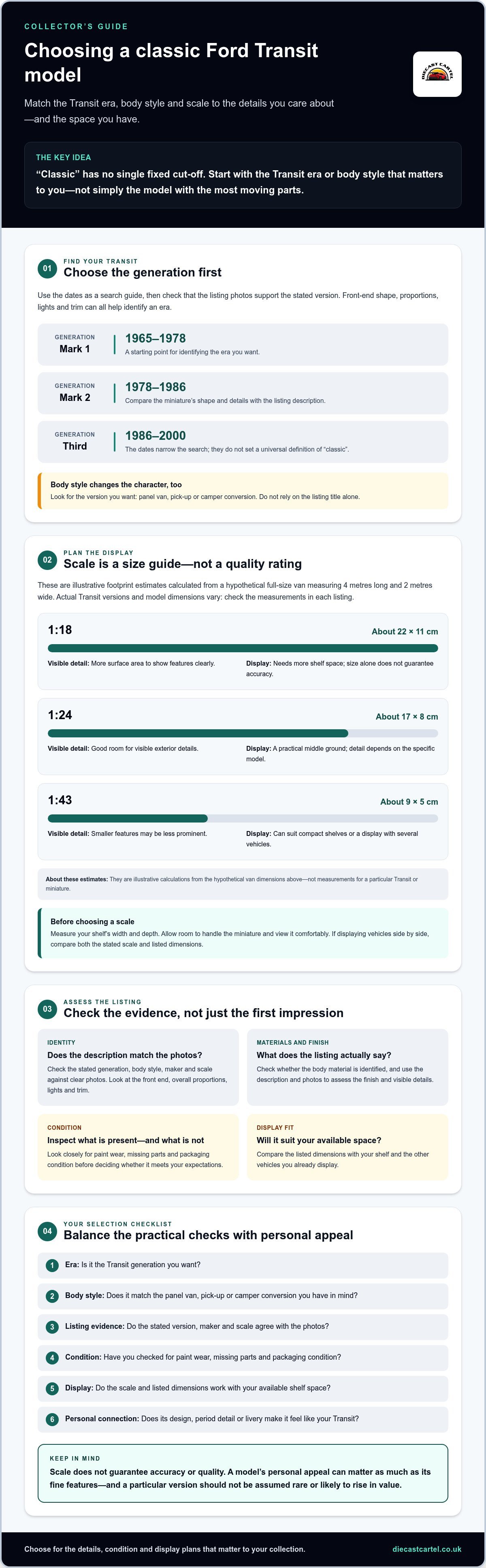
Use this classic Ford Transit model buying checklist before you choose
A clear order of decisions makes listings easier to compare and keeps the choice focused on what you’ll enjoy owning. Start with the vehicle you want represented, then consider scale, display space and the evidence in the listing. Personal meaning, accuracy and condition are more reliable reasons to choose a model than an unsupported promise of future resale value.
- Choose an era or body style. Decide which generation, van shape or period detail appeals to you most. It might be a Transit that reminds you of a family business, a familiar work van or a style you’ve always admired. Use that preference to narrow your search.
- Set your scale preference. Decide whether the miniature should match models already in your collection or whether you’d rather prioritise a larger display piece. Check the stated scale and dimensions instead of assuming that a bigger model will be more accurate.
- Define your display and condition needs. Measure your available shelf space and decide whether you want a pristine model or can accept minor wear. Consider the packaging too: is the original box important for storage or display, or is the miniature itself your priority?
- Assess each listing against your priorities. Compare the stated generation, body style, maker and material with the photos and packaging details. Look for clear evidence of condition, and weigh accuracy, completeness and personal appeal ahead of claims about rarity or investment potential.
Keep your own priorities in view. A model that matches the scale of your existing collection may make a more coherent display, while a different scale could suit your space or the version you’re keen to own. Packaging may matter if you store or display models boxed, but it needn’t outweigh the vehicle details you care about most.
What should you ask before completing a purchase?
If the listing leaves gaps, ask direct questions before deciding. For example: “What are the model’s exact dimensions and stated scale?”, “Is the manufacturer identified?”, “Are there close-up photos of the wheels, mirrors and glazing?” and “Are any parts missing or defects present?” Confirm what’s included, including packaging, and ask the seller to clarify anything the photos don’t show. Check the current listing and its terms rather than relying on general buying advice.
Use the same checks when exploring diecast truck models. Diecast Cartel’s categories don’t establish that a Transit is currently available. Browse Diecast Cartel’s diecast models and verify the details of any listing that catches your eye.
Find a classic Ford Transit model that fits your collection
The best choice brings together the Transit version you care about, a scale that works for your display and a level of detail and condition you’re happy with. A larger model may become a focal point on a shelf, while a smaller one can fit a compact space or sit neatly among several commercial vehicles. Neither is automatically the better pick. Consider how you want to enjoy the miniature once it’s part of your collection.
Which collector is each kind of model best suited to?
If you’re a Transit enthusiast, start with the era, body style or period details that mean the most to you. A close match to your favourite version may matter more than matching the scale of your other models. For a broader commercial-vehicle display, consistency can make the collection feel considered, so compare a prospective model’s scale with the vehicles you already own and the space available.
Choosing a gift? Find out what the recipient collects before settling on a model. Their preferred Transit generation, usual scale and available display space are useful clues. Packaging may matter too, particularly if they keep models boxed or display the original packaging alongside them. A little research can make the gift feel personal rather than simply van-shaped.
What are the next steps if your preferred version is hard to find?
Make your search more precise by combining the target generation with its body style and preferred scale. Then compare each listing against the checks in this guide: does the description match the photos, is the maker or material stated, and is the condition clear? If an important detail is missing, ask the seller before deciding. Don’t assume a retailer can source or commission a particular model unless it explicitly confirms that service.
Diecast Cartel is a UK-based online retailer of diecast cars and trucks, with 1:18 and 1:24 scale categories. A specific classic Ford Transit model isn’t confirmed as available, so check current listings rather than assuming you’ll find one.
Browse Diecast Cartel’s model range and check the current listings for models that suit your collection.
Choose the Transit miniature that feels right for your collection
A satisfying choice starts with the Transit era or body style you want to celebrate, then balances scale and visible detail with the space you have. Before buying, check that the listing’s photos and description support its claims about the model’s identity and condition. Clear evidence matters more than broad labels or assumptions about future resale value.
The right classic Ford Transit model is ultimately the one that fits your interests and expectations, whether you’re drawn to a familiar work van, a particular period design or a miniature that complements your wider collection. Take your time comparing listings, and ask for clarification if key details are missing.
Diecast Cartel is a UK-based online retailer specialising in diecast model cars and trucks, with 1:18 and 1:24 scale categories. Specific Transit availability isn’t confirmed, so check current listings as you browse. Explore Diecast Cartel’s diecast model range to see what might suit your collection.
Frequently Asked Questions
What is considered a classic Ford Transit?
There’s no single cut-off for what counts as a classic Ford Transit. Collectors often use the term for earlier generations, including the Mark 1 (1965-1978), Mark 2 (1978-1986) and third generation (1986-2000). Personal preference plays a part: one collector may favour the earliest shape, while another may consider a later van a classic. For a miniature, check which generation its maker or seller says it represents.
Which classic Ford Transit model is best for collectors?
The best choice is the one that fits your interests and collection, rather than a universally agreed “best” version. Start with the Transit era, body style or period details that matter most to you, then check whether the miniature represents them convincingly. Compare clear photos with the listing description, and consider scale, condition and display space. A personal connection can make a model more rewarding to own than assumed rarity or resale potential.
What scale are classic Ford Transit models usually available in?
There isn’t one standard scale for classic Transit miniatures; availability depends on the specific model and maker. Check the stated scale and dimensions in each listing rather than assuming that a particular Transit version comes in a particular size. Diecast Cartel has 1:18 scale model cars and 1:24 scale diecast models and trucks, but this doesn’t confirm Transit models in either scale. Check current listings for specific availability.
How can I tell whether a Ford Transit miniature is diecast?
Look for an explicit material description in the listing, such as a stated diecast body, and check any packaging information shown. Don’t rely on the model’s weight, appearance or the word “collectible” as proof of its construction. If the material isn’t identified, ask the seller to confirm it. A miniature can combine materials, so check whether the description distinguishes the body from parts such as the glazing, interior or base.
Are classic Ford Transit models valuable collectibles?
Some collectors value Transit miniatures for their design, period liveries or personal connections, but that doesn’t establish a particular model’s market value. Condition, completeness, maker, packaging and demand may affect what buyers are willing to pay, and asking prices aren’t proof of completed sales. Treat claims that a model is rare or a sound investment cautiously unless evidence is provided. Choose primarily for the enjoyment and meaning it brings to your collection.
What should I check before buying a classic Ford Transit model online?
Check the stated generation, body style, scale, maker and materials, then compare these details with photos from several angles. Inspect close-ups for paint wear, damaged glazing, missing mirrors or other parts, and ask whether packaging is included. Confirm unclear details with the seller before buying, and review the current listing and its terms. Clear evidence helps you judge whether the model matches your expectations and is in the condition described.
Does Diecast Cartel sell a classic Ford Transit model?
Diecast Cartel’s categories include diecast model cars, trucks and tractors, with 1:18 and 1:24 scale ranges. However, current stock of a classic Ford Transit model isn’t confirmed. Check the retailer’s online listings for availability rather than assuming a Transit miniature is offered. If you find a relevant listing, review its stated scale, vehicle version, materials and condition before deciding whether it suits your collection.
