
Diecast Guides
Best Batteries for RC Cars: 2026 Hobbyist Guide

Sep
What if the secret to a record-breaking lap time isn’t actually hidden in your motor, but tucked away in your battery tray? We’ve all been there; you’ve organised a perfect afternoon at the track, only for your session to be cut short by a battery that’s lost its punch or failed after only a few charges. Finding the best batteries for remote control cars can feel like a minefield of confusing acronyms and conflicting advice. It’s frustrating when you just want to get back to the hobby you love, yet you’re stuck wondering why your car feels sluggish or why your runtime is so short.
Whether you’re a seasoned collector of 1:18 scale models or a newcomer to the world of RC trucks, mastering your power source is the quickest way to unlock faster top speeds and longer sessions. This 2026 guide is designed to help you understand technical specifications whilst ensuring your gear stays safe. We’ll dive into the latest lithium-ion shipping regulations, such as the 30% state of charge rule, and compare LiPo versus NiMH chemistry. You’ll finish this article with a clear understanding of how to charge safely and choose the ideal battery to transform your driving experience.
Key Takeaways
- Understand the vital differences between NiMH and LiPo chemistries to select the best batteries for remote control cars that match your specific performance goals.
- Master technical jargon like mAh and Voltage to accurately predict your RC car’s runtime and potential top speed before you head to the track.
- Learn how to tailor your power source to your vehicle type, prioritising high discharge rates for racers or high capacity for detailed construction models.
- Protect your investment by following essential safety rules for charging and storing lithium-ion batteries to ensure they last for years rather than months.
- Discover the benefits of using high-quality rechargeable batteries to enhance the performance and longevity of your 1:22 or 1:24 scale collection.
Understanding RC Battery Chemistries: NiMH vs LiPo
Choosing the best batteries for remote control cars starts with understanding the chemistry under the bonnet. Are you looking for a relaxed afternoon in the garden or a high-speed sprint at the local club? Your goals dictate whether you reach for a Nickel-Metal Hydride (NiMH) pack or a Lithium Polymer (LiPo) cell. It isn’t just about speed; it’s about how the battery behaves whilst you’re driving and how much care it needs when the day is done.
The Case for NiMH Batteries
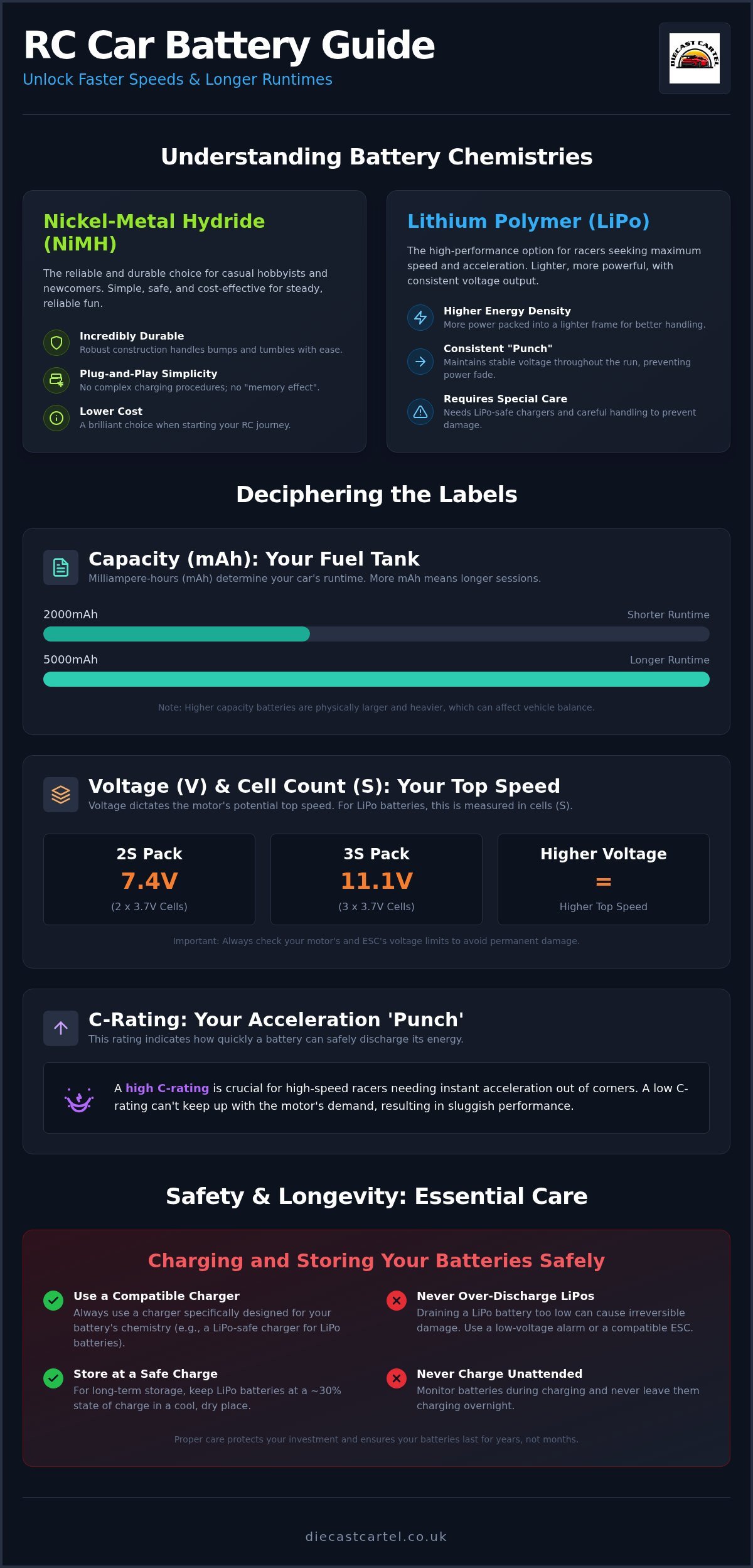
For many casual hobbyists and families, Nickel-Metal Hydride (NiMH) batteries are the perfect entry point. They’re incredibly durable and offer a “plug-and-play” simplicity that’s hard to beat. Unlike older technologies, modern NiMH cells don’t suffer from a “memory effect,” so you don’t need to worry about fully discharging them every single time. They’re particularly well-suited for our 1:24 scale RC trucks where extreme speed takes a backseat to steady, reliable fun. The lower cost of entry also makes them a brilliant choice if you’re just starting your journey into the world of RC.
The Power of LiPo Technology
When you’re ready to push your 1:18 or 1:16 scale models to their limits, LiPo technology is the clear winner. These batteries boast a much higher energy density, meaning they pack more power into a lighter frame. This weight saving directly translates to better handling and faster acceleration on the track. The real magic, however, is the “punch.” A LiPo battery delivers consistent voltage throughout the entire run, whereas NiMH power tends to fade as the charge drops. Just keep in mind that these high-performance cells require LiPo-safe chargers and low-voltage alarms to prevent damage, as they don’t like being drained too low.
Your vehicle’s Electronic Speed Controller (ESC) is the ultimate gatekeeper in this decision. Before buying the best batteries for remote control cars, you must check if your ESC is compatible with your chosen chemistry. A LiPo battery can easily overwhelm an ESC designed only for NiMH, potentially leading to a very short and smoky session. Physically, you’ll notice the difference immediately. LiPos are often lighter but more delicate, usually housed in a hard case for protection during “bashing.” NiMH packs are heavier and more robust, handling the occasional bump or tumble with ease. Which one fits your driving style best?
Deciphering the Labels: mAh, Voltage, and C-Ratings
Ever stared at a battery label and felt like you were trying to crack a secret code? You aren’t alone. These numbers are vital for finding the best batteries for remote control cars, acting as a roadmap for your vehicle’s performance. While labels follow strict international standards, similar to the U.S. Code for Battery Labeling, translating those specs into garden-track performance is where the real hobbyist expertise comes in. Let’s break down what these figures actually mean for your next session.
Choosing Your Capacity (mAh)
Think of mAh (milliampere-hours) as the size of your fuel tank. A 5000mAh battery holds more “fuel” than a 2000mAh one, which theoretically gives you a longer runtime. To estimate your driving time, you’d divide the capacity by the average draw of your motor, but remember the weight trade-off. A bigger tank is physically larger and heavier. If you’re running a compact 1:24 model, a massive battery might not even fit in the tray or could upset the car’s balance; for models and radio controllers using standard cell trays, opting for high capacity AA rechargeable batteries ensures maximum runtimes without adding unnecessary bulk. For most UK enthusiasts, the 2000mAh to 5000mAh range is the sweet spot, providing ample playtime without making the vehicle feel cumbersome.
Voltage and Cell Count (S)
Voltage (V) represents the electrical pressure that determines your motor’s top speed. In the LiPo world, we categorise this by “S” or cell count. Each cell has a nominal voltage of 3.7V. A 2S battery provides 7.4V, whilst a 3S pack jumps to 11.1V. More cells mean more raw power, but you must stay within your motor’s limits. Exceeding the rated voltage can lead to overheating or permanent electronic failure. This balance is particularly crucial for 1:22 scale remote control construction vehicles, where you need consistent torque for lifting rather than just high-speed bursts.
The C-rating is the final piece of the puzzle, telling you how quickly the battery can safely discharge its energy. High-speed racers require a high C-rating for that instant “punch” when accelerating out of a corner. If your battery can’t keep up with the motor’s demand, it will overheat and lose its lifespan quickly. Finding a balance is key; a massive battery with a high C-rating might actually hinder a small 1:22 scale lorry by adding unnecessary weight. If you’re looking to upgrade your current setup, you can find a range of compatible rechargeable batteries for remote control toys that strike the perfect balance between power and portability.
Selecting the Right Battery for Your Vehicle Type
Finding the best batteries for remote control cars isn’t just about raw power; it’s about matching that energy to the specific job your vehicle was built to do. A battery that’s perfect for a high-speed racing buggy might be a poor fit for a heavy-duty forklift. Different motors have vastly different “appetites” for energy. Whilst a racer needs a high C-rating for instant acceleration, a construction vehicle prioritises steady, reliable torque over a long afternoon. Have you considered how your driving style impacts your choice?
Before you commit, you must check your connector types. In the UK, most hobbyist vehicles use one of three standards: Deans (often called T-plugs), the classic Tamiya connector, or the high-current XT60. Getting this right is essential for a secure connection that won’t overheat during a long session. If your battery doesn’t match your car’s interior wiring, you’ll be stuck at the workbench instead of out on the track. It’s a small detail that makes a massive difference to your enjoyment of the hobby.
Batteries for RC Construction and Lorries
When you’re operating diggers or forklifts, top-end speed is rarely the goal. Instead, you want a battery that provides enough capacity to keep the hydraulic arms and wheels moving for hours. For 1:22 scale remote control construction vehicles, a capacity of around 2000mAh to 3000mAh is often ideal. This provides enough weight to help with traction whilst giving you the endurance needed for complex manoeuvres. If you’re building a fleet of heavy-duty vehicles, check out our guide on 1:24 scale diecast trucks UK to see how power and scale work together.
Upgrading Your Standard RC Car
Many entry-level models come with a tray for disposable AA batteries. Transitioning to dedicated rechargeable packs is the single best upgrade you can make. It doesn’t just save money in the long run; it revitalises the performance of older 1:16 scale RC trucks by providing a more consistent current. When you select high-quality rechargeable batteries for RC toys, you’re investing in the longevity of your collection. It’s a simple change that transforms a sluggish toy into a responsive hobby-grade machine. Are you ready to see what your car can really do with a proper power source?
Safety and Longevity: How to Charge and Store Your Batteries
Caring for your power source is just as vital as picking the right one. Even the best batteries for remote control cars will fail prematurely if they aren’t treated with respect. The golden rule is simple: never leave a charging battery unattended. Always charge on a non-flammable surface, well away from curtains, papers, or carpets. It’s about protecting your home whilst ensuring your hobby remains a joy rather than a hazard.
Safe Charging Practices
A quality balance charger is your best friend in this hobby. It ensures every individual cell in your pack is equalised, preventing any single cell from becoming overstressed or unstable. For a step-by-step walkthrough on the process, follow our detailed steps on how to charge RC car batteries safely. Using a fire-resistant LiPo charging bag adds an essential layer of security, containing any potential issues during the charging cycle.
Heat is the ultimate enemy of battery performance. If your pack feels hot to the touch after a heavy session, let it cool down to room temperature before you even think about plugging it into the charger. Storing LiPos at a full charge for weeks on end causes internal chemical degradation, which often leads to the dreaded “puffy battery” syndrome. Instead, use your charger’s “storage” mode to keep cells at roughly 3.8V per cell. This keeps the chemistry stable and ready for your next afternoon at the track.
Extending Battery Lifespan
Longevity often comes down to the 80% rule. You should never fully deplete a LiPo battery; aim to leave at least 20% capacity in the tank to avoid permanent voltage drops. Regularly cleaning your battery terminals with a dry cloth prevents resistance and heat build-up at the connection point. You’ll know a battery has reached the end of its functional life when it takes significantly longer to charge or loses its “punch” within minutes of driving.
When a battery finally retires, don’t just bin it with the household rubbish. Hobby batteries contain materials that must be handled correctly. Most UK household waste centres have dedicated recycling points for rechargeable cells. By disposing of them properly, you’re helping to keep the hobby sustainable for everyone. Ready for a fresh start with a reliable power source? Explore our range of rechargeable batteries for remote control toys to keep your 1:22 or 1:24 scale collection running at peak performance.
Maximising Performance with Diecast Cartel Accessories
Choosing the best batteries for remote control cars is only the first step in a much larger, more rewarding journey. As enthusiasts ourselves, we know that the right power source is a vital investment that protects the intricate electronics of your 1:18 or 1:24 scale models. It isn’t just about making the car move; it’s about the pride that comes from a well-maintained collection that performs exactly as it should, every single time you flick the switch. Why settle for anything less than peak performance?
The Complete Hobbyist Setup
Efficiency is the name of the game. Pairing your high-quality batteries with the correct UK-standard chargers ensures you aren’t just charging fast, but charging smart. Our specialised RC construction vehicles benefit immensely from premium power packs that provide the steady torque required for realistic lifting and digging. We’re committed to supporting your growth in this hobby, which is why our team is always on hand to offer personalised advice on battery compatibility. Are you unsure which connector fits your new forklift? Just ask.
Beyond the Battery: Total Maintenance
A true collector’s passion often extends beyond the display shelf or the garden track. Many of our community members apply the same level of care to their full-sized cars, using OBD diagnostic tools to keep their real-world vehicles in top shape whilst enjoying their scale models on the weekend. This holistic approach to maintenance ensures that every machine you own, regardless of its size, receives the best possible care. There’s a unique satisfaction in knowing your gear is organised, powered correctly, and ready for action at a moment’s notice.
The Diecast Cartel experience is built on a shared love for precision and discovery. By selecting the best batteries for remote control cars and matching them to our specific range of 1:22 and 1:24 scale vehicles, you ensure your collection stays in peak condition for years to come. We treat every customer as a peer, and we’re just as excited about your next acquisition as you are. Ready to take your hobby to the next level? Browse our full range of RC hobby vehicles UK and discover the perfect addition to your garage today.
Ready to Power Your Next Session?
Mastering your vehicle’s power source is the quickest way to turn a frustratingly short drive into an afternoon of high-speed discovery. By matching the right chemistry to your specific model and respecting the technical limits of your gear, you ensure every session is as thrilling as the last. Whether you’re prioritising the steady torque of a construction vehicle or the raw punch of a racing buggy, finding the best batteries for remote control cars is about balancing performance with long-term care. Remember to keep those LiPos at storage voltage and always use a balance charger to protect your investment.
As a specialist UK retailer for 1:24 and 1:18 scale models, we’re here to support your journey with enthusiast-led advice and secure online shopping for all your hobbyist electronics. Don’t let a flat battery stall your progress; get the expert guidance you need to keep your collection in peak condition. Explore our range of high-performance RC batteries and vehicles at Diecast Cartel. We’re just as excited as you are to see your next acquisition in action. Happy driving!
Frequently Asked Questions
What is the difference between LiPo and NiMH batteries for RC cars?
LiPo batteries offer a superior power-to-weight ratio and consistent voltage delivery, making them the favourite for high-performance racing. In contrast, NiMH batteries are more robust and forgiving, perfect for younger hobbyists or casual garden play with 1:24 scale trucks. Whilst LiPos require a balance charger and careful monitoring, NiMH packs are a simple “plug-and-play” solution. Choosing between them depends on whether you prioritise raw speed or ease of use for your collection.
How long do RC car batteries typically last on a single charge?
Most hobbyists find that runtimes range between 20 and 45 minutes per charge, depending on the battery’s capacity and your driving style. A higher mAh rating acts like a larger fuel tank, giving you more time on the track. If you are using the best batteries for remote control cars in a 1:22 scale construction vehicle, you might see even longer sessions due to the lower power draw compared to a high-speed racing buggy.
Can I use a higher voltage battery to make my RC car go faster?
Increasing voltage will definitely boost your top speed, but it’s a move that requires caution. Your vehicle’s Electronic Speed Controller (ESC) has a specific voltage limit that you must never exceed. If your car is rated for a 2S LiPo (7.4V), jumping to a 3S (11.1V) could cause permanent electronic failure or even a fire. Always verify your motor and ESC specs before upgrading to a more powerful cell series.
Is it safe to charge RC car batteries overnight?
You should never leave any RC battery charging overnight or unattended. Safety is paramount in this hobby, especially with high-capacity LiPo cells that can become unstable if a fault occurs during the cycle. Always charge your packs on a non-flammable surface, such as a tiled floor or inside a fire-resistant LiPo bag. It’s a simple habit that protects your home whilst ensuring your rechargeable batteries for remote control toys stay in top condition.
What does the “C” rating on an RC battery actually mean?
The “C” rating measures how quickly a battery can safely discharge its stored energy. A higher rating, such as 50C or 60C, provides more “punch” when you pull the throttle, which is essential for heavy 1:16 scale trucks or fast racers. If the C rating is too low for your motor’s demands, the battery will struggle to keep up, leading to overheating and a shorter lifespan. It’s all about matching the discharge rate to your motor.
How should I store my RC car batteries during the winter?
Proper winter storage involves keeping your batteries at a specific “storage voltage” rather than fully charged or empty. For LiPos, this is typically around 3.8V per cell. Storing them in a cool, dry place away from extreme temperature fluctuations prevents chemical degradation. We recommend checking your packs every few months with a digital voltage checker to ensure they haven’t self-discharged too low, which can lead to permanent cell damage or failure.
Why is my RC car battery getting hot during use?
Batteries often get warm during use, but they should never feel hot to the touch. Excessive heat usually indicates that the battery is being pushed beyond its limits, perhaps because the C rating is too low for your motor. Other causes include over-gearing the vehicle or debris caught in the drivetrain. If you’re searching for the best batteries for remote control cars, ensure you choose a pack that can comfortably handle your vehicle’s specific current draw.
How many times can I recharge an RC hobby battery before it needs replacing?
You can typically expect between 300 and 500 charge cycles from a well-maintained hobby battery before its performance starts to dip. Factors like over-discharging your cells or leaving them fully charged for long periods will reduce this number significantly. You’ll know it’s time for a replacement when the runtime drops noticeably or the battery loses its acceleration “punch.” Proper care is the secret to getting the most value from your rechargeable packs.
